
Book Review: Samuel F.B. Morse’s Gallery of the Louvre and the Art of Invention
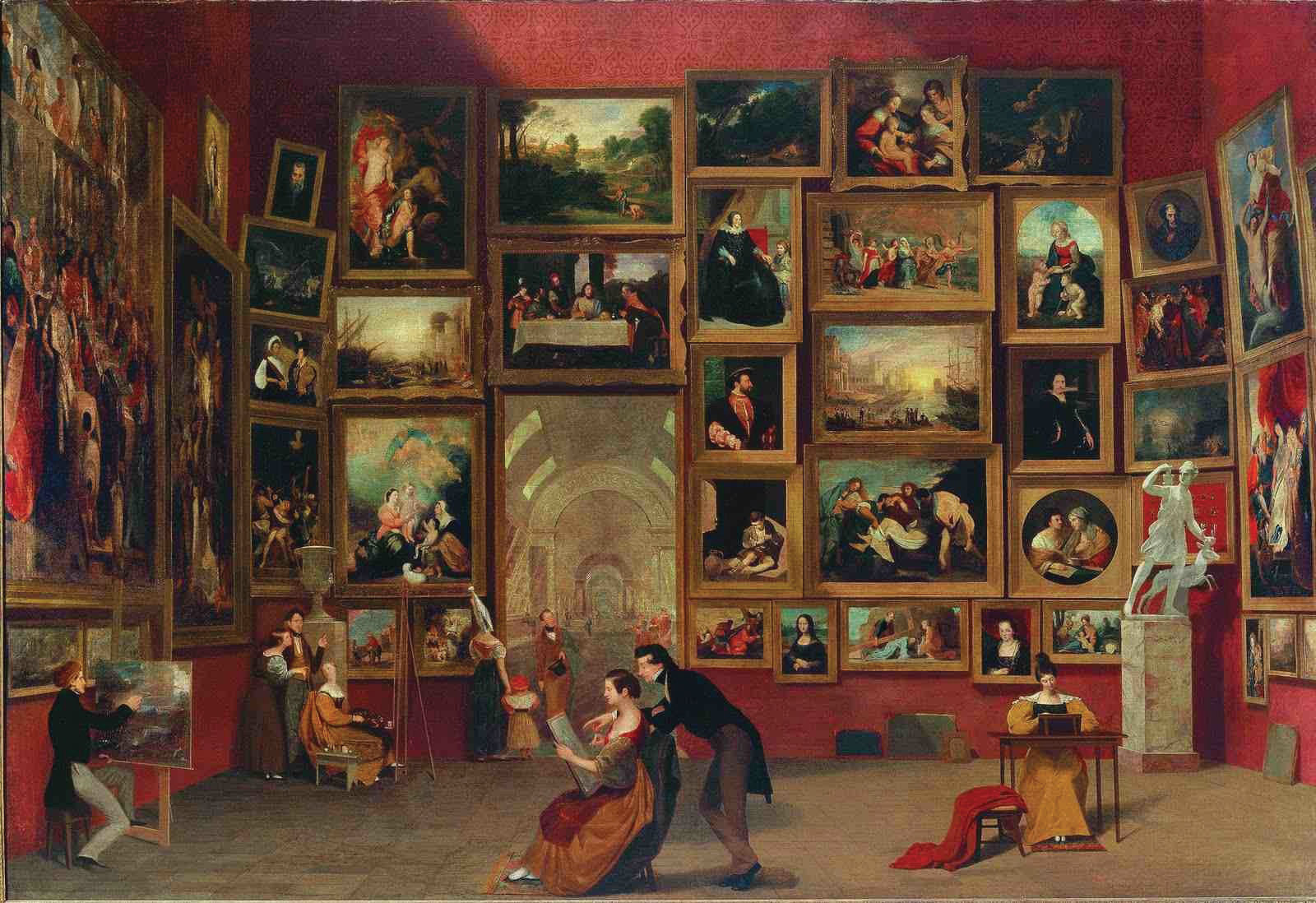
Morse’s Gallery of the Louvre (1831–33, Terra Foundation, Chicago).
Samuel F.B. Morse’s Gallery of the Louvre and the Art of Invention (2014)
Edited by Peter John Brownlee
Reviewed By Christian Roden
As the centerpiece of a nationwide travelling exhibit scheduled from 2015 through 2018, Morse’s narrative painting Gallery of the Louvre (1831–33) has come to be regarded as part of the canon of early-19th-century American art. This catalogue presents essays discussing both the painting’s content (miniature copies of thirty-eight paintings and depictions of two sculptures, plus eight portraits in the form of onlookers), and the wider cultural context of the American and European artistic scenes of the 1830s.
Of particular interest are three essays by Catherine Roach, Wendy Bellion, and Alexander Nemerov discussing: the composition in contrast to two other views of the Louvre’s Salon Carré painted in the same year; the curious paucity of sculpture depicted in the painting despite the artist’s involvement with sculpture and sculptors on both continents; and the triangulated relationship between this painting, the Old Masters it depicts, and the American experience of the 1830s. Also included are an essay discussing the conservation of the painting, and a photographic appendix of Morse’ own Descriptive Catalogue of the Pictures penned to accompany the painting on its first tour of the United States. (Yale University Press, 2014, $45)
Samuel F.B. Morse’s Gallery of the Louvre and the Art of Invention (2014)
Edited by Peter John Brownlee
Reviewed By Christian Roden
As the centerpiece of a nationwide travelling exhibit scheduled from 2015 through 2018, Morse’s narrative painting Gallery of the Louvre (1831–33) has come to be regarded as part of the canon of early-19th-century American art. This catalogue presents essays discussing both the painting’s content (miniature copies of thirty-eight paintings and depictions of two sculptures, plus eight portraits in the form of onlookers), and the wider cultural context of the American and European artistic scenes of the 1830s.
Of particular interest are three essays by Catherine Roach, Wendy Bellion, and Alexander Nemerov discussing: the composition in contrast to two other views of the Louvre’s Salon Carré painted in the same year; the curious paucity of sculpture depicted in the painting despite the artist’s involvement with sculpture and sculptors on both continents; and the triangulated relationship between this painting, the Old Masters it depicts, and the American experience of the 1830s. Also included are an essay discussing the conservation of the painting, and a photographic appendix of Morse’ own Descriptive Catalogue of the Pictures penned to accompany the painting on its first tour of the United States. (Yale University Press, 2014, $45)
Morse’s Gallery of the Louvre (1831–33, Terra Foundation, Chicago).