
NEW RESEARCH
In addition to the Decorative Arts Trust’s support of scholarship through the Emerging Scholars Program, we eagerly promote the research, exhibitions, and projects undertaken by colleagues at museums around the country in our member magazine, The Magazine of the Decorative Arts Trust. We invite you to enjoy the online versions of magazine articles featured below.
See more stories about recent research in The Decorative Arts Trust Bulletin.
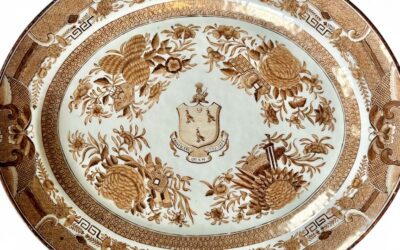
“My Dinner Set from China”: Charles Manigault’s Chinese Export Porcelain
BY CHAD STEWART
In the decades following the American Revolution, Charleston, SC, stood at the cultural, social, and economic center of one of the young nation’s wealthiest regions. The vast resources wielded by the slave-owning planter and merchant classes facilitated the acquisition of expensive, refined objects including splendid furniture, silver, art, and imported Chinese porcelain.
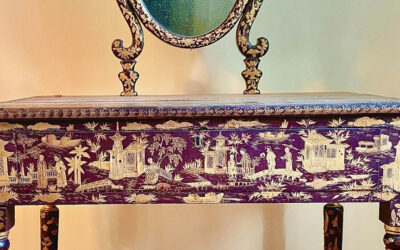
Understanding Wyck’s Chinese Desk
BY GRACE FORD-DIRKS AND CRISTINA FREIRE
For nearly 200 years, a small Chinese writing desk has been the prized and lamented possession of generations of Quaker women in Philadelphia. Today, it sits in the front parlor at Wyck, the ancestral home of nine generations of the Wistar-Haines family in Germantown.

Raising the Edge: A Scrutiny of Historic Frames at the Art Gallery of Ontario
BY ERIC BIRKLE
An edge, a border, an ornament, a container—even a fitting—these are various ways in which picture frames have been described, studied, and understood over time. The notion of the frame as a work of art—as either a standalone object or a crucial component of an interdependent whole—is a less familiar concept.
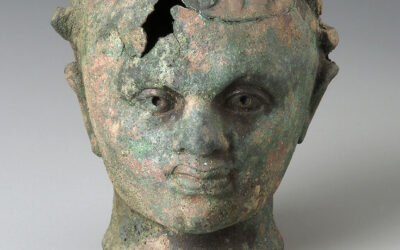
Enlivening Ancient Vessels: Interactions with Roman Bronze Figural Balsamaria
BY ARIELLE SUSKIN
Balsamaria are a somewhat enigmatic genre of Roman metalwork. They are small containers in the shape of human heads or busts, ranging from approximately two to eight inches tall, typically featuring hinged lids and applied handles.
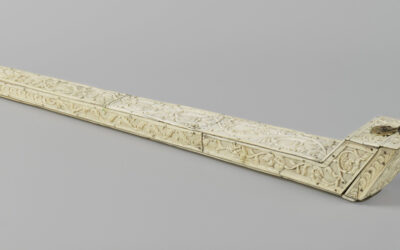
Shapes and Motifs in Motion: Rethinking Ivory Pipe Cases Across Worlds
BY NUR’AIN TAHA
Ivory has long been one of the most charged raw materials of global exchange, prized for its smooth texture, lustrous surface, and capacity for fine carving. The ivory pipe case—a portable yet striking item—offers a revealing window into the intersections of trade networks, cultural exchanges, and material.

Changing Identities: 17th-Century Netherlandish Miniatures
BY JASPER MARTENS
Netherlandish miniature portraits with costumed mica overlay share a uniform visual language and were produced within a relatively short span during the 1630s and 1640s. These little-studied objects are primarily female portraits accompanied by about 20 translucent overlays depicting a wide range of costumes, both male and female, that often reference distinct geographical identities and social and economic roles.
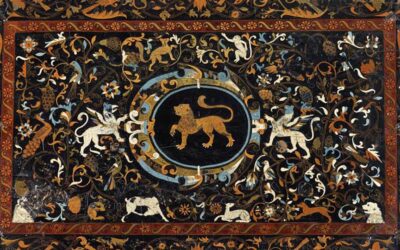
Luster, Shimmer, and Polish: Transpacific Materialities in the Arts of Colonial Latin America
BY JULIANA FAGUA ARIAS
Between the late 16th and the early 19th centuries, the so-called Manila Galleons connected the Southeast Asian port of Manila with the Mexican counterpart of Acapulco. Direct trade between these two essential nodes of the Spanish empire enabled artistic circulation between Asia and the Spanish Americas, a cultural flow that enriched both sides of the Pacific.
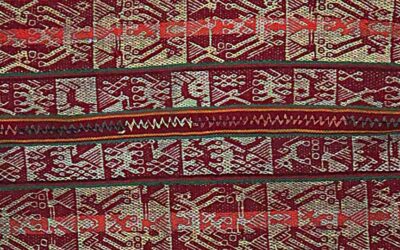
Discovering the Origins of Rare Textiles at Museo De Las Américas
BY YADIRA QUINTERO AND LAURA BEACOM
Museo De Las Américas in Denver, CO, has a growing collection of over 4,000 objects, including approximately 600 textiles, consisting of a wide variety of historical and contemporary garments with accessories, tablecloths, handicrafts, and other housewares.
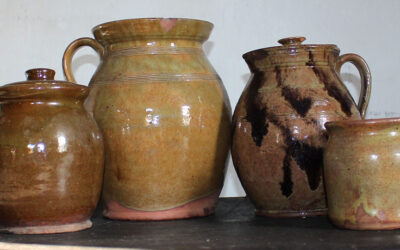
Colonial Architecture, Decorative Arts, and Enslavement at the Colonel John Ashley House
BY LIVY SCOTT
I have spent the last year as the Peggy N. Gerry Curatorial Fellow at The Trustees of Reservations (The Trustees) working at the Colonel John Ashley House. In this two-year fellowship, my role entails cataloging the house’s collection, reinterpreting its historic interiors for a new furnishing plan, and conducting new scholarly research.
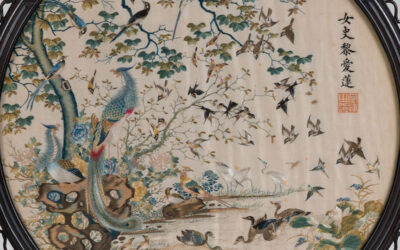
Convergence at the Market: Vernacular Artisans and Literati in Late Imperial China
BY DANIELLE ZHANG
The boundary between vernacular and literati art seemed to change in Late Imperial China (1368–1912). Instead of concentrating on imagery and motifs, some creative and talented vernacular craftspeople started to incorporate themes that belonged to literati.