






New Art Catalogue Showcases the Vision and Legacy of Linda H. and George M. Kaufman
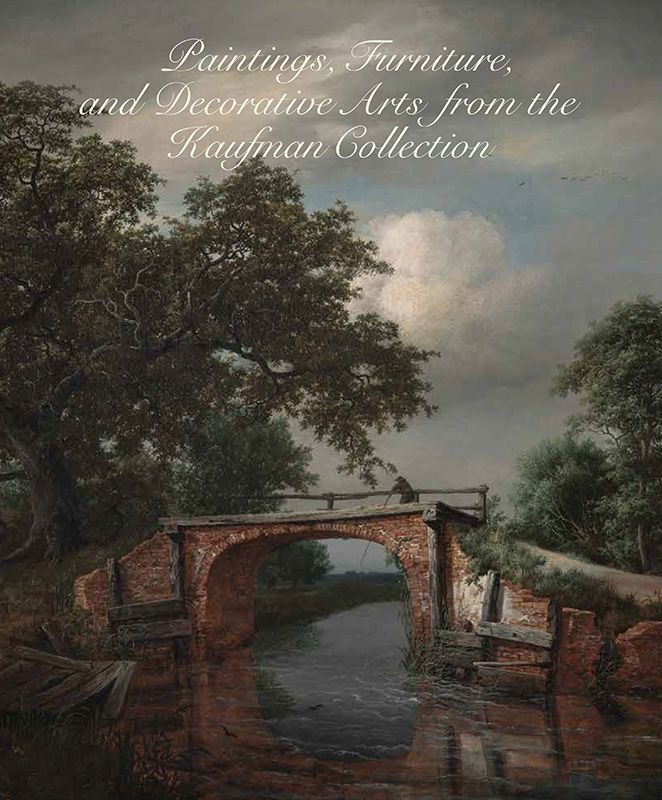 The stunning new volume Paintings, Furniture, and Decorative Arts from the Kaufman Collection unveils the extraordinary scope and depth of the celebrated collection that Linda H. and the late George M. Kaufman assembled over decades.
The Kaufman Collection has long been recognized as one of the most significant private collections of early American furniture, and now this richly illustrated publication reveals Linda and George’s broader passion for collecting rare American, European, and Chinese export porcelains; remarkable silver-form brass; exceptional Dutch paintings; and delicate French and American watercolors.
In 1986, the National Gallery of Art presented a landmark exhibition dedicated to the Kaufmans’ American furniture. The accompanying exhibition catalogue served as the model for this more expansive 323-page publication. The book features two introductory essays discussing the Kaufmans’ approach to collecting and 106 scholarly entries on the works themselves.
A stellar example is a japanned high chest of drawers (figure 1). “Although made in Boston,” Tara H. Cederholm and Christine P. Thompson explain in their essay, “this high chest speaks to the network of global trade in Asian luxury goods which reached a peak in the seventeenth century” (p. 176). The most striking feature of this object is the well-preserved surface decoration. Based on several distinctive characteristics, the painting and gilding was attributed to Robert Davis. Bound to the Painter-Stainers’ Company in London in 1709/10, Davis emigrated to Boston where he married Elizabeth Randle, the daughter of Boston japanner William Randle, in 1735. Records show that Davis worked in Boston for only five years, but during that time he produced some of the most beautiful and complex of all the Boston japanned pieces.
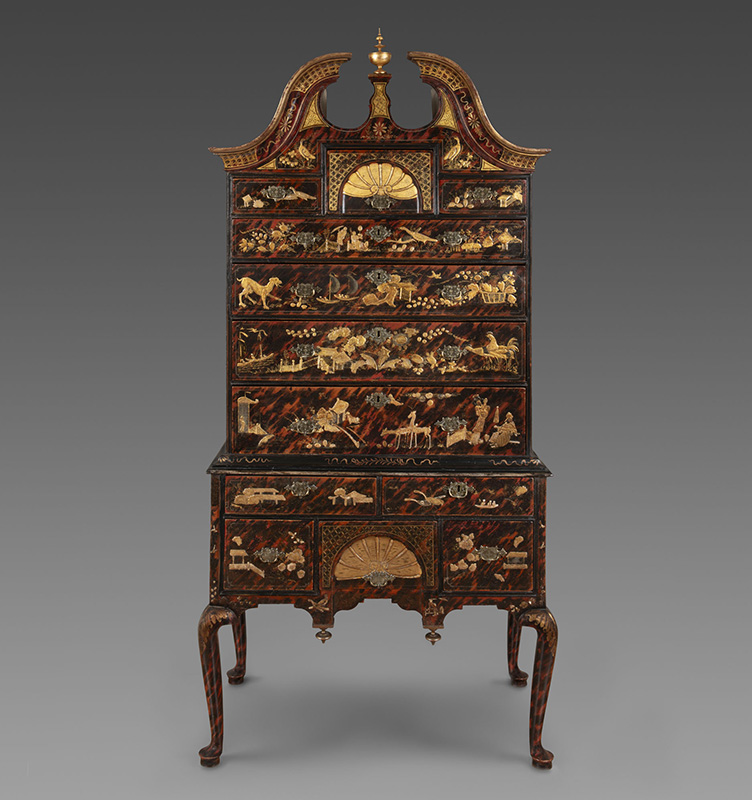
Figure 1. High chest of drawers, c. 1735, Boston, MA. Maple and pine; brass; gesso, red, and black pigments in resin, gold leaf and gold and metallic powders and resinous varnishes. Collection of George M. and Linda H. Kaufman. Photo by Gavin Ashworth.
The Kaufmans collected an admirable array of silver-form brass, graciously gifting 23 pieces to Winterthur last year. One standout piece in Linda Kaufman’s private collection is a c. 1740 basket (figure 2) that was probably crafted in London. In 1751, French confectioner Joseph Villiers published a book on desserts and associated table settings that features an illustration of a table set with pierced baskets similar to this form. “Of all the silvered brass in the Kaufmans’ collection, this basket is probably the most French in its design,” Donald L. Fennimore points out, “particularly with respect to the pattern of piercing, but also to the profile the handle supports” (p. 214). The basket’s designs resemble the brass, tortoise shell, and pewter designs in the cabinets of Andre Charles Boulle. This French influence on English 18th-century arts has roots in the 1685 Edict of Nantes, when many Huguenot artisans left France for London. Silversmiths Paul de Lamerie, Paul Crespin, and Louis Laroche brought a new style to England, leading to the English transitioning to dining “à la mode Français.”
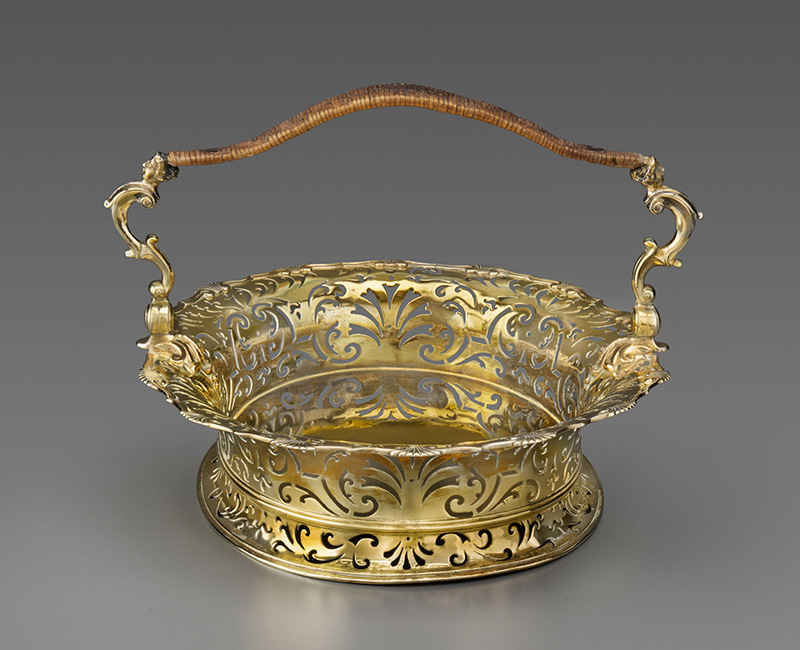
Figure 2. Basket, c. 1740, probably London, England. Silvered brass, rattan. Collection of George M. and Linda H. Kaufman. Photo by Gavin Ashworth.
On the Chinese export porcelain front, the Brown Family services feature elements from two late-18th-century dinner sets and one tea set. The portion of the collection decorated with a Neoclassical urn was made for Providence, RI, merchant John Brown (1726–1803), one of the first Americans to trade directly with China. He was also involved in the slave trade, bringing captured Africans to the Caribbean and North America. The components that feature a shield and the initials “NAB” come from a service made for John’s nephew, Nicholas Brown, Jr. (1769–1841), and his wife, Anne Carter (1770–98). They likely commissioned the set around the time of their 1791 marriage. The tea bowl and saucer (pictured on the bottom shelf) shows two hearts with the initials and is thought to be part of a wedding gift for Nicholas and Anne. Like his aforementioned uncle, Nicholas was a merchant, co-founding the international trading company Brown & Ives. “Personalized Chinese export porcelain, whether decorated with their owners’ coat of arms, initials, or other special design, was the ultimate type of fine tableware,” shares Ronald W. Fuchs, “symbolizing not just wealth or status, but also connections to the China trade that made its procurement possible” (p. 244).
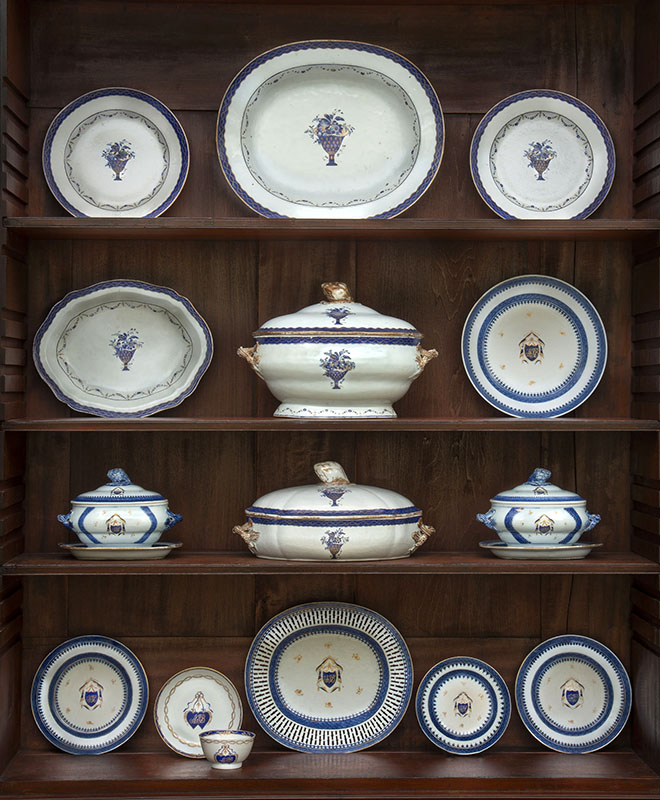
Figure 3. Partial dinner service with floral urn (1794–95) and partial dinner service with shield and initials “NAB” (1791–98), made in Jingdezhen, China, decorated in Guangzhou, China. Hard-paste porcelain. Collection of George M. and Linda H. Kaufman. Photo by Gavin Ashworth.
Goussé Bonnin and George Anthony Morris founded the American China Manufactory in Philadelphia in 1769, signaling, in the words of Robert Hunter, “an event of international consequence, not only as an American scientific triumph in deciphering the mysteries of porcelain making but an outright challenge to the monopolies of British and European manufactures” (p. 270). Unfortunately, the undertaking was not economically viable, and the factory left behind scattered records and only 20 intact examples of this soft-paste porcelain. Pickle stands (figure 4) were the most complex form made at the Manufactory and had been a mainstay product for the British porcelain industry, coinciding with Anglo-American adoption of French cuisine practices involving a multitude of sauces, relishes, and confectionaries. In the figure below, the central pickle stand is the standard, least costly version produced by the American China Manufactory. The pair of pickle stands flanking it were a special order from John and Elizabeth Lloyd Cadwalader, no doubt much more expensive. The expertise required to create these complex stands was supplied by an influx of foreign workers responding to a 1770 advertisement by Bonnin and Morris. Hunter concludes that “the pickle stands of the American China Manufactory are without question among America’s greatest ceramic treasures.”
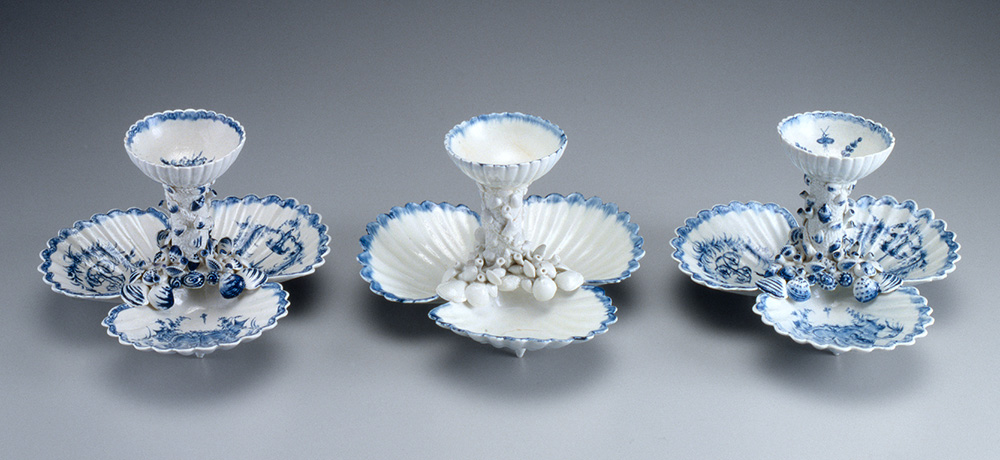
Figure 4. American China Manufactory, Pickle stands, 1770–72, Philadelphia, PA. Soft-paste porcelain. Collection of George M. and Linda H. Kaufman, promised gift to National Gallery of Art, Washington, D.C. Photo © National Gallery of Art
True philanthropists, the Kaufmans have generously pledged most of the works featured in this catalogue as promised gifts to the National Gallery of Art, ensuring that their remarkable collection will be accessible to the public for generations to come.
Editor Wendy A. Cooper is a leading scholar of American decorative arts and Curator Emerita of furniture at Winterthur Museum. She previously worked at the Museum of Fine Arts, Boston; Colonial Williamsburg; and the Baltimore Museum of Art. Editor Arthur K. Wheelock Jr. is Senior Advisor to The Leiden Collection, former Curator of Northern Baroque painting at the National Gallery of Art, and internationally recognized for his scholarship on Dutch and Flemish art.
Over 30 experts contributed to this publication, including numerous members of the Decorative Arts Trust. The list of authors includes: Reinier Baarsen, Luke Beckerdite, Carol B. Cadou, Tara H. Cederholm, Wendy A. Cooper, Donald L. Fennimore, Alice C. Frelinghuysen, Ronald W. Fuchs, Margaret M. Grasselli, Wallace B. Gusler, John A. Hays, Morrison H. Hecksher, Jennifer Henel, Erica E. Hirschler, Robert Hunter, Brock W. Jobe, Patricia A. Kane, Peter M. Kenny, Alexandra A. Kirtley, Dean T. Lahikainen, Thomas S. Michie, Carolyn H. Miner, Mary Morton, Robert D. Mussey, Richard C. Nylander, Clark Pearce, Michael S. Podmaniczky, Rachel Pollack, Henriette Rahusen, J. Thomas Savage, Christine P. Thomson, and Arthur K. Wheelock Jr.
The publication is available for purchase through the National Gallery of Art and Winterthur.
About The Decorative Arts Trust Bulletin
Formerly known as the "blog,” the Bulletin features new research and scholarship, travelogues, book reviews, and museum and gallery exhibitions. The Bulletin complements The Magazine of the Decorative Arts Trust, our biannual members publication.
Click Images to Enlarge
Did you know that clicking on the images in Bulletin posts will allow you to get a closer look? Simply click on an image, and a larger version will open in a pop-up window.