






The Netherlands and Belgium Enchant Travelers during the Low Countries Study Trip Abroad
Amsterdam, Bruges, Brussels…These cities are on so many travelers’ must-see lists, and we are thrilled that we were able to usher two tours to the enchanting Low Countries region as our March 2026 Study Trip Abroad.
Amsterdam and The Hague
Our adventure began in Amsterdam, with a fascinating introductory lecture by architectural historian Frederick Franken in our stylish and historic headquarters, the Pulitzer Amsterdam. Franken then guided us on a captivating walking tour featuring many of Amsterdam’s quintessential building styles.
Our exploration of Amsterdam featured the renowned Rijksmuseum, visited with Curator of Furniture Alexander Dencher, Head of the Decorative Arts Department Femke Diercks, and Head of the Asian Arts Department Menno Fitski, who provided in-depth analysis of the extraordinary collection. The exquisite Van Loon Museum, which we toured with art historian Anita Liemburg, retains the original complex of house, garden, and coach house and preserves the important history of a mercantile family. The National Maritime Museum illustrated the history of the Dutch empire at sea through fine and decorative arts and a 20th-century replica of an 18th-century Dutch East India Company ship. Franken’s walking tour of Amsterdam’s historic district led us to tours of Our Lord in the Attic, a clandestine 17th-century Catholic church, and the 1671–75 Portuguese Synagogue with its impressive woodwork and lighting. He has assisted in the preservation and restoration of both of these key ecclesiastical buildings.
In The Hague, the political center of the Netherlands, the striking 1633–44 Mauritshuis contains some of the most iconic paintings in Western art, including Vermeer’s Girl with a Pearl Earring. The nearby Bredius Museum displays a variety of 17th-century etchings, paintings, and porcelain as well as a rare perspective box by Samuel van Hoogstraten.
Private lunches at the farmhouse of Narda van ‘t Veer and the townhouse of Claas Conijn, as well as convivial receptions at lovely canal houses, allowed us to mingle with gracious hosts and enjoy their personal collections.
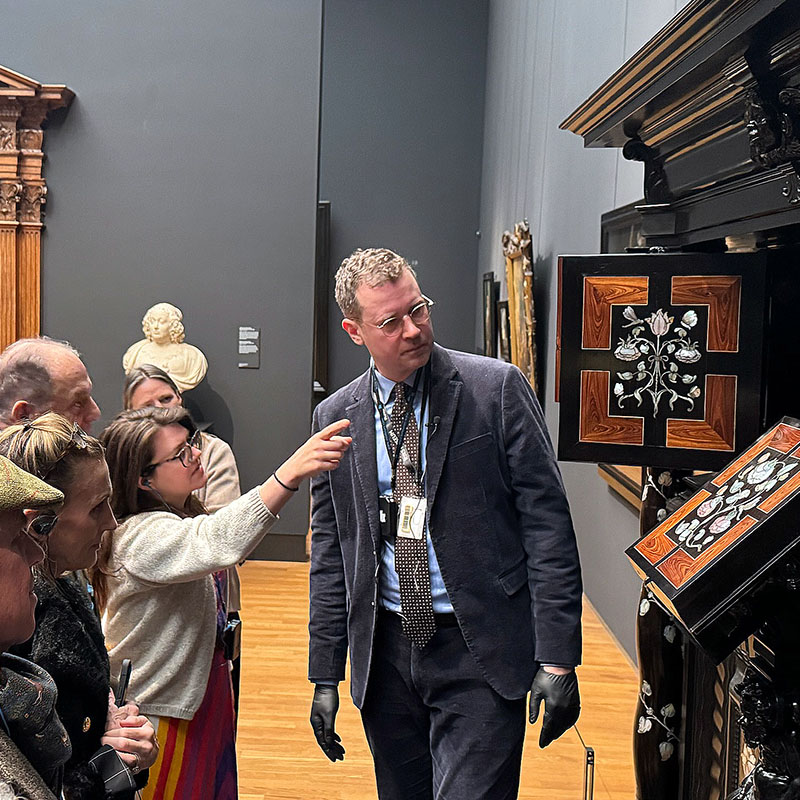
The Rijksmuseum’s Curator of Furniture Alexander Dencher opened a cabinet to reveal the interior decoration.
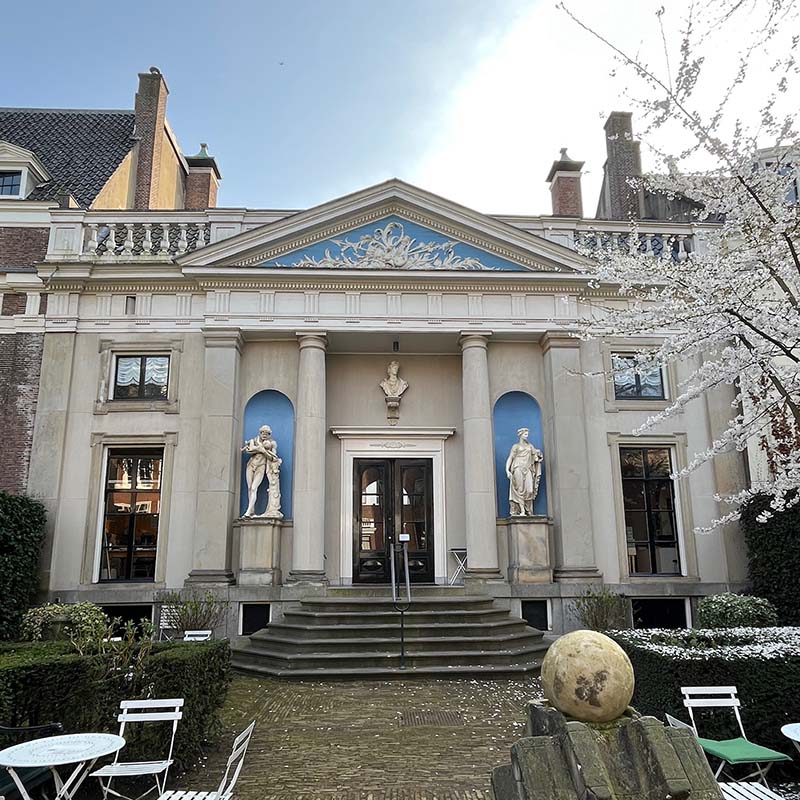
The garden and carriage house of the Van Loon Museum.
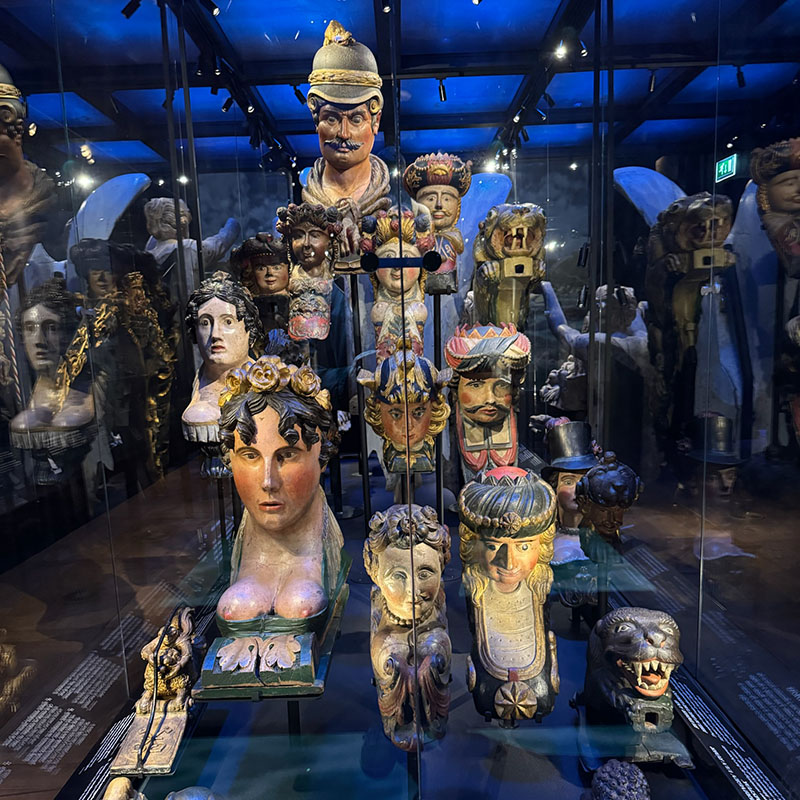
Carved ornaments at the National Maritime Museum.
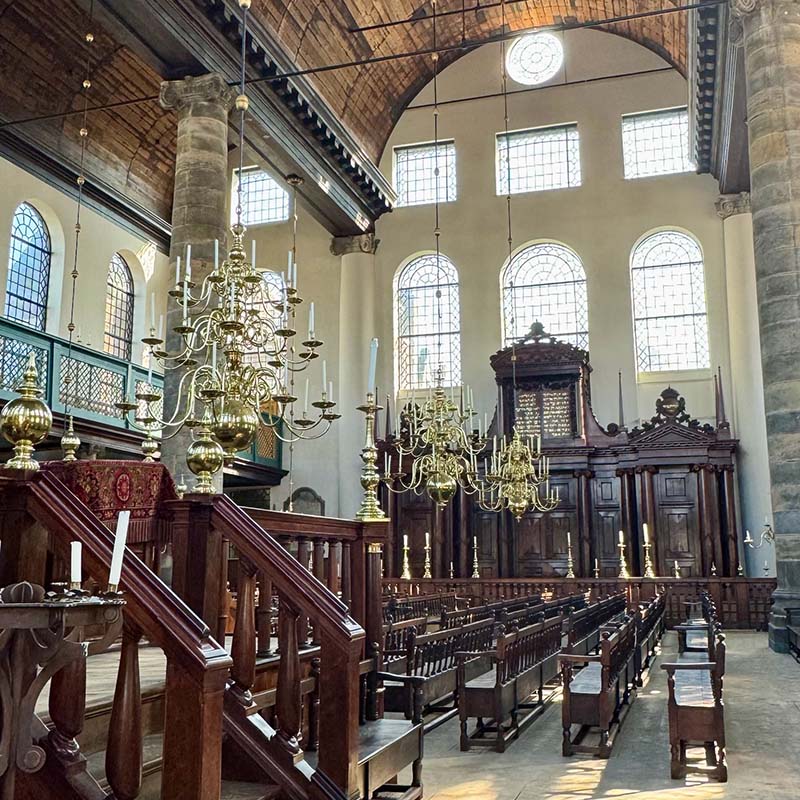
Portuguese Synagogue.
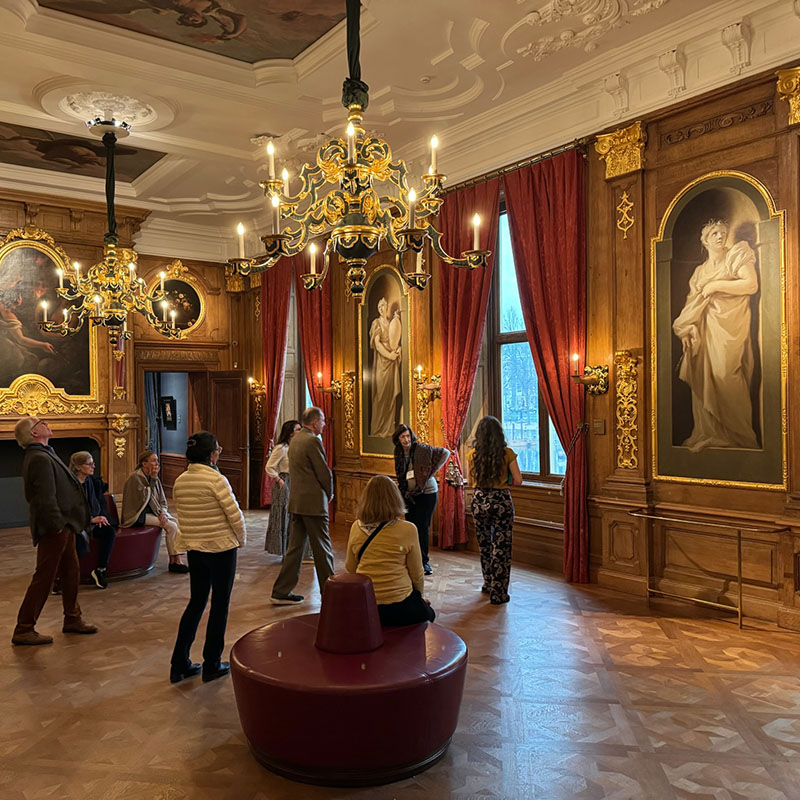
The interiors of the Mauritshuis were rebuilt after an early-18th-century fire gutted the building.
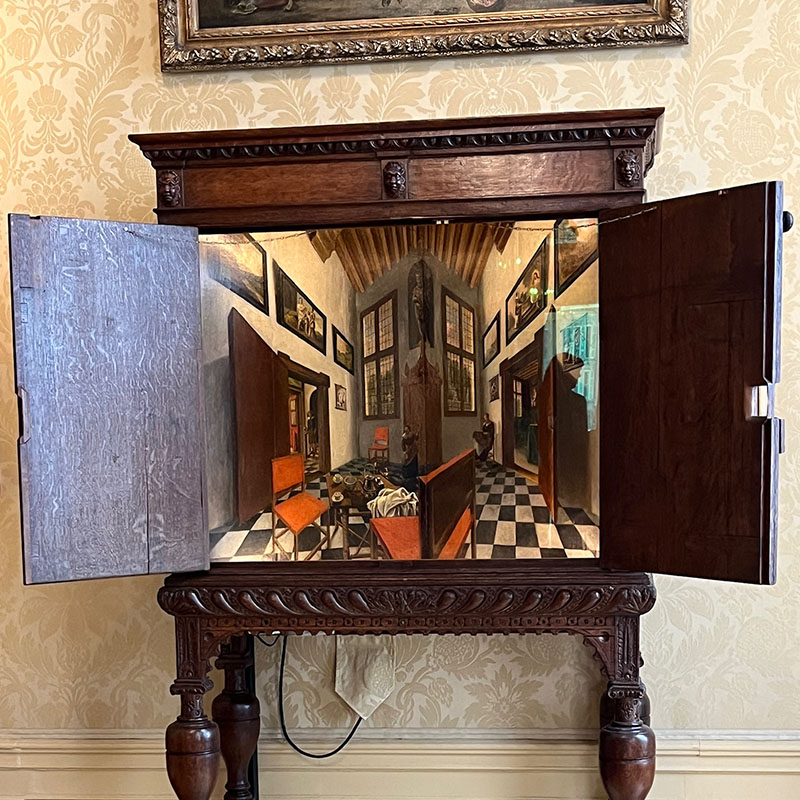
The Bredius Museum’s perspective box by Samuel van Hoogstraten.
Delft and Bruges
Heading southward, we set our sights on the Royal Delft Museum and Manufactory, founded in 1653 and the only original Delftware factory from that era still in operation. After an enlightening tour of the historic collection and contemporary manufacturing process, we departed for Ridderkerk and Het Huys ten Donck, an impressive country house built in 1746. Arriving in Belgium, we settled at our accommodations in Bruges, the splendid Hotel de Tuilerieën.
Bruges, like Amsterdam, is a city criss-crossed with canals and therefore very walkable and very cruisable! We strolled along streets sweetly scented by the many chocolateries to the Gruuthuse Museum, housed in the late Medieval city palace. Nearby, the Groeninge Museum retains six centuries of Belgian visual art, and the riverside Hospital of St. John dates back to the 12th century and contains extraordinary work by Hans Memling. Many guests took advantage of the opportunity to see Michelangelo’s Pieta in the Church of Our Lady.
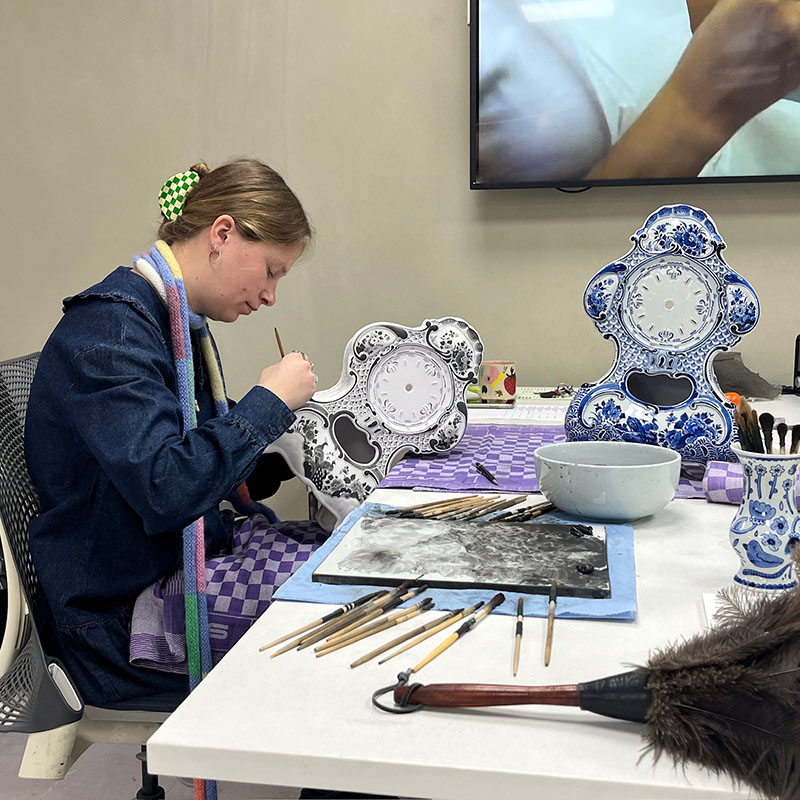
The Royal Delft Manufactory continues to incorporate hand-painted ornament.
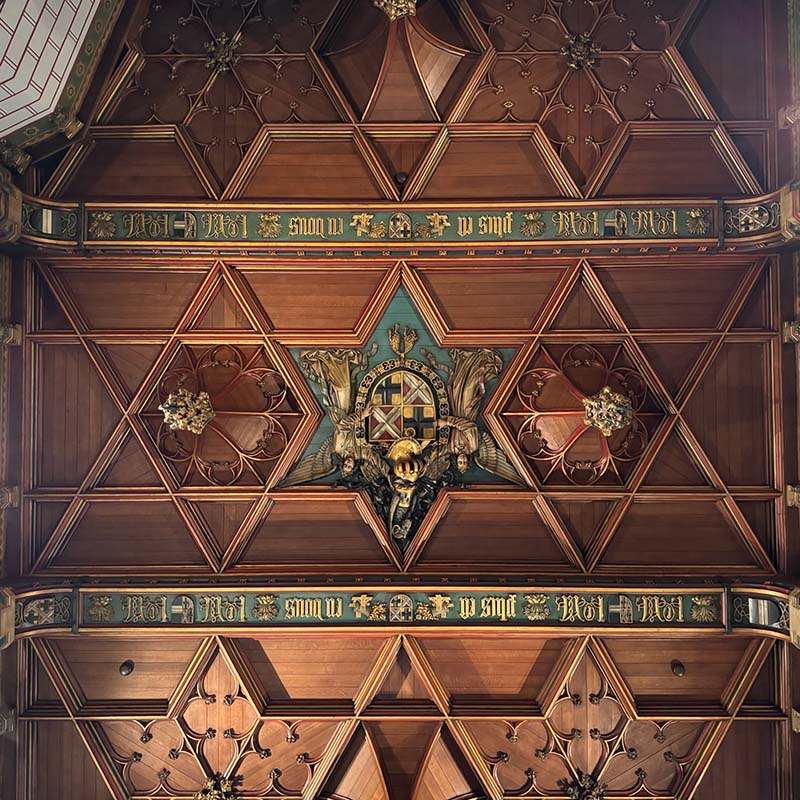
The Gruuthuse Museum in Bruges received a Gothic Revival treatment in the late 19th century.
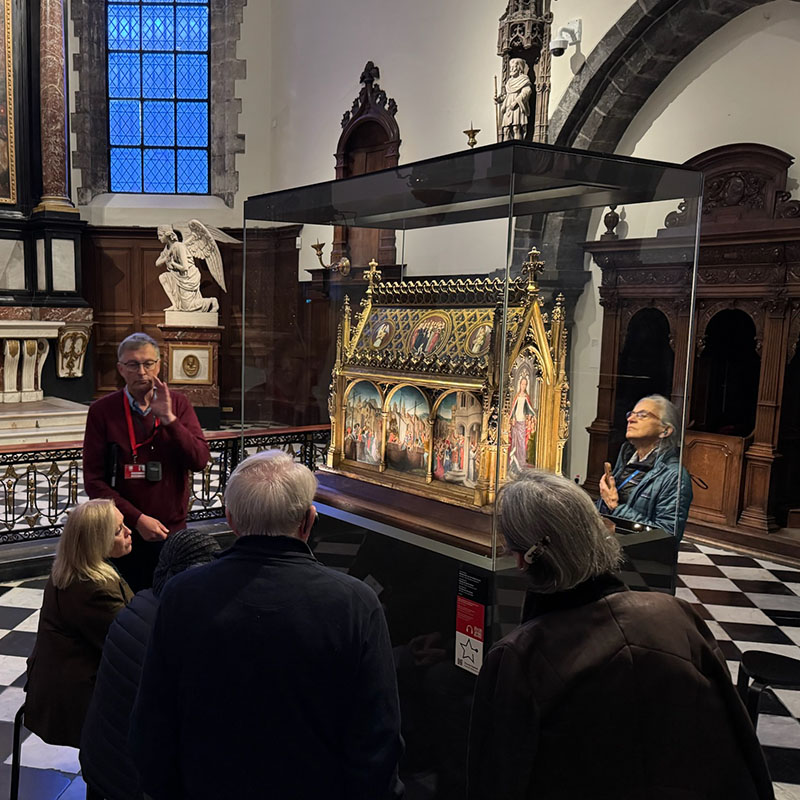
A reliquary bearing panels painted by Hans Memling at the Hospital of St. John.
Mechelen and Brussels
With Bruges in our rear view mirror, we jaunted to Mechelen, a small town known for an influential textile industry and a must-see Town Hall complex around the Grote Markt. At the De Wit Foundation, we were treated to a guided tour of the Royal Tapestry Manufactory and Workshop, where an acclaimed team of conservators preserves important tapestries from public and private collections.
In Brussels, the fashionable Hotel Amigo welcomed us, and we were excited to embark on a walking tour of the Grand Place and other notable sites with art historian Karin Debbaut. As the birthplace of the Art Nouveau movement, one does not visit Brussels without attending the Horta Museum, dedicated to the Belgian architect and designer whose touches can be glimpsed throughout the city. An expert-guided tour of the Art and History Museum showcased highlights from their collection of decorative arts from the 15th century to the present, with standouts from the Art Nouveau period. Wrapping up the tour, Debbaut shared insights into her favorite paintings at the Royal Museum of Fine Arts. During a closing dinner, we reveled in our travels and compared notes on our favorite towns and sites in this beautiful region.
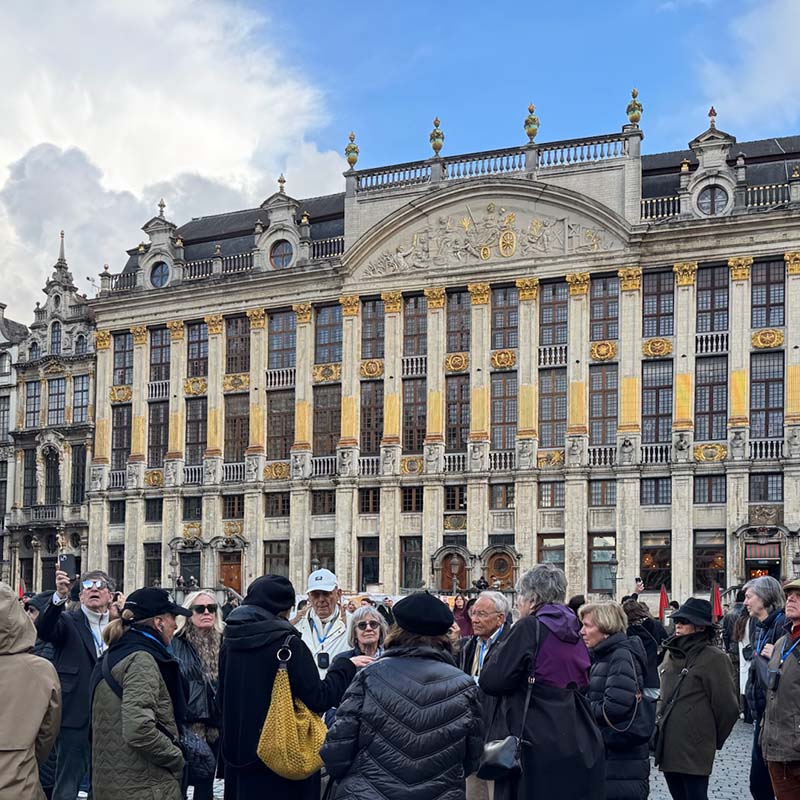
Grand Place, Brussels.
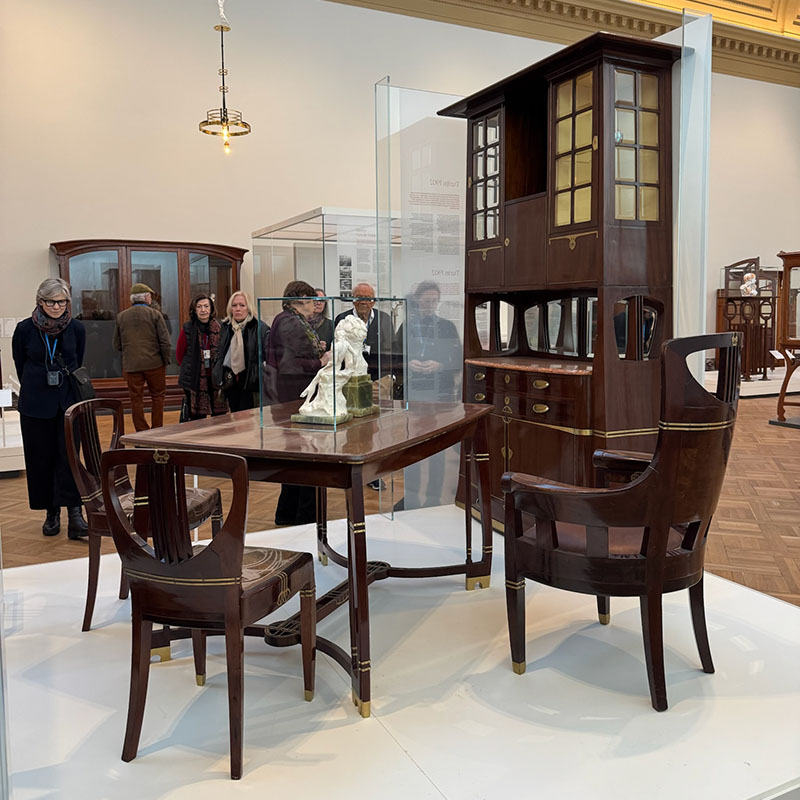
Art and History Museum.

Royal Museum of Fine Arts.
Maastricht and TEFAF
The Optional Extension kicked off with an extra taste of Brussels, in the form of the Charlier Museum, housed in an early-19th-century hôtel particulier and featuring period rooms from the Louis XV, Louis XVI, and Empire periods. We were particularly intrigued by the Chinese dining room, decked with wallpaper and furnishings exemplifying the era’s interest in Asian ornament.
But why did we go to the Low Countries in March? Well, The European Fine Art Fair in Maastricht, of course! TEFAF, as it is popularly known, is the leading event of its kind in Europe, with over 250 dealers from 20 countries. Our strategy to tackle such large and varied assembly of eye-popping material was to visit with expert dealers who shared the highlights of their booths. From silver to ceramics to furniture to jewelry and beyond, visiting TEFAF was like visiting a museum… but everything was available for purchase!
A walking tour of Maastricht introduced the storied Vrijthof square, with nearby St. Servaas Basilica and the collegiate chapel with the Treasury. At the Bonnefanten Museum, a curator led us through their renowned Applied Arts collection. Dinner at the Amstenrade Castle, a stately home built c. 1780, allowed us to take in some of the finest Neoclassical interiors in the Netherlands.
The Hotel Château St. Gerlach, where we rested our heads, was located in the Netherlands’ gem Valkenburg, so we were able to partake in a guided tour of the town’s historic center. During an ambitious day, we also visited the Curtius Museum in Liège, Belgium, and Aachen’s Cathedral and Treasury in Germany. The nation-hopping day concluded with a hospitable reception at the home of Guus and Marijke Röell.
Thorn was our destination on the final full day of the extension, with plans for a walking tour and lunch at Maurick Castle, which dates to the 14th century. In nearby Utrecht, we deviated sharply from the 18th century to see the 1924 Rietveld Schröder House, a showpiece of the de Stijl movement.
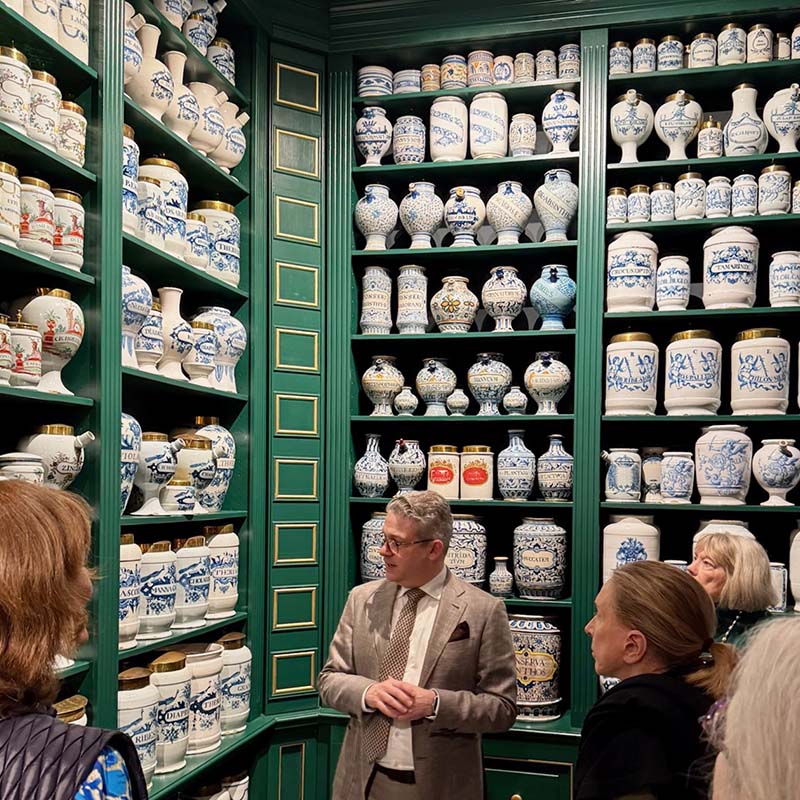
TEFAF.
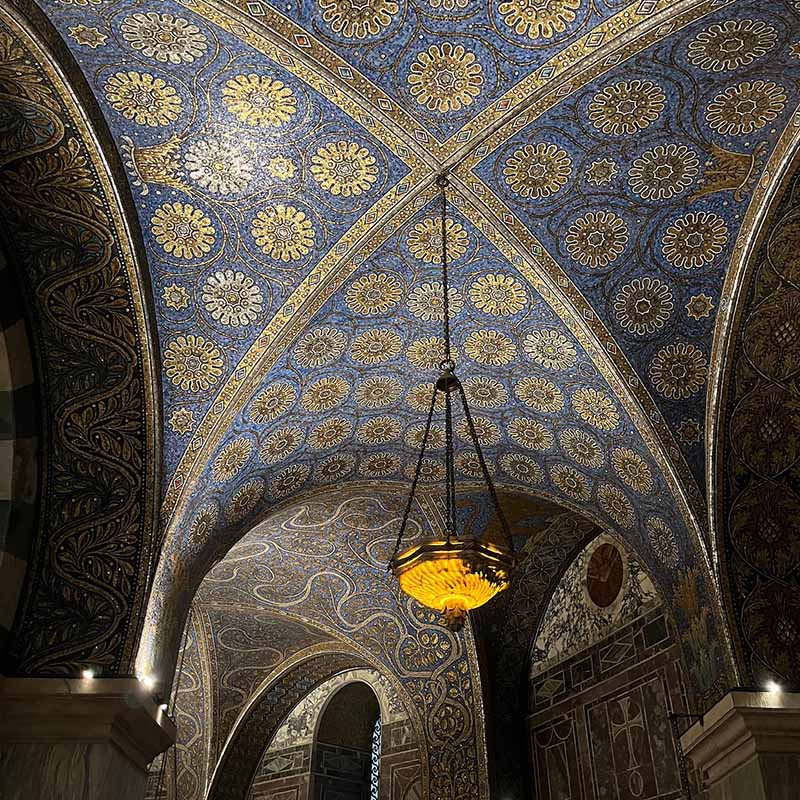
Aachen Cathedral.
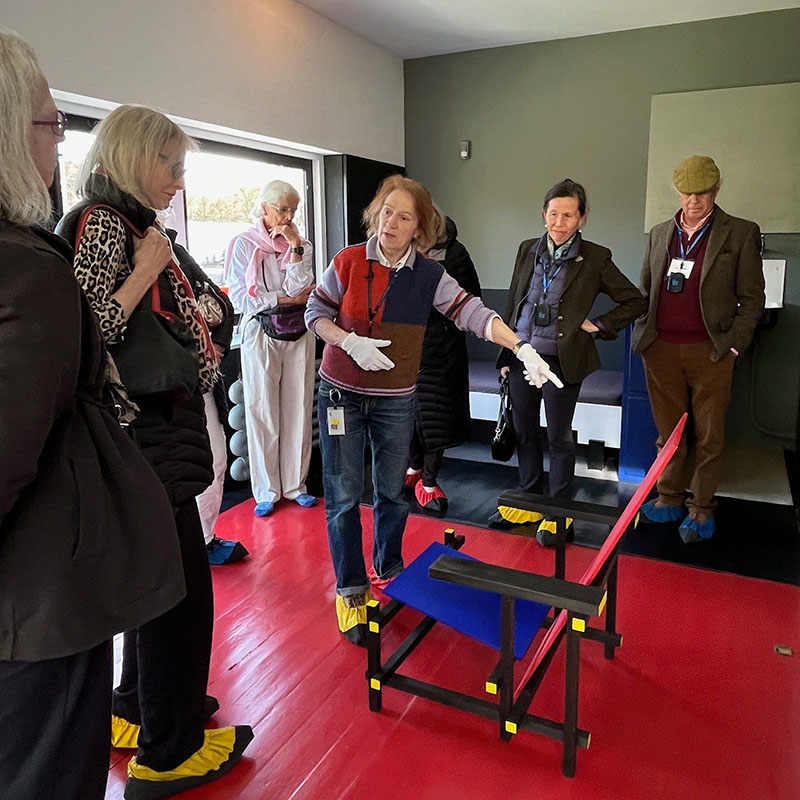
Rietveld Schröder House.
Overall, our excursion to the Low Countries was one we will always remember with fondness! If you are interested in the Decorative Arts Trust’s upcoming programs, visit our Calendar of Events and make sure you are subscribed to our email list for updates about registration openings.
About The Decorative Arts Trust Bulletin
Formerly known as the "blog,” the Bulletin features new research and scholarship, travelogues, book reviews, and museum and gallery exhibitions. The Bulletin complements The Magazine of the Decorative Arts Trust, our biannual members publication.
Click Images to Enlarge
Did you know that clicking on the images in Bulletin posts will allow you to get a closer look? Simply click on an image, and a larger version will open in a pop-up window.