






Framing My Research: Mary Lizzie Macomber and the British Pre-Raphaelites
by Fiona Owens
When I first examined Saint Catharine (1896, figure 1) by Mary Lizzie Macomber (1861–1916) at the Museum of Fine Arts, Boston (MFA Boston), I was struck not only by the beauty of the painting, but by its frame, how the water gilding, applied directly to the wood, allowed the gold and the wood grain to remain simultaneously visible. An elaborate label on the reverse, reading “J. Eastman Chase: Painting, Etchings, and Frames,” (figure 2) caught my attention. Who was Chase? And what attracted Macomber to his work?
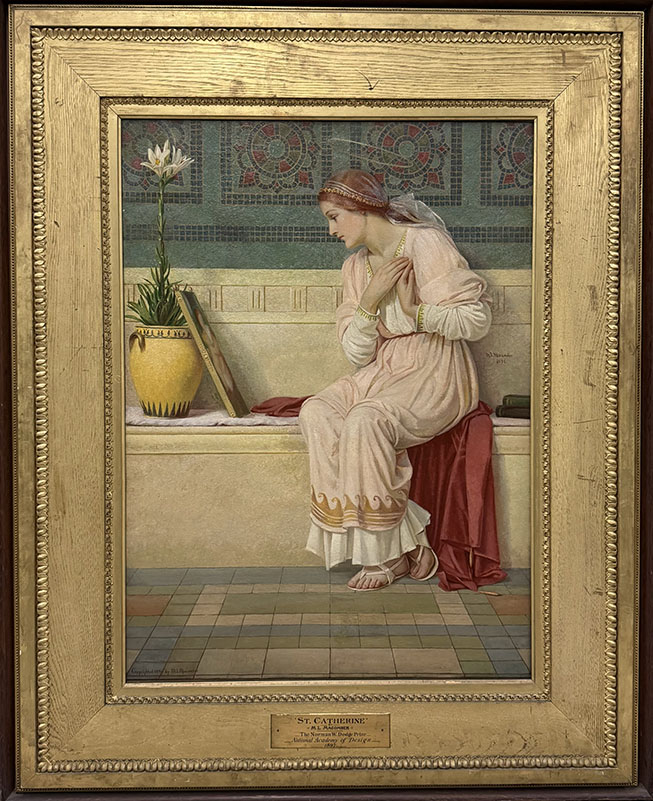
Figure 1. Mary Lizzie Macomber, American, 1861–1916, 𝘚ain𝘵 𝘊𝘢𝘵𝘩𝘢𝘳𝘪𝘯𝘦, 1896. Oil on canvas, 83.5 x 61.28 cm (32 ⅞ x 24 ⅛ in.). Museum of Fine Arts, Boston, gift of the artist, 98.622. Photograph by author. Photograph © June 3, 2026 Museum of Fine Arts, Boston.
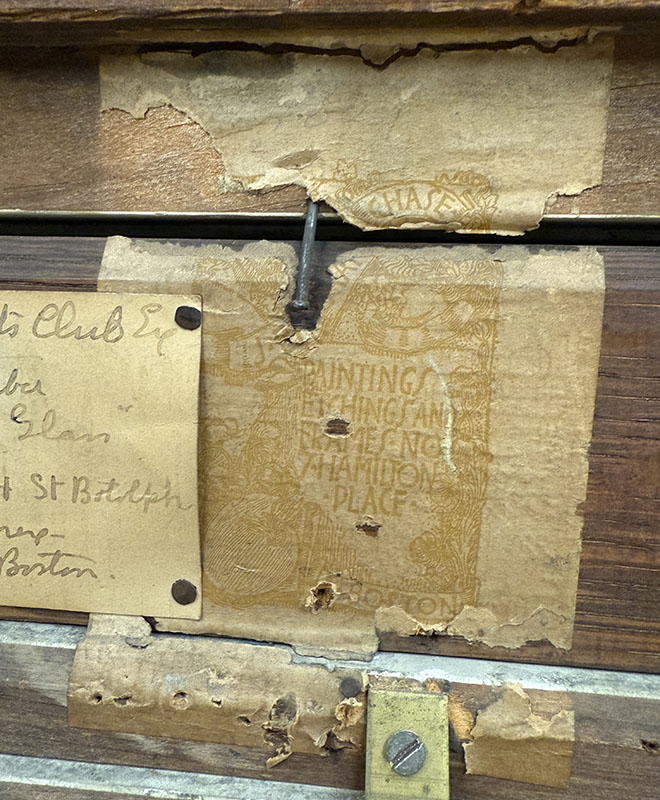
Figure 2. J. Eastman Chase frame label on the reverse of Mary Lizzie Macomber, American, 1861–1916, 𝘚𝘢𝘪𝘯𝘵 𝘊𝘢𝘵𝘩𝘢𝘳𝘪𝘯𝘦, 1896. Oil on canvas, 83.5 x 61.28 cm (32 ⅞ x 24 ⅛ in.). Museum of Fine Arts, Boston, gift of the artist, 98.622. Photograph by author. Photograph © June 3, 2026 Museum of Fine Arts, Boston.
The role of the British Pre-Raphaelites in frame-making is well published, yet less is known about the frame design of their followers in the United States. My research examines how Macomber, a critically understudied Boston-based artist, used frame design to communicate her Pre-Raphaelite affiliations. With support from the Decorative Arts Trust’s Marie Zimmermann Research Grant, I visited collections in Boston and Fall River, MA, tracing Macomber’s framing choices from 1892–1916. Research at Vose Galleries, the MFA Boston, and institutions in Fall River yielded key insights into Macomber’s three frame-makers.
Macomber’s earliest frame-maker was the aforementioned J. Eastman Chase, an art dealer and frame-maker based in Boston.1 Macomber’s painting My Mother (The Hour—Glass) (1900, figure 3) contains a J. Eastman Chase framing label. The nearby Saint Catherine (1896) includes a label referencing Chase as Macomber’s potential dealer. These two frames share decorative elements, chiefly the application of gilding directly onto wood, a technique strongly associated with Pre-Raphaelite framing styles.2 The shared gilding technique and the presence of Chase’s label on both works strongly suggest that he supplied their frames. Surviving correspondence from the J. Eastman Chase Papers held by the Smithsonian Archives of American Art show that Chase also did framing work for Charles Elliot Norton, the executor of John Ruskin’s estate and one of the most important champions of Pre-Raphaelite art in the US.3 Macomber’s decision to work with Chase demonstrates her effort to materially associate herself with the Pre-Raphaelites, and to directly engage with Pre-Raphaelite circles in Boston.

Figure 3. Mary Lizzie Macomber, American, 1861–1916, 𝘔𝘺 𝘔𝘰𝘵𝘩𝘦𝘳 (𝘛𝘩𝘦 𝘏𝘰𝘶𝘳—𝘎𝘭𝘢𝘴𝘴), 1900. Oil on canvas, 71.12 x 58.74 cm (28 x 23 ⅛ in.). Museum of Fine Arts, Boston, bequest of the artist, 17.1687. Photograph by author. Photograph © June 3, 2026 Museum of Fine Arts, Boston.
Although Macomber may have begun her career with Chase frames, a letter I uncovered in the Vose Galleries archives shifts our understanding of Macomber’s agency, and suggests a move to Foster Brothers. In a letter addressed to her agent Robert Vose (1873–1964), with whom Macomber was signed from 1901 until her death in 1916, Macomber writes of her close relationship with the prominent Boston frame-making company:
That frame must be made at Foster Bros. because I bought [sic] that design from Antwerp. It’s a very old design. I took it to Foster Bros. and had them draft a working pattern and promise not to make it for anyone but me…Its [sic] my own pet frame and I don’t want other makers to get it by making one like it besides its [sic] not fair to Foster Bros. after the restrictions I put on them.4
The “pet frames” to which Macomber refers were likely her signature tabernacle frames, which survive on five known extant paintings (figure 4 and figure 5), and in two photographs of now lost paintings (figure 6). These frames are characterized by their fully realized three-dimensional Corinthian columns made from composition and by their use of triple water gilding, an advanced technique in which multiple layers of gold leaf are applied in order to reproduce the appearance of solid gold.
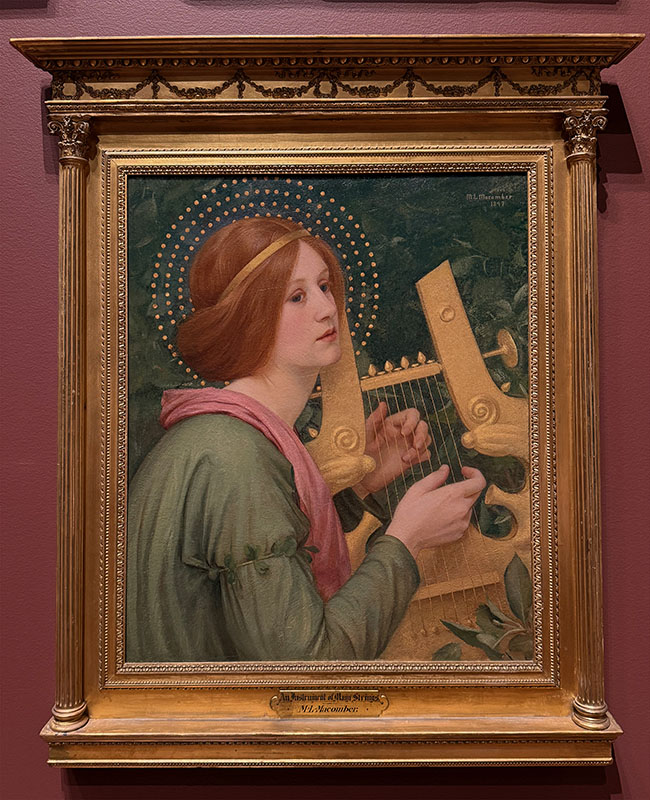
Figure 4. Mary Lizzie Macomber, 𝘈𝘯 𝘐𝘯𝘴𝘵𝘳𝘶𝘮𝘦𝘯𝘵 𝘰𝘧 𝘔𝘢𝘯𝘺 𝘚𝘵𝘳𝘪𝘯𝘨𝘴, 1897. Oil on canvas mounted to a cradled wooden/masonite board. Delaware Art Museum, 2019-109. Photo by author.
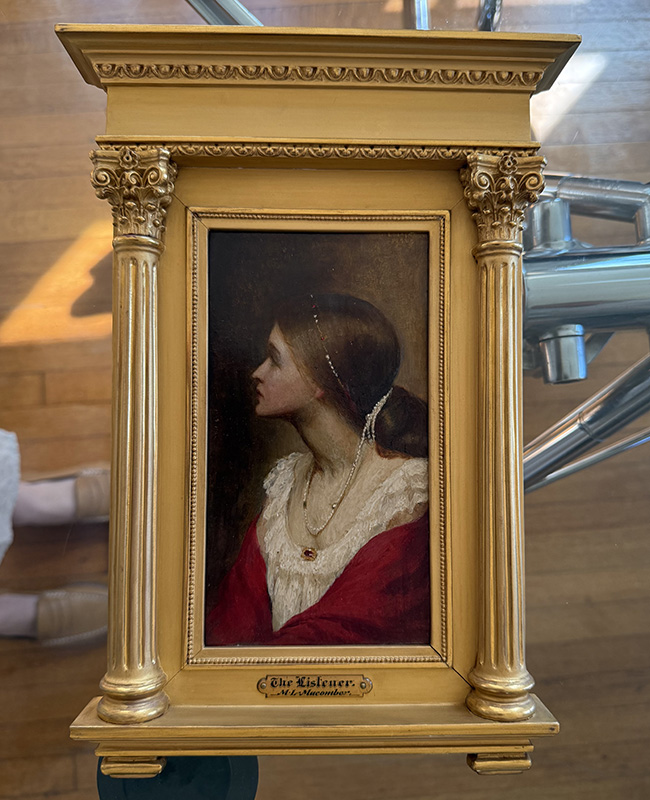
Figure 5. Mary Lizzie Macomber, 𝘛𝘩𝘦 𝘓𝘪𝘴𝘵𝘦𝘯𝘦𝘳, 1903. Oil on canvas. Private Collection. Photo by author.
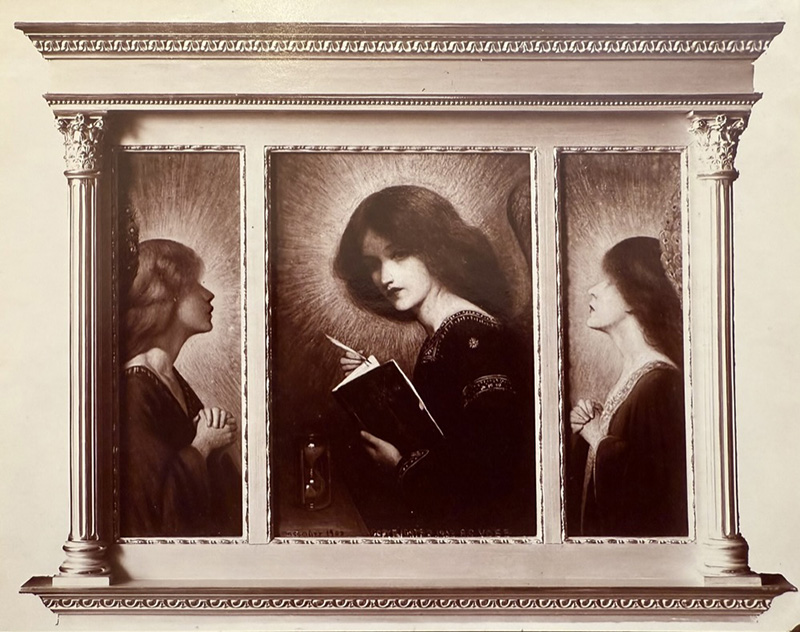
Figure 6. Mary Lizzie Macomber, 𝘛𝘩𝘦 𝘏𝘰𝘶𝘳 𝘰𝘧 𝘎𝘳𝘢𝘤𝘦, 1903. Photograph of a painting presumed to be oil on canvas. Painting location unknown, photograph collection of Vose Galleries. Photo by author.
None of these frames bear a Foster Brothers stamp, likely due to their highly customized and exclusive nature. Moreover, although the Foster Brothers Papers at the Smithsonian Archives of American Art do not mention Macomber by name, stock records show that they were accustomed to producing tabernacle frames for mirrors, with many designs featuring identical columns to those found on Macomber’s frames (figure 7). Foster Brothers advertised their expertise in reproducing antique Dutch frames and Arts and Crafts gilding, skills that would have appealed to Macomber (figures 8 and 9). The very act of having her own custom frames would have associated Macomber with the Pre-Raphaelite Brotherhood, an association strengthened by the visual similarity of these frames to those favored by Edward Burne-Jones (1833–98) and Frederic Leighton (1830–96).5
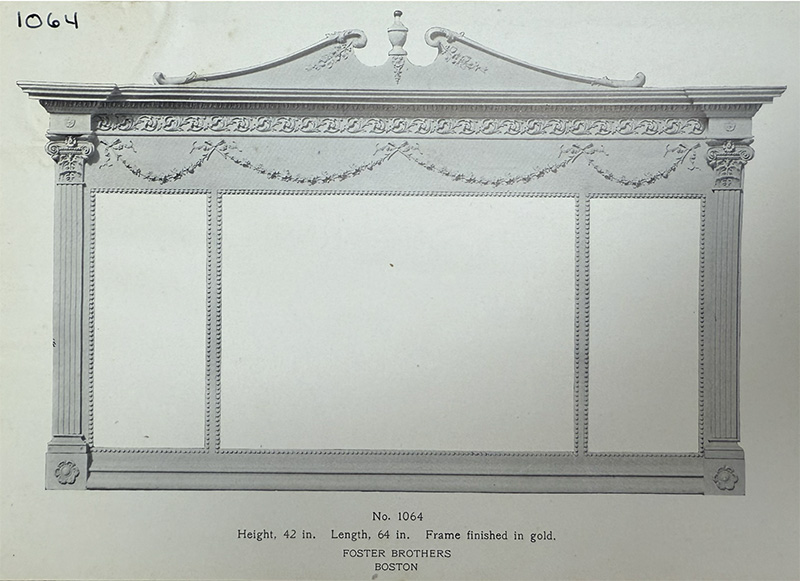
Figure 7. Foster Brothers, 𝘚𝘵𝘰𝘤𝘬 𝘙𝘦𝘤𝘰𝘳𝘥 𝘕𝘰. 1064, Date unknown. Smithsonian Archives of American Art. Photo by author.

Figure 8. Foster Brothers, Arts and Crafts Frame Advertisement Featuring Copley Print, c. 1907. Smithsonian Archives of American Art. Photo by author.

Figure 9. Foster Brothers, “FB Picture Frames” Advertising Card, Date unknown. Smithsonian Archives of American Art. Photo by author.
A second visit to Boston and Fall River allowed me to uncover the final stage of Macomber’s framing practice, that of the “Guild Pictures.” These eight paintings were produced for her 1915 solo exhibition at the Guild of Boston Artists. At 50 by 40 inches, these sizable works present Classicizing allegorical themes, including personifications of such abstract concepts as The Water of Life, The Bearer of the Soul, and Maternity.6 She painted this series a year before she died when she was weak and often bedridden, a state she attributed to lead poisoning.7 My visit to Fall River allowed me to examine one of Macomber’s Guild Pictures, titled Love and Memory (figure 10), now held in a private collection. Although clearly original, the thin, simple frame, with its flaking water gilding and greening gold paint, was a far cry from Macomber’s earlier “pet frames.”
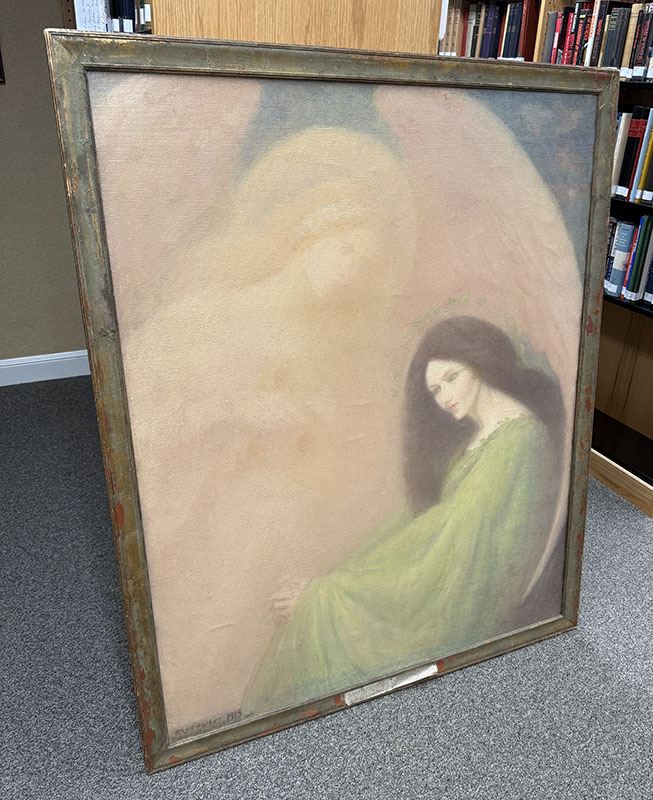
Figure 10. Mary Lizzie Macomber, 𝘓𝘰𝘷𝘦 𝘢𝘯𝘥 𝘔𝘦𝘮𝘰𝘳𝘺, 1915. Oil on canvas (zinc). Private Collection. Photo by author.
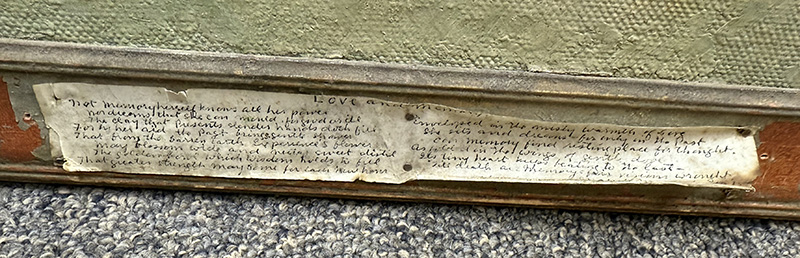
Figure 11. A close up of the sonnet on the frame of Mary Lizzie Macomber’s 𝘓𝘰𝘷𝘦 𝘢𝘯𝘥 𝘔𝘦𝘮𝘰𝘳𝘺, 1915. Paper imitating parchment, ink. Private Collection. Photo by author.
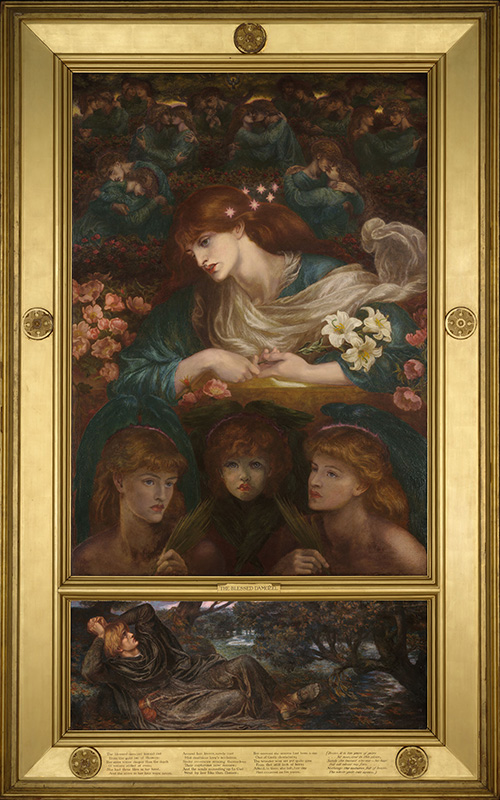
Figure 12. Dante Gabriel Rossetti, 𝘛𝘩𝘦 𝘉𝘭𝘦𝘴𝘴𝘦𝘥 𝘋𝘢𝘮𝘰𝘻𝘦𝘭 , 1871–78. Oil on canvas. Harvard Art Museums, 1943.202.
Although commercially successful between 1901 and 1914, by 1915 Macomber had lost most of her earnings in the stock market.8 Unable to commission her usual “pet frames,” I propose that Macomber turned instead to secondhand water-gilded liners, which she or another amateur frame-maker refreshed with gold paint. In an effort to personalize these frames, a handwritten accompanying sonnet remains tacked to the bottom of the frame (figure 11). While Macomber had written poems for past works, this is the first time that she incorporated poetry into her frames. The placement bears a striking similarity to Pre-Raphaelite frames, particularly to the frame on Rossetti’s The Blessed Damozel (1871–78, figure 12), which I also viewed during my time in New England. By incorporating poems directly onto her frames, Macomber created a triple work of art, in which poem, painting, and frame function as independent yet cohesive statements.9 Macomber’s “Guild Pictures” thereby show her longstanding interest in the Pre-Raphaelite movement, and her determination to achieve her goals by overcoming challenges of health and poverty.
Support from the Decorative Arts Trust enabled firsthand examination of Macomber’s frames and archival research which led to new attributions. These findings will inform my ongoing research into Macomber’s contributions to the international Pre-Raphaelite conversation and the central role of framing within her artistic practice.
1. Jayna M. Josefson, “A Finding Aid to the J. Eastman Chase Papers, 1866-1917,” Archives of American Art, March 21, 2022, https://www.aaa.si.edu/collections/j-eastman-chase-papers-7387.
2. Lynn Roberts. “Victorian Frames: Pre-Raphaelites, Victorian High Renaissance and Arts and Crafts.” Essay. In In Perfect Harmony: Picture + Frame, 1850-1920, edited by Eva Mendgen, 57–87. Vienna, Austria: Van Gogh Museum, 1995.
3. Letter from Charles Elliot Norton to J. Eastman Chase, February 21, 1882, J. Eastman Chase Papers, 1866-1917, Box 1, Letters 1867-1898 Folder, Smithsonian Archives of American Art, Washington, DC.
Sophie Lynford. Painting Dissent: Art, Ethics, and the American Pre-Raphaelites. Princeton, NJ: Princeton University Press, 2022.
4. Letter from Mary Lizzie Macomber to Robert C. Vose, November 7, 1915. Box 1, Folder 3. Mary Lizzie Macomber (1861–1916) Archives, Vose Galleries, Boston, Massachusetts.
5. Roberts. “Victorian Frames” Essay. In In Perfect Harmony: Picture + Frame, 1850-1920, 1995.
6. Ideal Paintings Memo. Box 1, Folder 1, Mary Lizzie Macomber (1861–1916) Archives, Vose Galleries, Boston, Massachusetts.
7. Interview with Mr. Burdick, 1916. Box 1, Folder 1, Mary Lizzie Macomber (1861-1916) Archives, Vose Galleries Archives, Boston, Massachusetts.
8. Interview with Mr. Burdick, 1916. Box 1, Folder 1, Mary Lizzie Macomber (1861-1916) Archives, Vose Galleries Archives, Boston, Massachusetts.
9. Roberts. “Victorian Frames” Essay. In In Perfect Harmony: Picture + Frame, 1850-1920, 1995.
Fiona Owens is a Lois F. McNeil Fellow in the Winterthur Program in American Material Culture at the University of Delaware.
About The Decorative Arts Trust Bulletin
Formerly known as the "blog,” the Bulletin features new research and scholarship, travelogues, book reviews, and museum and gallery exhibitions. The Bulletin complements The Magazine of the Decorative Arts Trust, our biannual members publication.
Click Images to Enlarge
Did you know that clicking on the images in Bulletin posts will allow you to get a closer look? Simply click on an image, and a larger version will open in a pop-up window.