






An Unforgettable Exploration of Mexico City, Puebla, and Teotihuacan
The Decorative Arts Trust’s first program in Mexico delighted members with the exploration of Mexico City, Puebla, and Teotihuacan. Led by two extraordinary experts on the Trust’s Board of Governors, Jorge F. Rivas Pérez from the Saint Louis Art Museum (November) and Dennis Carr from The Huntington (December), the immersive site visits delighted and inspired.
An Introduction to Mexico City
The unofficial kick-off to our exploration of Mexico City was a visit to Templo Mayor. Those who arrived to town early could join for a guided tour of this magnificent archaeological site in the center of the city. The Templo Mayor (Main Temple) in Tenochtitlan, capital of the mighty Aztec empire, was built in 1325 and was where the most important ritual and ceremonial activities in Aztec life took place. Our visit included a walk through the site, remarkably situated in the shadow of the mighty Catedral Matropolitana, and an examination of objects in the adjoining museum.
After settling in at the hip and comfortable Andaz Hotel in Mexico City’s charming Condesa neighborhood, members explored the Casa Guillermo Tovar de Teresa, a 1910 mansion displaying the impressive collection of the namesake historian. An after-hours visit to the Museo Nacional de Antropología featured significant objects from Mexico’s pre-Columbian history, including the famous Stone of the Sun (or Aztec calendar stone), stone heads from the Olmec civilization, and the jade death mask of an ancient Mayan king. An informative and engaging welcome lecture by art historian Rodrigo Torres gave us deeper insights into the Mexican culture we are exploring.
The second day began with a trip to the Centro Histórico, to take in the Art Nouveau interior of the Gran Hotel Ciudad de México and its famed Jacques Grüber stained glass ceiling. The Catedral Metropolitana is considered the pinnacle of Colonial architecture in the Americas and took nearly 250 years to complete. We enjoyed the mild weather while visiting museums near Alameda Central, established in 1592 as the Americas’ first public park. At the Museo Franz Mayer, we reveled in the collection of furniture, clocks, ceramics, silver, paintings, and maps from the 1600s to the early 1900s, all housed in a stately 16th-century building. The Museo de Arte Popular, Mexico City’s premier destination for folk art, is located in a whimsical 1927 Art Deco structure. The striking Palacio de Bellas Artes is known for an Art Deco design that synthesizes Neoclassical and Art Nouveau elements. The interior includes murals by Diego Rivera, José Clemente Orozco, David Alfaro Siqueiros, and Rufino Tamayo, and the stage curtain in the main theater comprises a glass mosaic designed by Gerardo Murillo and crafted by Tiffany Studios in New York in 1911.

Casa Guillermo Tovar de Teresa.

Gran Hotel Ciudad de México.

Palacio de Bellas Artes.
Journeying to Puebla
On the third day, participants traveled to the historic town of Puebla, founded in 1531 and famous for the beautifully preserved town center and the pottery industry that continues to flourish here. We were fortunate to experience a live demonstration at the Talavera de la Luz pottery, one of the few certified workshops legally permitted to use the Talavera name because it employs historic processes: hand-forming on the potter’s wheel, tin-glazing, hand-painting using traditional colors, and double firing. The stunning Biblioteca Palafoxiana, founded in the 17th century, stands as the first public library in the Americas. The library was finished in 1773 and features a 43-meter-long vaulted hall on the second floor, with many of the benches and tables original to the space. Museo Amparo, housed within two renovated Colonial buildings with a charming herringbone brick façade and sunny garden courtyard, boasts an exquisite collection of furniture, silver, textiles, oil paintings, and ivory sculpture. The austere gray façade of the 16th-century Templo de Santo Domingo, rendered from volcanic cantera stone, belies the interior’s stunning interior decoration. Each tour enjoyed an additional, though very distinct, opportunity to visit another historic ecclesiastical site. Those in the November tour marveled at the colorful tavalvera-clad façade of the 1730 Templo de San Francisco de Acatepec. Our December travelers were amazed by the intricate design and important holdings of the 17th-century Catedral de Puebla. At the end of the day, travelers reveled in the sites of Puebla as we journeyed back to our Mexico City accommodations.
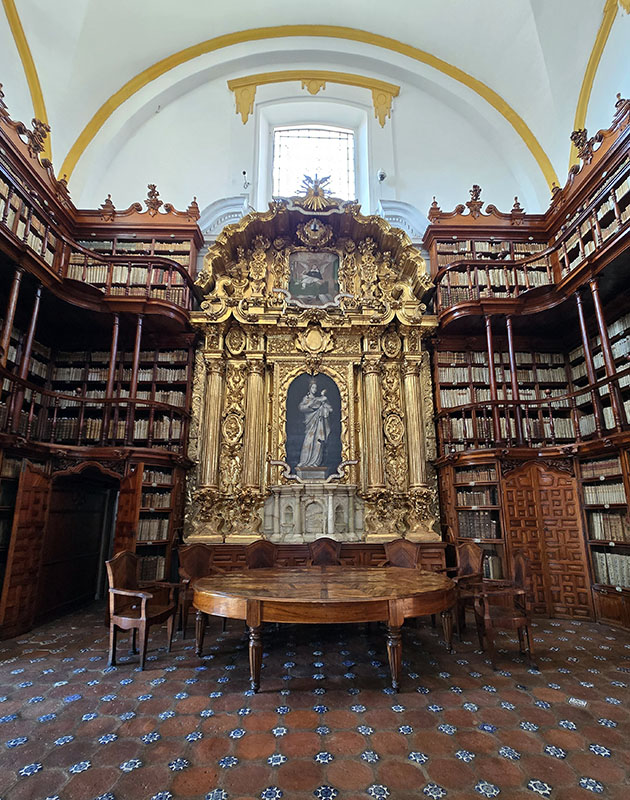
Biblioteca Palafoxiana.

Talavera de la Luz.

Templo de Santo Domingo.
Delving into More of Mexico City
On the final day, members departed for the historic Coyoacán neighborhood for a special visit hosted by fashion designer Carla Fernández and artist Pedro Reyes at their unique Casa Estudio. Our hosts welcomed us into their distinctive home, which features a Brutalist base of concrete punctuated with vibrant colors, and we were thrilled to have the opportunity to discuss (and acquire) their artwork. The nearby Museo Anahuacalli was built in 1942–57 to display painter Diego Rivera’s impressive collection of pre-Hispanic objects. Many of the museum’s ceilings are decorated with original mosaics by the great artist. Designed by Mexican architect Luis Barragán in 1947, Casa Pedregal is a masterpiece of Modern architecture finished in 1952 and featuring ceramics from Oaxac, furniture by Clara Porset, and interior finishing rendered from a native wood known locally as sabino or ahuehuete. The Museo Casa Estudio Diego Rivera y Frida Kahlo is a unique site to see the separate but conjoined spaces where Kahlo and Rivera lived and worked alongside each other. The distinct yet connected homes and studios reveal their individual sensibilities and their complicated relationship to one another. The Casa del Risco contains the fascinating Fuente del Risco, a fountain attached to the two-story Viceregal-style house. Likely built in the late 18th century, it is adorned with plates, platters, cups, jars, and porcelain pieces as well as sculptures, mirrors, and mother-of-pearl shells. Our Mexico adventures ending too soon, we gathered for a celebratory dinner, with some members preparing to continue onto the optional extension the next morning.

Casa Estudio Carla Fernández y Pedro Reyes.

Museo Anahuacalli.

Detail of Fuente del Risco.
Exploring Teotihuacan
After the formal conclusion of each Sojourn, we hosted one-day optional extensions to Teotihuacan, an ancient city built between the 1st and 7th centuries CE. The city’s plan includes a wide road called he Miccaotli (the Avenue of the Dead) lined with monumental buildings and complexes, including the Pyramid of the Sun, the Pyramid of the Moon, the Feathered Serpent Pyramid, the Ciudadela, and the Great Compound. The city is known for the talud-tablero style of architecture, where a steeply sloping wall is surmounted by a table-like, right-angled panel with an inset. The Museo de Murales Beatriz de la Fuente honors its namesake’s pioneering research in ancient Mesoamerican art by showcasing the elaborate murals that once adorned virtually every structure in ancient Teotihuacan as well as the carved stone, ceramics, and obsidian tools.

Pyramid of the Moon.

Temple of the Feathered Serpent.

Museo de Murales Beatriz de la Fuente.
All were thrilled with the hospitality of our gracious hosts, the delicious cruising, and the impressive range of experiences. Mexico City is a wonderful winter destination, to which many participants plan to return, including a potential adventure to Oaxaca in southern Mexico in 2027! If you are interested in our upcoming programs, see our Calendar of Events and make sure you are subscribed to our email list for updates about registration openings.
About The Decorative Arts Trust Bulletin
Formerly known as the "blog,” the Bulletin features new research and scholarship, travelogues, book reviews, and museum and gallery exhibitions. The Bulletin complements The Magazine of the Decorative Arts Trust, our biannual members publication.
Click Images to Enlarge
Did you know that clicking on the images in Bulletin posts will allow you to get a closer look? Simply click on an image, and a larger version will open in a pop-up window.