





Journey Into Medium: Mother-of-Pearl and the Hidden European Enlightenment
by Emma Piercy-Wright
As vibrant as the multi-hued windfalls of a New England autumn, mother-of-pearl (or nacre) is the concealed, autonomously generated inner layer of some bivalve molluscs and snails, whose shimmering, shifting beams simultaneously perplex and enchant. Each nacre is unique in color, thickness, and size. This organic-inorganic composite material is non-biodegradable, non-porous, and almost as strong as silicon. Thanks to a generous Research Grant from the Decorative Arts Trust, I was able to spend two weeks last fall viewing nacreous objects in American collections as part of my doctoral research at the University of Exeter. Mother-of-pearl’s captivating iridescence is poorly conveyed via photography, necessitating careful examination of crucial case studies in situ in order to better understand their remarkably complex materiality. The funding thus greatly benefitted my scholarship, enabling me to investigate a plethora of pertinent artifacts (figure 1) and further develop my nacreous cognizance—indeed, very much in the spirit of Enlightenment science itself.
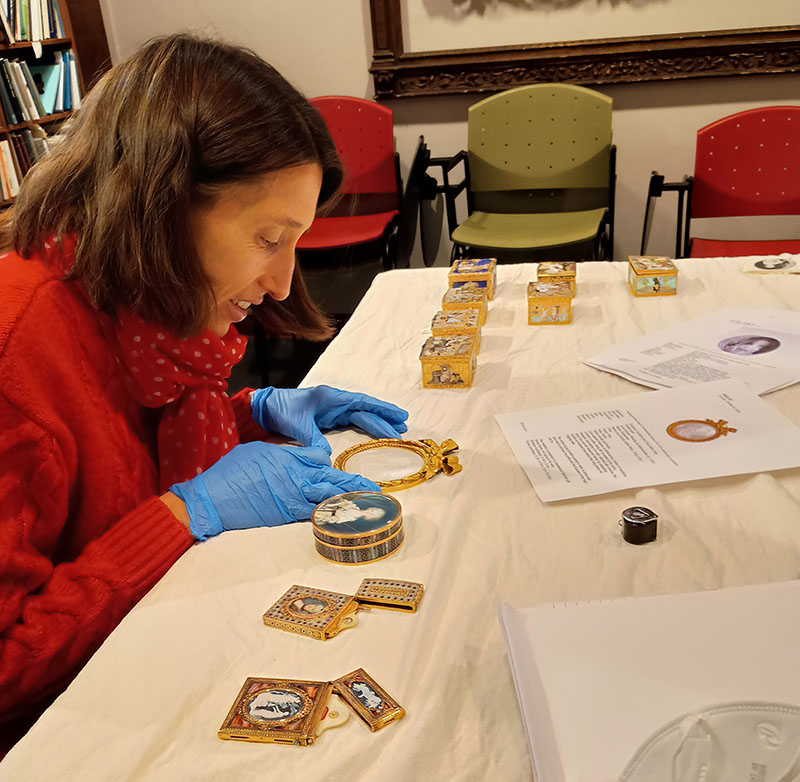
Figure 1. The author handles mother-of-pearl objects at The Metropolitan Museum of Art. Photo courtesy Emma Piercy-Wright.
Scant scholarly literature exists specifically on nacre, texts being either outdated or tending to focus on different historical periods. Furthermore, while often combined with gold, pietre dure, and other precious materials to create flamboyant treasures that epitomized the luxury and elitism of the pre-revolutionary epoch, mother-of-pearl was also utilized in humbler trinkets such as foundling tokens, buttons, and handmade crafts. My thesis therefore seeks to redress this imbalance, producing the first comprehensive study on mother-of-pearl in Britain and France between 1685 and 1790, while also decentring the traditional narrative of superlative craftsmanship surrounding nacreous goods—bringing both material, empire and margin to the fore and thus revealing an obscured, alternative history. By focusing on nacre-rich objects that can serve as Enlightenment transcripts, I give mother-of-pearl the chance to candidly speak its mind.
Among the sumptuous selection of objects I handled at The Metropolitan Museum of Art’s European Sculpture and Decorative Art’s Collection, my interest was particularly piqued by a delicate portrait medallion (figure 2) of esteemed physician Louis-Jacques Pipereau de Bellevannes. Its fine burin marks captured even the tiniest lock of hair and completely reanimated the sitter. The fourth chapter of my thesis will foreground the forgotten artisans of Dieppe, a coastal town in Normandy, who carved mother-of-pearl in addition to other exotic materials such as ivory and tortoiseshell—all colonial commodities reaching the bustling port from faraway lands. Research in the Thomas J. Watson Library allowed me to ascertain that Pierre-Louis Durand, maker of this mesmerising medal, was Dieppois born and bred, his father having been a marchand-mercier. Celebrated within his lifetime for his nacreous creations and his miniatures, Durand was the enamellist of the Duc d’Orleans, friends with Diderot (who praised his skill), and allegedly made a mother-of-pearl portrait of Louis XV.
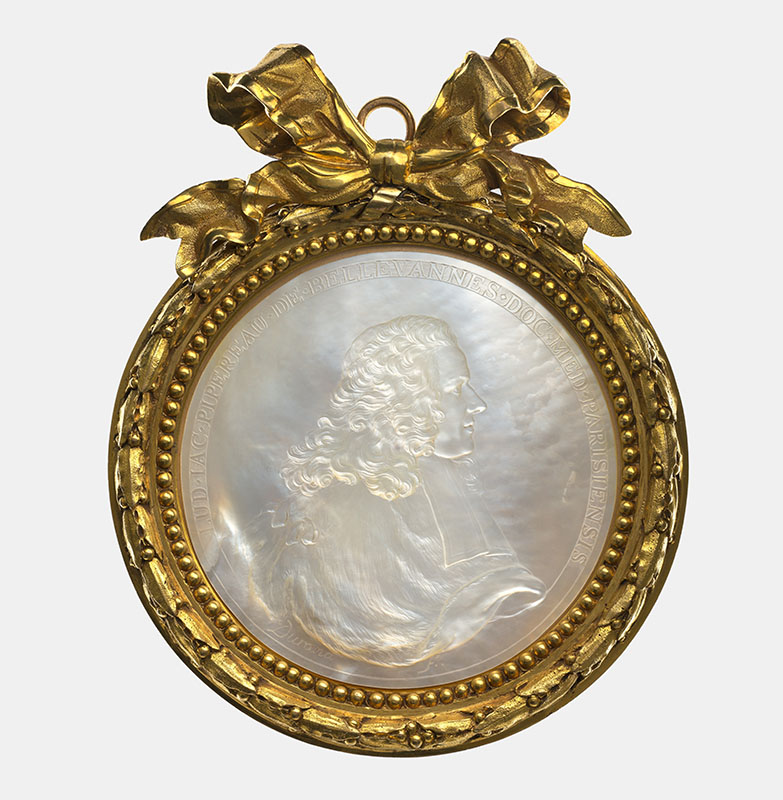
Figure 2. Pierre-Louis Durand, Portrait medallion of Louis-Jacques Pipereau de Bellevannes, 1740s, France. Mother-of-pearl and gilt bronze. The Metropolitan Museum of Art, New York, purchased by Amandine and Stephen C. Freidheim and gifted, in honor of Juliette Freidheim, 2022.331. Photo by The Metropolitan Museum of Art.
My curiosity was kindled further at the Costume Institute, where a petite brisé fan (figure 3) and a collection of nacreous buttons (figure 4) depicting mythological scenes took centre stage. The fan1—a French transliteration of Chinese figures, flora, and fauna—speaks eloquently of Otherness and Western misconception. Inscribed “CML” and with the Latin phrase “Luceo non uro (“I shine not burn”), the fan left me hungry to probe deeper into its entangled history and materiality. The rare buttons—engraved with intriguing, individual scenes highlighted with black ink—formed a small part of the vast button collection amassed by Hanna S. Kohn and donated to the Museum between 1948 and 1950. Thorough inspection of these fascinating fasteners revealed the skill that went into their fabrication. The large size, thickness, and glue residue evident on their undersides hints, perhaps, that they were meant for display, not clothing. Could they have been intended as display pieces for a button maker advertising his wares?
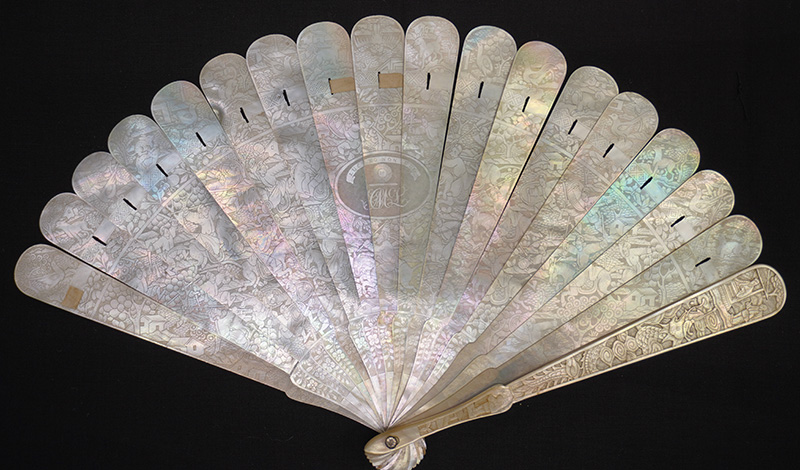
Figure 3. Unknown French maker, Brisé fan, 18th century, France. Mother-of-pearl. The Metropolitan Museum of Art, New York, gift of Miss Margaret H. Bronson, C.I.55.22.4. Photo by The Metropolitan Museum of Art.
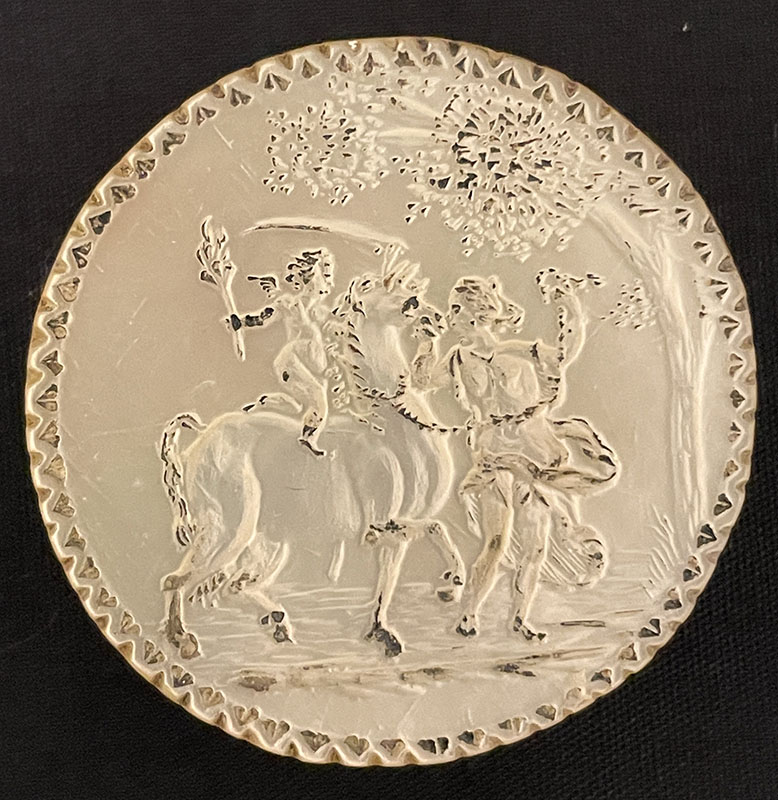
Figure 4. Unknown French maker, Button, c. 1780, France. Mother-of-pearl. The Metropolitan Museum of Art, New York, from the Hanna S. Kohn Collection, 50.231.180–.186. Photo by The Metropolitan Museum of Art.
After more research at the Cooper Hewitt Design Museum, and a visit to the newly renovated Frick Collection, my voyage of discovery took me to Bowdoin College Museum of Art, to view an extraordinary snuffbox (figure 5) portraying Cornwallis’ surrender at Yorktown, alongside archives pertaining to the Walker Sisters who owned it. With an intricate watercolour on mother-of-pearl, a beautifully turned fruitwood framework, and metal embellishment on the minutest scale, this exceptionally sophisticated object marked a fitting end to my travels, embodying the complexity and brilliance of the nacreous medium itself.
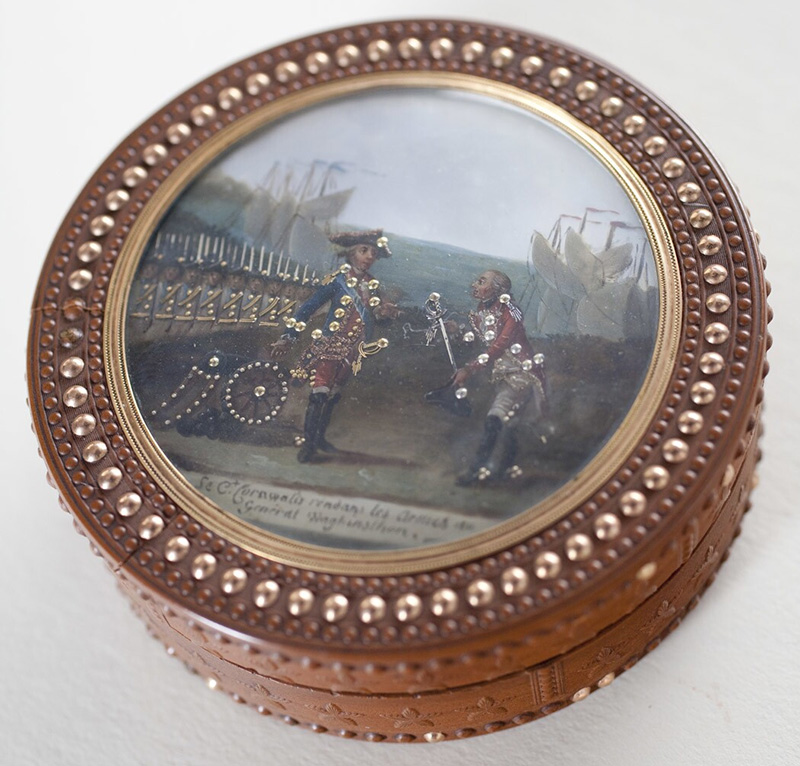
Figure 5. Unknown French maker, Snuff box, c. 1790, France. Watercolour on mother-of-pearl, tortoiseshell, fruitwood. Bowdoin College Museum of Art, Brunswick, Maine, bequest of Miss Mary Sophia Walker, 1904.78. Photo by Bowdoin College Museum of Art.
Cerebrally ignited, I returned to the UK energised about my project and most grateful for the hands-on material-led experience I had gained.
1. An authentic Far Eastern example resides at the Victoria and Albert Museum. Another was owned by the Duchesse de Berry.
Emma Piercy-Wright is a PhD Candidate in Art History and Visual Culture at the University of Exeter, funded by the Arts and Humanities Research Council via the South West and Wales Doctoral Training Partnership (SWWDTP).
About The Decorative Arts Trust Bulletin
Formerly known as the "blog,” the Bulletin features new research and scholarship, travelogues, book reviews, and museum and gallery exhibitions. The Bulletin complements The Magazine of the Decorative Arts Trust, our biannual members publication.
Click Images to Enlarge
Did you know that clicking on the images in Bulletin posts will allow you to get a closer look? Simply click on an image, and a larger version will open in a pop-up window.