






Needlework at the Turn of the Century: Technology’s Effects on 1880s–1900s Labor and Practices
by Anna Flinchbaugh
Thanks to a generous Research Grant from the Decorative Arts Trust, I was able to complete two study trips in support of my dissertation at the University of Southern California, titled “Replication, Repetition, and Historical Revisionism: Art Needlework in the United States and United Kingdom.”
In October 2025, I spent two weeks conducting research across Massachusetts, during which I visited six collections held by four institutions. In addition to providing a delightful burst of autumn foliage and crisp weather (much appreciated as a current Californian), the trip yielded research discoveries far beyond what I had anticipated. The material that I consulted provides key evidence for the second chapter of my dissertation, in which I consider the varied ways in which the process of completing embroidery could be divided around the turn of the century, with particular attention to new technologies for embroidery pattern transfer and kits sold in states of partial completion.
At Harvard’s Schlesinger Library, I focused on the papers of Amelia Muir Baldwin, an interior decorator and needlework pattern designer during the first decades of the 20th century. Her business correspondence provides useful information about the logistical and creative challenges of selling needlework kits, such as ensuring consistent thread dye lots, determining pricing for supplies, and tracking finished pieces for promotional purposes. Such intricate detail is usually absent from the records of larger pattern and kit makers but is invaluable for my argument about the complex supply chains involved in assembling embroidery kits.
Historic New England’s collection, held at a facility in Haverhill, contains examples of many different embroidery pattern transfer technologies and their varied applications. I was particularly eager to consult the extensive holding of paper patterns used by Grace Isabel Berkeley, which helped to hone my thinking in two key ways. First, they demonstrated all the steps involved in producing a pricked-and-pounced pattern, a process for which descriptions are abundant but extant material evidence is scanty. Second, they showed that even “low-tech” methods of embroidery pattern transfer were highly modular and informed by an ethic of efficiency.
This balancing act between the period celebration of historical methods of embroidery and a concurrent insistence upon efficient, replicable production was especially pronounced in the materials of the Deerfield Society of Blue and White Needlework, which I consulted at the Deerfield Memorial Hall Museum (figure 1). The group’s founders, Margaret C. Whiting and Ellen Miller, kept notebooks detailing many aspects of their project, including time studies for several patterns. Whiting and Miller annotated sketches of their designs (figure 2) with the amount of time taken by different workers to complete the components. These written remarks provide direct evidence for my hypothesis that early-20th-century art needlework was subject to the labor organization strategies of industrialization, even as it purported to provide an aesthetic reprieve against the same.
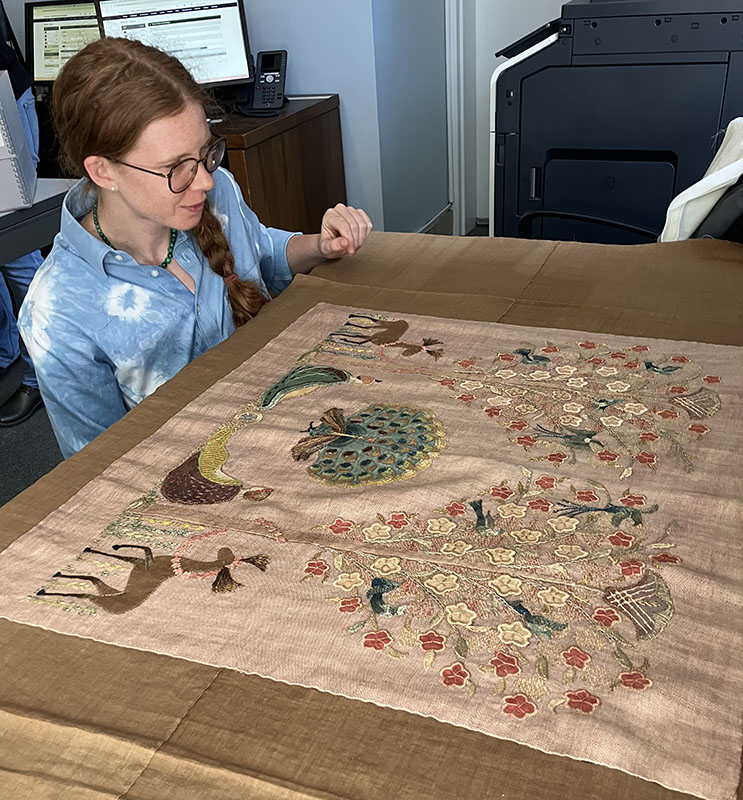
Figure 1. Anna Flinchbaugh examining “The Peacock,” an embroidered screen panel made by the Deerfield Society of Blue and White Needlework, c. 1910, Massachusetts. Deerfield Society of Blue and White Needlework, Memorial Hall Museum. Photo by Ray Radigan, October 21, 2025.
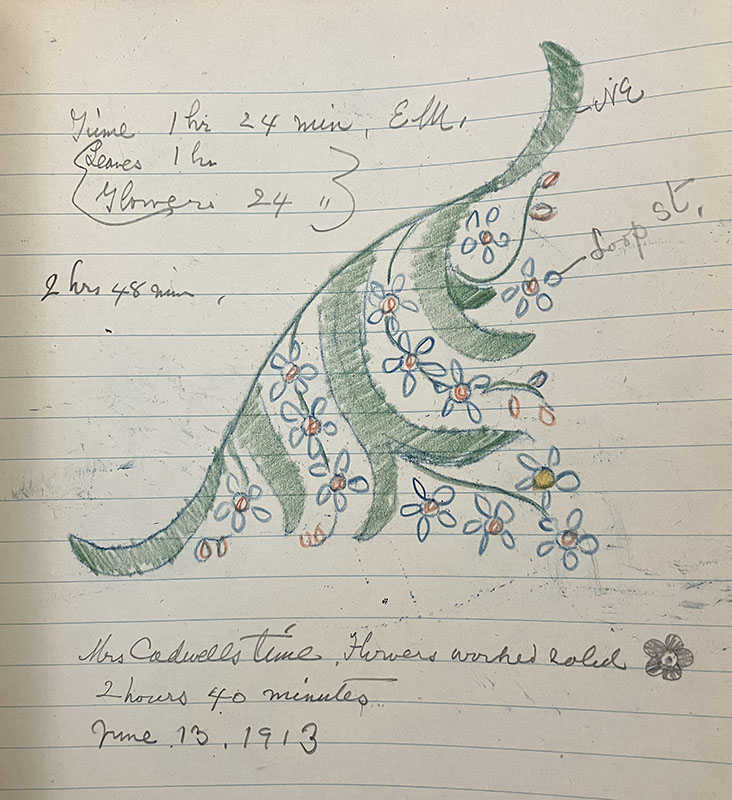
Figure 2. Page from a notebook kept by Margaret C. Whiting and Ellen Miller of the Deerfield Society of Blue and White Needlework detailing the time required to complete different components of an embroidery design, 1901, Massachusetts. Deerfield Town Papers collection, Memorial Hall Museum Library and Archives. Photo by Anna Flinchbaugh, October 22, 2025.
In April of this year, I traveled to New York for a week around the 32nd Annual Parsons / Cooper Hewitt Graduate Student Symposium, during which I shared a presentation of my research. While visiting The Metropolitan Museum of Art’s Antoni Ratti Textile Study Center and the Cooper Hewitt, Smithsonian Design Museum’s Drue Heinz Study Center for Drawings and Prints I accessed key materials for the first and third chapters of my dissertation.
At the Metropolitan Museum of Art’s Antoni Ratti Textile Study Center, I consulted several textiles produced by the design firm Associated Artists under the auspices of Candace Wheeler (figure 3). This organization played a key role in expanding the possibilities of art needlework as a decorative medium around the turn of the 20th century through strong design sensibilities and innovative materials and techniques. Wheeler’s Associated Artists serve as one of the key case studies for the third chapter of my dissertation, which considers how narratives of national history and natural history intersect through intentional selection of materials for turn-of-the-century embroidery. Before examining the pieces in person, I had not appreciated how many different materials—especially different metals—Wheeler incorporated into Associated Artists’ textiles (figure 4). Seeing these works in person affirmed my hypothesis that close attention to materials can help to articulate the political stakes of art needlework pieces.
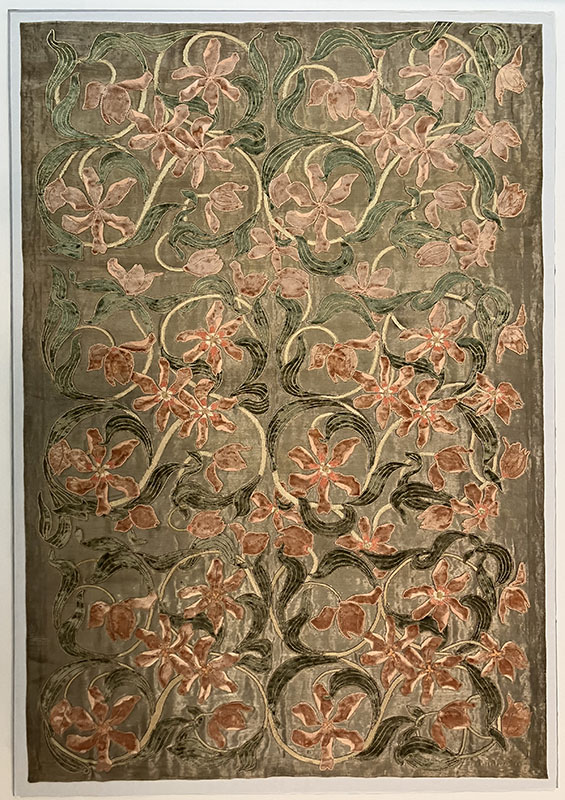
Figure 3. Candace Wheeler and the Associated Artists, unfinished “tulips panel,” 1883–87, New York. Silk and metallic cloth appliqued with silk velvet and embroidered with silk and metallic-wrapped cotton threads. The Metropolitan Museum of Art. Photo by Anna Flinchbaugh, April 13, 2025.
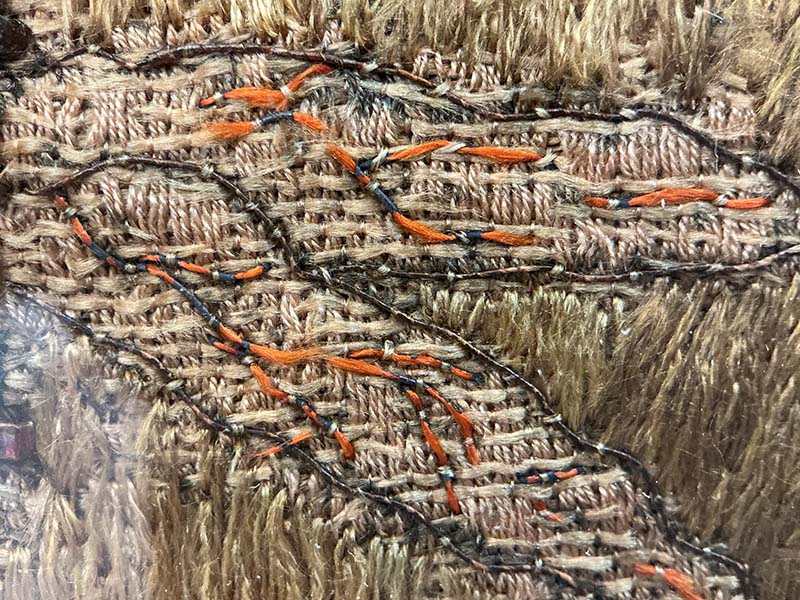
Figure 4. Candace Wheeler and the Associated Artists, detail of “irises panel” showing metallic wrapping around orange thread, 1883, New York. Silk embroidered with silk and metallic-wrapped cotton threads, metal sequins, and cut-glass beads. The Metropolitan Museum of Art. Photo by Michelle McVicker, April 13, 2025.
At the Ratti, I was also fortunate enough to consult Penelope Unraveling Her Work at Night, the only known surviving example of so-called needlewoven tapestry produced by the Associated Artists. The work is one of the key examples in the first chapter of my dissertation, which traces the appearance of the mythological figure of Penelope in materials relating to turn-of-the-century embroidery. Needlewoven tapestry was a technique invented and trademarked by Candace Wheeler. For this technique, Wheeler worked with a silk manufacturer to produce a ground fabric with particularly loose weft threads; the embroiderers at Associated Artists then wove the image into this surface. Wheeler’s innovation was thus formed through the intersection of commercial manufacturing and skilled hand work, further demonstrating art needlework’s complex relationship with industrialization. The finished tapestries were exceptionally luminous, but also very fragile. Their unplied weft threads were susceptible to snagging, tearing, and falling out of alignment. The Met’s Penelope exemplifies and illustrates the scholarly challenges associated with the relative ephemerality of embroidery. Examining the piece in person allowed me to better understand the labor-intensive technique, its lustrous results, and the way in which it fell apart.
The materials that I consulted at Cooper Hewitt included patterns and advertisements produced in continental Europe for both embroidered goods and embroidery tools. These materials helped me to gain a broader sense of how art needlework was discussed and promoted between the 1870s and 1930s. Consulting these documents should also help me hone my sense of what is particular about art needlework in the United States and United Kingdom.
Studying these materials in person both confirmed existing theories and opened up new avenues for inquiry. I am tremendously grateful for the Decorative Arts Trust’s support in making this research possible.
Anna Flinchbaugh is a PhD Candidate in the Department of Art History at the University of Southern California.
About The Decorative Arts Trust Bulletin
Formerly known as the "blog,” the Bulletin features new research and scholarship, travelogues, book reviews, and museum and gallery exhibitions. The Bulletin complements The Magazine of the Decorative Arts Trust, our biannual members publication.
Click Images to Enlarge
Did you know that clicking on the images in Bulletin posts will allow you to get a closer look? Simply click on an image, and a larger version will open in a pop-up window.