






A Revolutionary and Remarkable Exploration of Boston
To continue our commemoration of the United States Semiquincentennial, the Decorative Arts Trust members gathered in Boston, touted as the birthplace of the American Revolution. The Fall 2026 Symposium explored influential and inspiring sites of this renowned region, led by decorative arts experts and welcomed by gracious residents.
Lincoln and Concord
An Optional Pre-Symposium Tour on Tuesday, September 15 took us to the towns of Lincoln and Concord, MA, whose names conjure images of Colonial bravery. The Codman Estate, a two-story Georgian mansion house built between 1735 and 1741 by Lincoln founder Chambers Russell, was the first stop of the day. The house later passed to the Codman family and features late 19th-century interiors created by the celebrated designer Ogden Codman, Jr. Leaping forward a few hundred years, we visited Gropius House, designed in 1938 by Walter Gropius, the founder of the Bauhaus School. Turning to Concord, the 1770 Old Manse in Concord is a Georgian clapboard house whose occupants, William Emerson and his family, witnessed the Battle of Lexington and Concord from the house. The North Bridge, within Minute Man National Historical Park in Concord, marks the first occasion on which colonial militia were ordered to fire upon British soldiers during the 1775 conflict. The esteemed Concord Museum hosted us for lunch and tours of the April 19 Galleries, Thoreau Collection, and Decorative Arts Collection. To conclude the day’s adventures, members were honored to visit the private collections of Anna and Neil Rasmussen at the Stratton Taverns and Ed Tiedemann at the Brooks-Hayward House.

Codman Estate.

Gropius House.
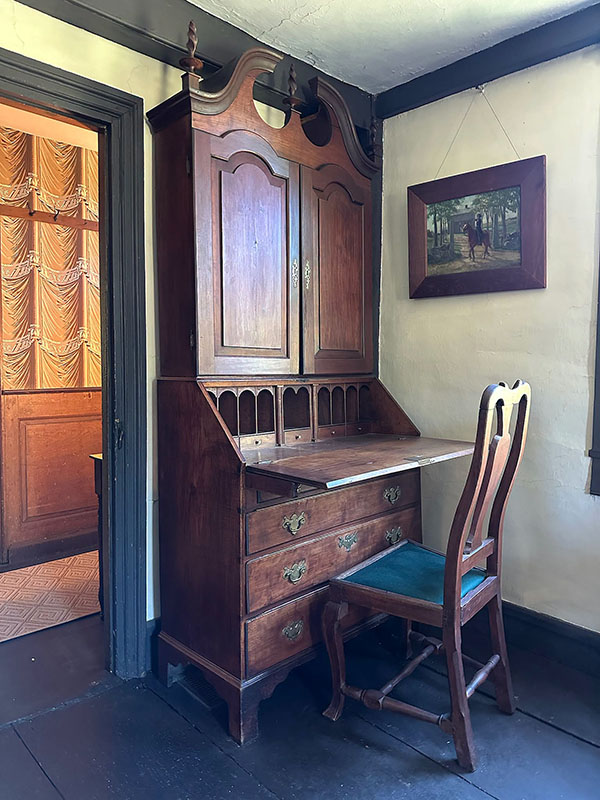
The Old Manse.
We couldn’t visit this region of Massachusetts without exploring standout sites in Cambridge and Waltham, which we accomplished during a Pre-Tour on Wednesday, September 16. Our morning included a walking tour of Cambridge featuring Harvard Yard, as well as a visit to the Longfellow House, a Georgian mansion built in 1759 for John Vassall, and which George Washington occupied from July 1775 to April 1776. After lunch, we traveled to the Harvard Art Museums, which brings together the collections of the Fogg, Busch-Reisinger, and Arthur M. Sackler Museums and encompasses more than 250,000 works. We enjoyed curator-led tours of the European and American galleries, as well as the exhibition On Location: Drawing the Outdoors. In nearby Waltham, Gore Place was purchased by Christopher and Rebecca Gore in 1786, who built a carriage house in 1793 and a Federal-style brick mansion in 1806. An evening reception at the lovely site was the perfect conclusion to an exquisite day.
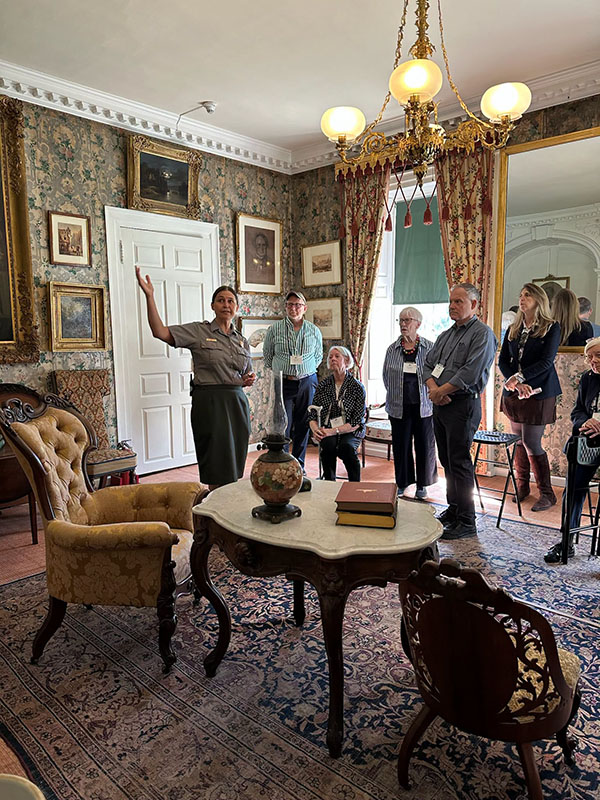
Longfellow House.

Harvard Art Museums, 1750–70 Massachusetts bombé secretary desk.
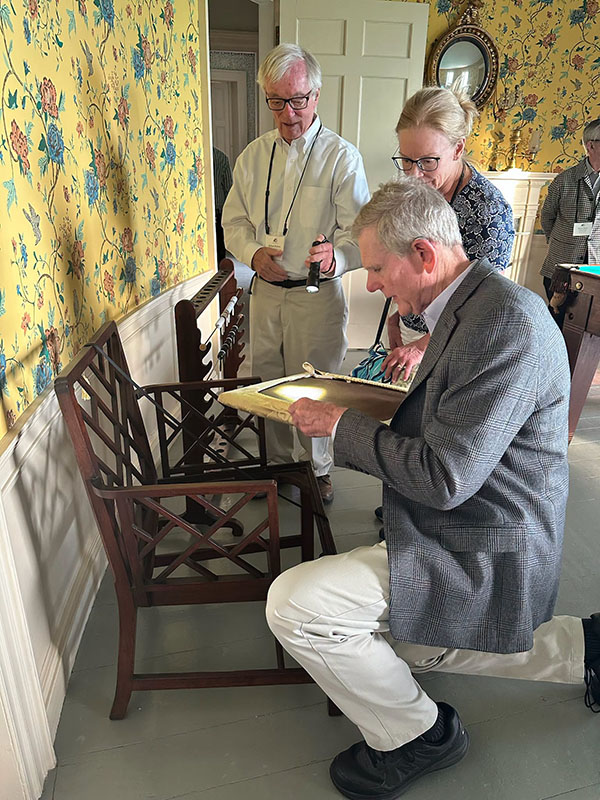
Brock Jobe at Gore Place.
The South Shore region was the focus of the third Pre-Tour, on Thursday, September 17. Seaside Quincy, MA, features the Adams National Historical Park, home to the birthplaces of two presidents: John Adams and his son, John Quincy Adams. The “Old House” was built in 1731, and the Stone Library was built in 1870 by Charles Francis Adams to house John Adams’s extensive book collection. The Josiah Quincy House was constructed by the namesake Revolutionary leader Josiah Quincy in 1770. Continuing to Milton, MA, members enjoyed a delightful meal and tours of the Eustis Estate, a William Ralph Emerson masterpiece built in 1878 for newlyweds William Ellery Channing Eustis and Edith Hemenway Eustis. As the afternoon wound down, we prepared for the opening of the main Symposium back in Boston.
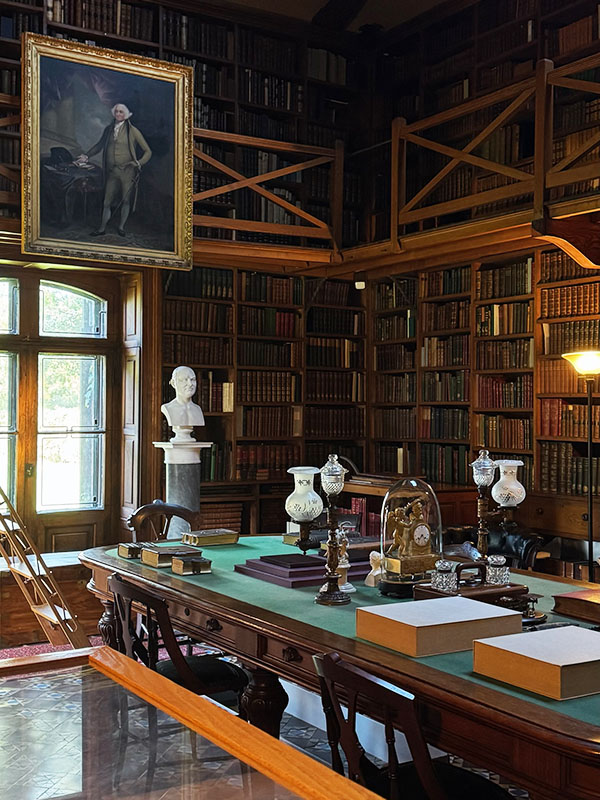
Adams National Historical Park, Stone Library.
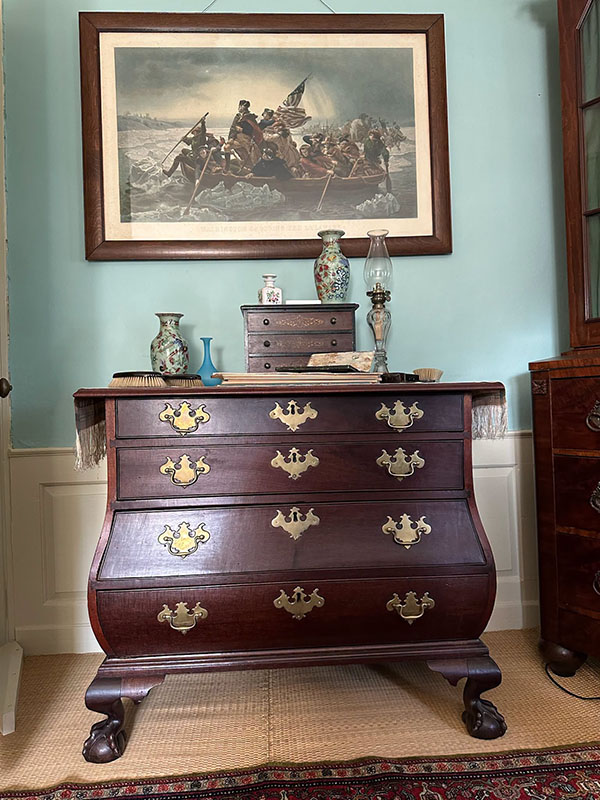
Josiah Quincy House.

Eustis Estate.
The Symposium kicked off at Boston Park Plaza, where Decorative Arts Trust Executive Director Matthew A. Thurlow and Board President Margaret Pritchard welcomed the group. Brock Jobe shared a nostalgic memoriam to Past President Jonathan L. Fairbanks, which was appropriately followed by the Jonathan L. Fairbanks Lecture: From Stuff to Story: Uncovering Boston’s Past Through Material Culture by Joe Bagley, City Archaeologist and Director of Archaeology for the City of Boston. A convivial reception followed at American Ancestors, generously supported by Brunk Auctions.
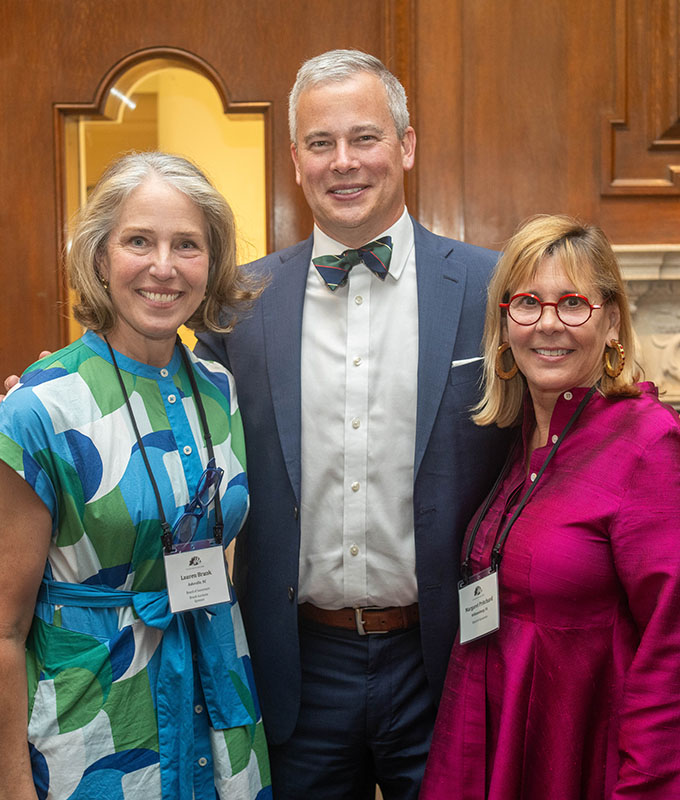
Lauren Brunk, Matthew Thurlow, and Margaret Pritchard.

Brock Jobe discussing an 18th-century easy chair at American Ancestors.

Matthew Thurlow with Dewey Lee Curtis Symposium Scholarship recipients Isabella Galdone and Eden Sherrod.
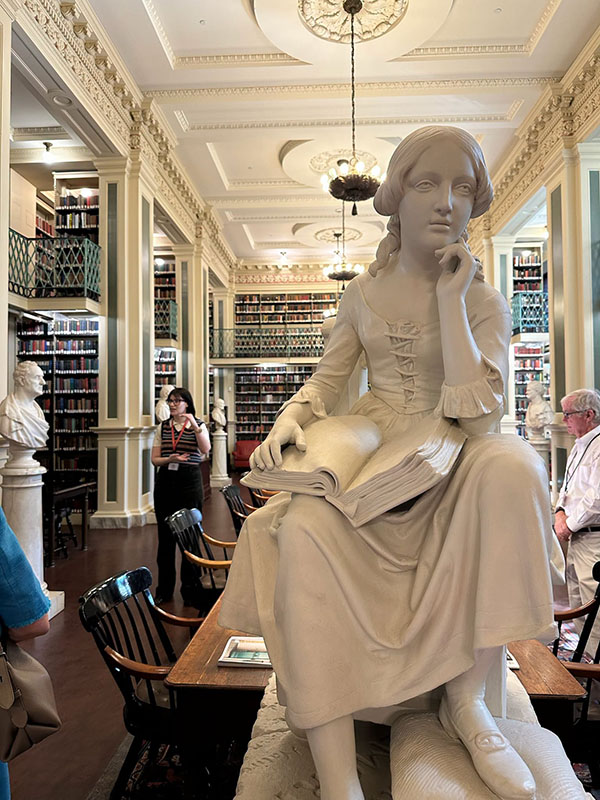
Boston Athenaeum.

Gregg Porter in the Museum of Fine Arts, Boston Conservation Lab.

Nonie Gadsden at the Museum of Fine Arts, Boston.
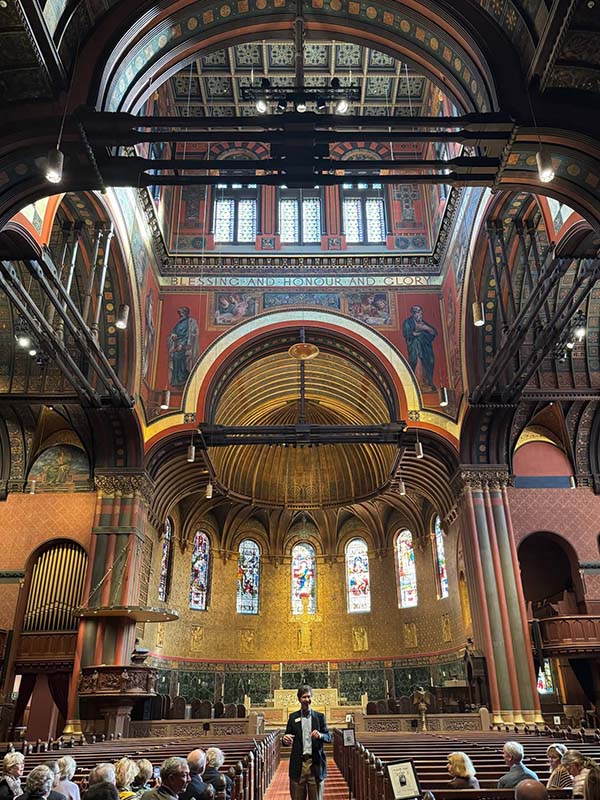
Trinity Church.

Massachusetts Historical Society.

Gibson House.
The final morning of the Symposium featured four lectures illuminating Boston material culture. Erica Hirshler, the Croll Senior Curator of American Paintings at the Museum of Fine Arts, Boston, presented Echoing the Past: John Singer Sargent and 18th-Century Portraiture. The Marie Zimmermann Emerging Scholar Lecture was A Total Work of Art: The “Ideal Work” of Mary Lizzie Macomber, 1880–1916 by Fiona Owens, a PhD Candidate at Case Western Reserve University. Hailey Robbins, Curator at the Gibson House Museum and Site Manager at the Royall House and Slave Quarters, gave the John A.H. Sweeney Emerging Scholar Lecture, A Sign of the Times: Frankie Bunyard and Carving Boston’s Revitalization, 1952–1993. Brock Jobe, Professor Emeritus of American Decorative Arts at Winterthur Museum, Garden & Library, closed the program with the talk A Boston Masterpiece: Benjamin Frothingham’s Bombe Desk and Bookcase. This quartet of impressive presentations put an exclamation point on the conclusion of another successful Symposium.
Isabella Stewart Gardner Museum
An Optional Post-Symposium Tour and lunch on the afternoon of Sunday, September 21, guided members through the Isabella Stewart Gardner Museum, renowned for its namesake’s collection that encompasses antiquities, paintings, sculpture, furniture, textiles, metalwork, books and manuscripts, and works on paper, as well as a lush garden courtyard reminiscent of a Venetian palazzo.

Isabella Stewart Gardner Museum.

Isabella Stewart Gardner Museum.
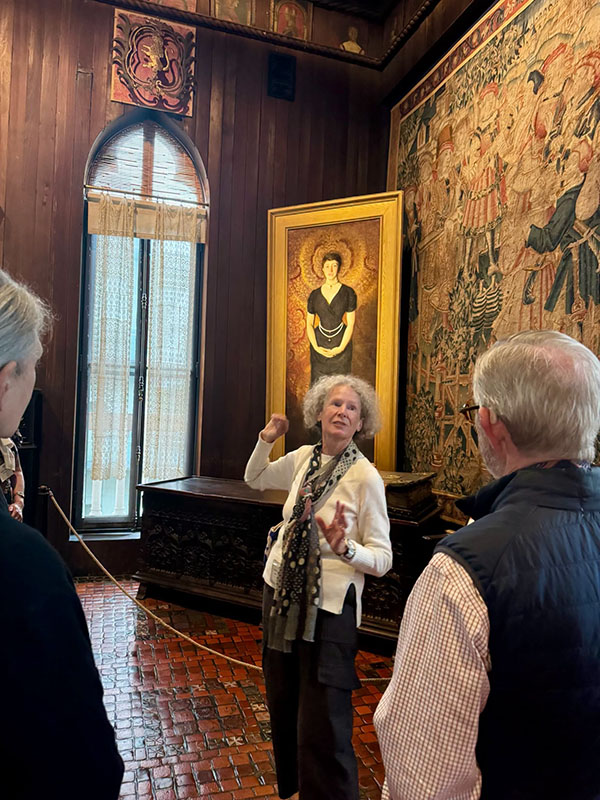
Isabella Stewart Gardner Museum.
About The Decorative Arts Trust Bulletin
Formerly known as the "blog,” the Bulletin features new research and scholarship, travelogues, book reviews, and museum and gallery exhibitions. The Bulletin complements The Magazine of the Decorative Arts Trust, our biannual members publication.
Click Images to Enlarge
Did you know that clicking on the images in Bulletin posts will allow you to get a closer look? Simply click on an image, and a larger version will open in a pop-up window.