






Developing Neoclassicism in Mexico
by Rebecca Yuste
In 1791, the Valencian sculptor Manuel Tolsá arrived in Mexico City, bringing with him books, instruments, and over 60 crates of plaster casts (figures 1 and 2) destined for the newly founded Royal Academy of San Carlos. The casts, the focus of my dissertation research, were intended to establish a canon of Classical forms to train colonial artists in the aesthetics of Western Europe; to cultivate buen gusto; and to correct the excesses of the exuberant, expressive churrigueresque, a florid Baroque style. Drawn from collections in Spain, France, and Italy, these sculptures represented the pinnacle of artistic achievement in the eyes of Spanish administrators and academicians: the Laocöon, the Apollo Belvedere, the Medici Venus, Castor and Polux, Spinario, and the Gaddi Torso (figure 1), among many others. Thanks to a Decorative Arts Trust Research Grant, I traveled to Mexico City to examine both the plaster cast collection at the Academy of San Carlos and the corresponding archival records, today held by the National Autonomous University of Mexico (UNAM).
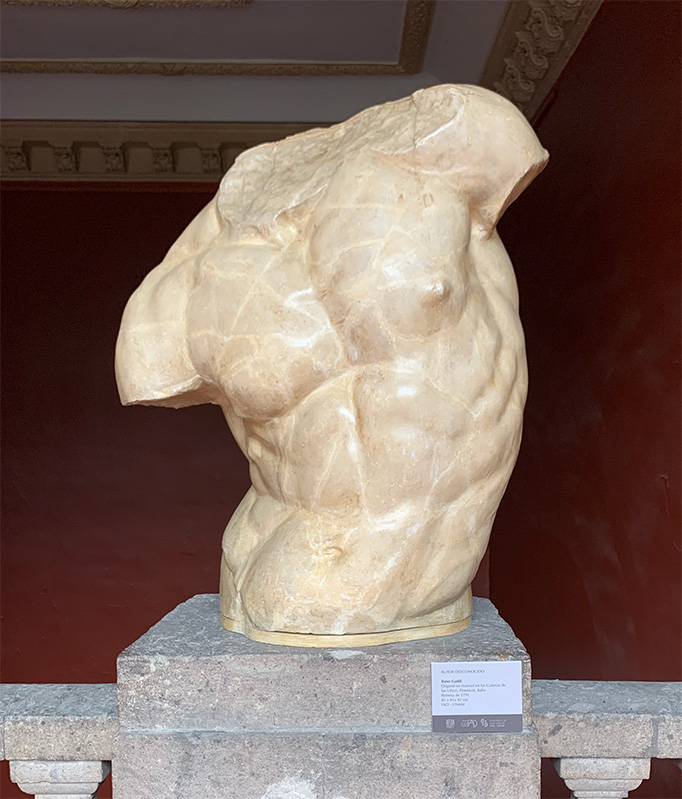
Figure 1. Gaddi torso, c. 1790. Plaster cast. Academia de San Carlos, UNAM, Mexico City. Photo by author.
One of the central hurdles the young academy faced—a problem which would define the institution well into the 20th century—was the ability to educate artists in the Classical tradition without the possibility of learning from antique examples. Although books, models, prints, and plaster casts could be imported into Mexico City, there were no extant Classical ruins to study. The task at hand, then, was how to mount an art academy from scratch, how to export Classical aesthetics and taste to a visual landscape defined, as contemporary scholars like Paul Niell argue, by hybridity.1
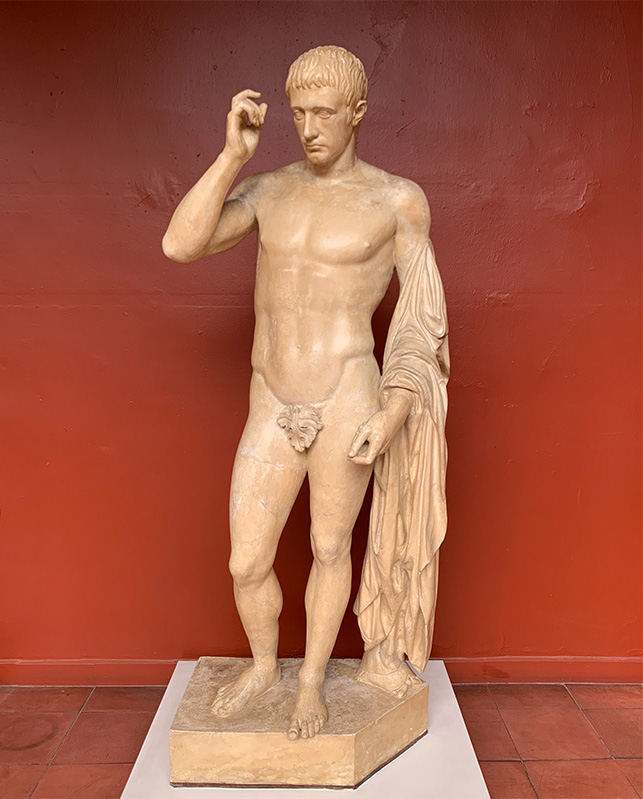
Figure 2. Germanicus, c. 1790. Plaster cast. Academia de San Carlos, UNAM, Mexico City. Photo by author.
The cultivation of taste, of buen gusto, through plaster casts was paramount to the task of educating young artists, alongside their technical training in drawing, engraving, and sculpture. As “apostles of good taste,” as Diderot famously described them, these plaster casts thus served to more tightly integrate Novohispanic artists into the cultural practices of Western modernity, bringing them closer, ideologically and aesthetically, to sister academies in Europe, like those in Madrid, Paris, and London.2 For those who studied and imitated the ancients, as the painter Antón Raphael Mengs argued, following his friend and colleague Johann Joachim Winckelmann, “would no doubt achieve el Buen Gusto.”3
Once in Mexico City, casts like the Germanicus (figure 2) occupied a central role in the educational course of study at the Real Academia de San Carlos. Like in European academies, students began by copying prints and drawings, before moving on to plaster casts, and eventually life drawing. Hundreds of student drawings of the cast collection, which was actively used by the academy into the 20th century, survive into the present.4 Through the repeated act of copying, these casts became instruments through which a new Neoclassical ideal travelled to the American continent.
The reliance on plaster casts and other imported models, however, underscores the fragility of a constructed Classical style in this ultramarine context. The plaster casts, carefully packed by José Panucci in Madrid (figure 3), shattered during their transatlantic journey. The Classical body had to be reassembled once it made landfall in America. Their introduction also coincided with the rediscovery of two monumental pre-contact sculptures: the Sun Stone and the Coatlicue, unearthed a few city blocks away from the San Carlos academy in the Zócalo, destabilizing what antiquity meant for 18th-century residents of New Spain.
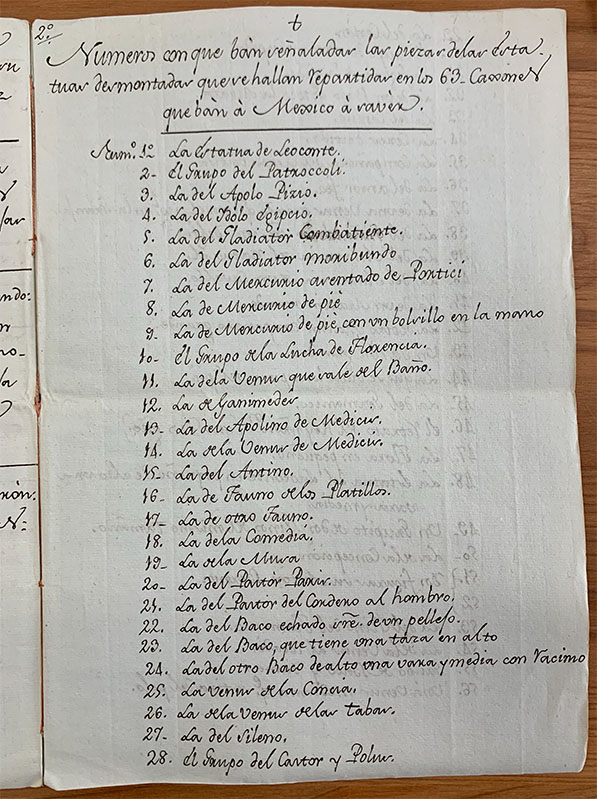
Figure 3. The numbers which indicate the pieces of the disassembled statues that are distributed among the 63 crates being sent to Mexico, c. 1790. Ink on paper. Archivo General de Indias, Seville, Indiferente 103. Photo by author.
The study of these plaster casts—in physical form in Mexico and through archival documents in Seville—thus offers an opportunity to complicate our understanding of the afterlives of Classical sculpture. It raises fundamental questions about what it means to import style, how artistic canons function across different cultural and geographic contexts, and how Classicism travels and takes root in new environments, ones with archaeological traditions of their own.
1. See, for example Paul Niell, “Neoclassical Architecture in Spanish Colonial America: A Negotiated Modernity,” History Compass 12, no. 3 (2014): 252–62.
2. Denis Diderot made the remark in his 1763 essay “Observations sur la sculpture et sur Bouchardon.” For more information, a translation of the passage, and a complete bibliography, see Eckart Marchand, “Apostles of Good Taste? The use and perception of plaster casts in the Enlightenment,” Journal of Art Historiography no. 25 (December 2021): 1-16.
3. Original: “Quien trabaje con la cabeza y con las manos, y reflexione sériamente sobre ellos, llegará sin duda á conseguir el buen Gusto.” Antón Rafael Mengs, “Cotejo del Gusto de los Antiguos con el de los Modernos,” in Obras de D. Antonio Rafael Mengs, Primer Pintor de Camara del Rey, ed. Joseph Nicolás de Azara (Madrid: Imprenta Real de La Gazeta, 1780), 55.
4. For more information on the history of the cast collection in the nineteenth century, see Clara Bargellini and Elizabeth Fuentes, Guía que permite captar lo bello: yesos y dibujos de la Academia de San Carlos, 1778-1916 (Mexico City: Instituto de Investigaciones Estéticas, UNAM, 1989).
Rebecca Yuste earned her PhD in Art History and Archaeology from Columbia University in 2026. Starting in the fall, she will serve as the 2026–2027 Frances A. Yates Curatorial Fellow at the Warburg Institute, London, and will be a post-doc at the Warburg this fall. In conjunction with this project, she founded the Global Neoclassicism Project.
About The Decorative Arts Trust Bulletin
Formerly known as the "blog,” the Bulletin features new research and scholarship, travelogues, book reviews, and museum and gallery exhibitions. The Bulletin complements The Magazine of the Decorative Arts Trust, our biannual members publication.
Click Images to Enlarge
Did you know that clicking on the images in Bulletin posts will allow you to get a closer look? Simply click on an image, and a larger version will open in a pop-up window.