






Transfer-Printed Japonisme: A New Look at the Rousseau Service
by Sarah Rapoport
With the generous support of a Decorative Arts Trust Research Grant, I embarked upon a week of research in Paris. My trip centered around the so-called “Rousseau” service (figure 1), a transfer-printed ceramic table service commissioned by Eugène Rousseau, featuring motifs drawn from Japanese prints and translated into etchings by the printmaker Félix Bracquemond. When it debuted at the 1867 Exposition Universelle, critics celebrated its modern appearance, enabled by the combination of Japanese motifs and Bracquemond’s creative use of transfer printing. The Rousseau service is the opening case study of my dissertation, which offers the first critical account of how industrialization shaped the development of Japonisme across the fine and decorative arts. This project examines a group of artists, designers, and critics who turned to Japanese craft models to grapple with the technologies, problems, and aesthetic possibilities of industrial manufacture. During visits to the Bibliothèque nationale de France (BnF), the Musée d’Orsay, the Musée des Arts Décoratifs, and even to Parisian antique stores, I accessed collections and archives that lend new insight into the service’s connections to 19th-century design reform.
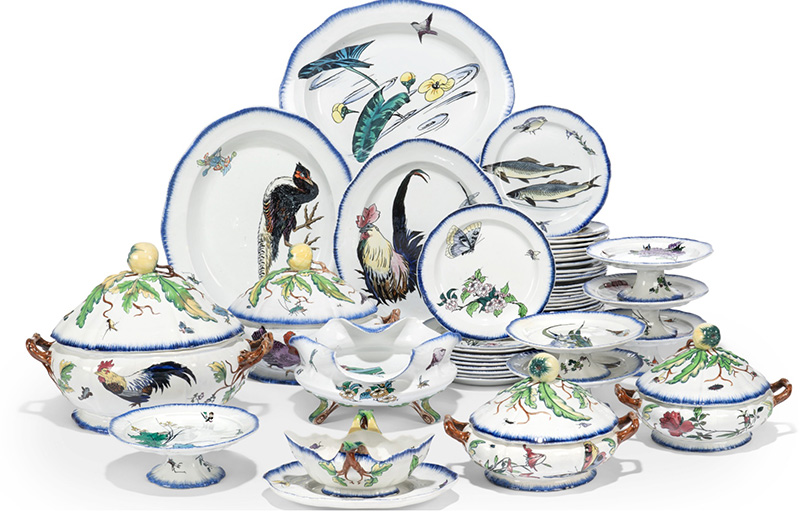
Figure 1. Félix Bracquemond (designer) for Eugène Rousseau, various manufacturers (Lebeuf, Milliet & Cie.; Barluet & Cie; E. Léveillé; Toy; Toy et Léveillé), ‘Rousseau’ Service, designed 1866. Transfer-printed earthenware with hand painting in colored enamel. Christie’s, London, Auction 24667, Lot 105. Photo by Gavin Macdonald.
My week began at the BnF, where I examined a genre of Japanese woodcuts rarely considered in histories of Japonisme: Katsushika Hokusai’s pattern books for craftsmen (figure 2). The three-volume set, Imayō sekkin hinagata (Modern Designs for Combs and Tobacco Pipes), entered the collection of the BnF in 1855, where Bracquemond and his interlocutor, the critic and design reformer Philippe Burty, may have examined it. In studying the patterns myself, I noted a strong resonance between the innovative use of transfer printing in the Rousseau service, in which single motifs could be applied across a variety of forms (plates, tureens, teacups, etc.), and Hokusai’s application of his own motifs to different decorative objects.
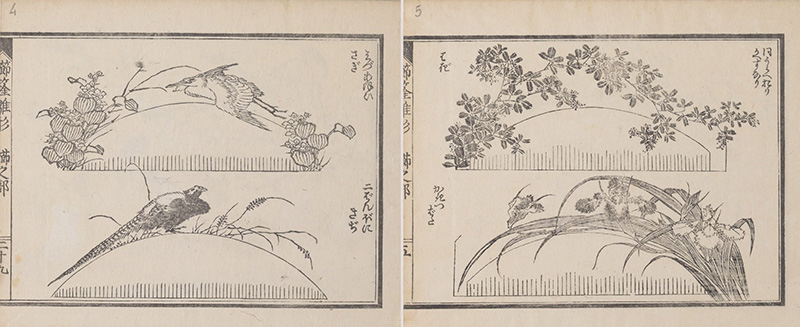
Figure 2. Katsushika Hokusai, two pages from 𝘔𝘰𝘥𝘦𝘳𝘯 𝘋𝘦𝘴𝘪𝘨𝘯𝘴 𝘧𝘰𝘳 𝘊𝘰𝘮𝘣𝘴 𝘢𝘯𝘥 𝘛𝘰𝘣𝘢𝘤𝘤𝘰 𝘗𝘪𝘱𝘦𝘴 (𝘐𝘮𝘢𝘺𝘰 𝘴𝘦𝘬𝘬𝘪𝘯 𝘩𝘪𝘯𝘢𝘨𝘢𝘵𝘢), 1823. 3 volumes of woodblock prints. Bibliothèque nationale de France, Départment de manuscrits, Japonais 349.
At the BnF, I was also able to look through a box of letters written to Burty, all pertaining to ceramics. I was particularly excited to see a letter from Bracquemond himself, in which he describes international developments in ceramic production and notes that Minton had copied his designs with their Naturalist service. This long history of industrial exchange between England and France is subtly registered by the ceramic bodies themselves, as the faïence fine produced by the Creil-Montereau manufactories was produced to emulate and compete with Wedgwood’s innovative creamware.1 The cobalt shell-edge decoration likewise reflects the influence of English ceramics on late-18th-century French decorative styles. Despite Japonisme’s apparent cosmopolitanism, the Rousseau service highlights the entanglements between modern aesthetic developments and the dynamics of transnational industrial competition.
In the offsite reserves of MAD, I examined a collection of Rousseau service pieces. As museums typically only provide images of one or two sides of these objects, this was an invaluable opportunity to examine and photograph each object in the round. Looking beyond institutional collections later in the week, I was able to photograph additional examples at an antiques store, Au Bain Marie. These photographs allow me to make comparisons across collections, objects, and individual motifs (figure 3), showing how the same motif recurs in new guises. Comparisons demonstrate that Bracquemond’s unique system of design rarely resulted in two identical objects, revealing an unexpected vision of industrial production not as infinite replication, but rather as infinite permutation.
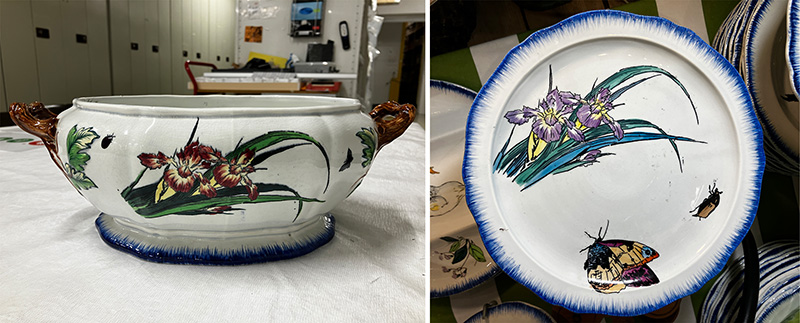
Figure 3. Comparison across collections: a tureen from the Rousseau service in MAD’s offsite storage facility and a cake platter at Au Bain Marie in Saint-Germain. The comparison demonstrates how the same iris motif is used across different types of objects and further varied through coloring, arrangement, and juxtaposition with other motifs.
Several afternoons spent in MAD’s archives helped ground these observations in the context of debates in the 1860s about the possibilities of industrial production and yielded the most thrilling discovery of the trip. Looking through boxes related to the Union centrale des beaux-arts appliqués à l’industrie (a coalition of design reformers of which Eugène Rousseau was a founding member), I identified a document from 1865 referencing a Union centrale competition for a ceramic table service, the parameters of which closely mirror the design of the Rousseau service.2 The design had to be durable and affordable, created “in common pottery” such as faïence, and had to balance good design with economical production. The competition encouraged the use of transfer printing as a technology that could make well-designed objects more accessible to consumers, but with the caveat that “the mechanical aspect should be disguised as much as possible.” The technological challenge issued by the Union centrale thus asks whether economical design necessitates uniform replication. Can we see the Rousseau service as an embodiment of this ambition to rethink the possibilities of industrial production? And could 1865 provide another starting point for Japonisme, locating aesthetic innovations in relation to technological debates? Such questions are at the heart of my dissertation.
During my time in Paris, I continued to think about how Japanese prints fit into debates about modern manufacture. At the BnF’s Department of Prints, I examined a complete set of Bracquemond’s designs for the service. In the archives of the Musée d’Orsay, I examined a collection of counterproofs made for transferring images during the production of the Rousseau service. Seeing these prints in person gave me a striking sense of their materiality as paper objects, rather than simply as two-dimensional images. In the historiography of 19th-century French art, Japanese prints are often associated with a modern pictorial vocabulary of flatness and color. Yet Bracquemond’s own design system, which entailed the cutting, burning, and ultimate destruction of these sheets, engaged print as a distinctly material object. Such an approach, which reorients our attention towards the very making of objects, prompts us to rethink assumptions that Japonisme was a movement primarily occupied with visual form. Traces of this production-oriented Japonisme reverberate throughout the archives A ledger of loans (figure 4), for example, indicates that Burty lent numerous albums of Japanese prints to the Union centrale’s 1865 Musée retrospectif, a display of historical art intended to offer inspiration to French designers.
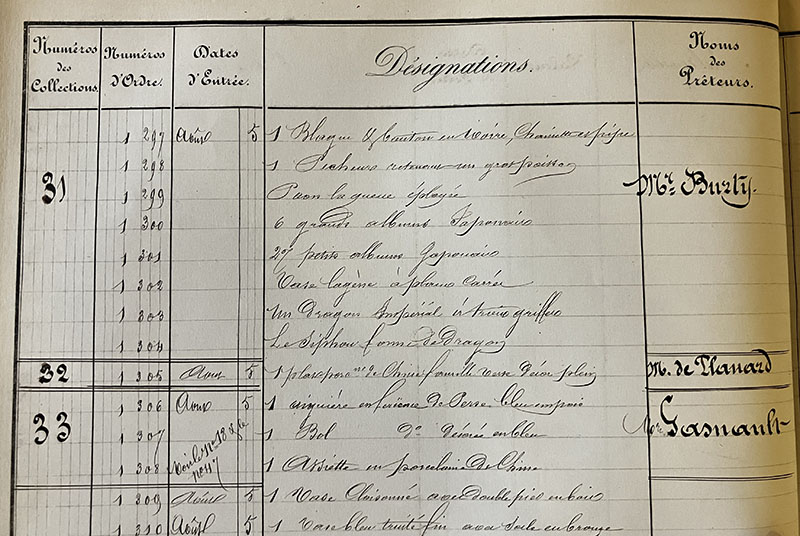
Figure 4. Union Centrale des Beaux-Arts appliqués à l’industrie, 𝘙𝘦𝘨𝘪𝘴𝘵𝘳𝘺 𝘰𝘧 𝘰𝘣𝘫𝘦𝘤𝘵𝘴 𝘭𝘦𝘯𝘵 𝘵𝘰 𝘵𝘩𝘦 𝘔𝘶𝘴𝘦́𝘦 𝘳𝘦́𝘵𝘳𝘰𝘴𝘱𝘦𝘤𝘵𝘪𝘧, 1865. Archives, Musée des Arts Décoratifs, A1/69.
With the support of the Decorative Arts Trust and the enthusiastic help of curators, archivists, and antiques dealers, I have begun to recover this industrial history of Japanese prints in 19th-century France. Mapping these intersections between artistic and industrial milieux reveals an alternative conception of Japonisme not merely as a visual style, but rather as a mode of production in intimate conversation with the currents of industrial modernity.
- Scholarship often refers to the ceramic body used in the Rousseau service as “faïence,” though it may be more specifically described as “faïence fine,” as it has been catalogued by the Musée d’Orsay and the Musée des Arts Décoratifs. Faïence fine first emerged in the late-18th century in response to the popularity of Wedgwood’s creamware in France, and the manufactories of Montereau and Creil became important centers of production over the course of the nineteenth century. Like creamware, faïence fine is made of a light-colored clay and a lead-based glaze. It should not be confused with traditional French faïence, in which colored clays are concealed by an opaque tin-based glaze. For a discussion of faïence fine, its material composition, and a brief history of its English invention and French emulation, see Aimé Girard, Exposition universelle de 1867 à Paris. Rapports du jury international…Faïences fines, faïences décoratives et porcelaines tendres (Paris: Paul DuPont, 1867), 3-8.
- Union centrale des beaux-arts appliqués à l’industrie, Exposition de 1865 au Palais de l’industrie…Concours de composition d’art appliqué à l’industrie (Paris, n.d. [1864/65]), 4. Archives, Musée des Arts Décoratifs, A1/44, B.24
Sarah Rapoport is a PhD candidate in the Department of the History of Art at Yale University. She is presenting at the Decorative Arts Trust Emerging Scholars Colloquium in January 2027.
About The Decorative Arts Trust Bulletin
Formerly known as the "blog,” the Bulletin features new research and scholarship, travelogues, book reviews, and museum and gallery exhibitions. The Bulletin complements The Magazine of the Decorative Arts Trust, our biannual members publication.
Click Images to Enlarge
Did you know that clicking on the images in Bulletin posts will allow you to get a closer look? Simply click on an image, and a larger version will open in a pop-up window.