
Understanding Wyck’s Chinese Desk
Click on images to enlarge them and view captions.
by Grace Ford-Dirks and Cristina Freire
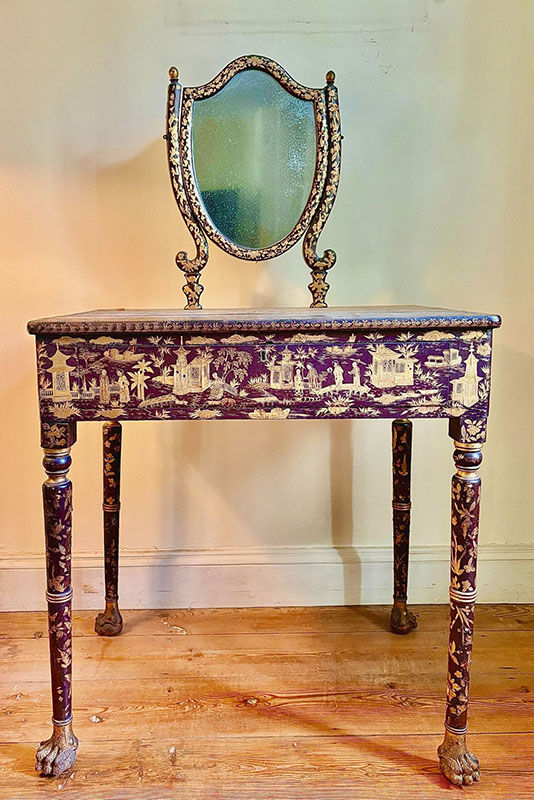
For nearly 200 years, a small Chinese writing desk (figure 1) has been the prized and lamented possession of generations of Quaker women in Philadelphia. Today, it sits in the front parlor at Wyck, the ancestral home of nine generations of the Wistar-Haines family in Germantown. Made in China between 1810 and 1830, the lacquered desk is a visual outlier whose unusual form reflects the eccentricities of multi-generational ownership and gestures to its owners’ participation in a global network of exchange. A Dean F. Failey Grant from the Decorative Arts Trust enabled Wyck staff to dig beneath the surface to interrogate the desk’s provenance and social history and begin an essential conservation treatment to ensure its longevity and stability.
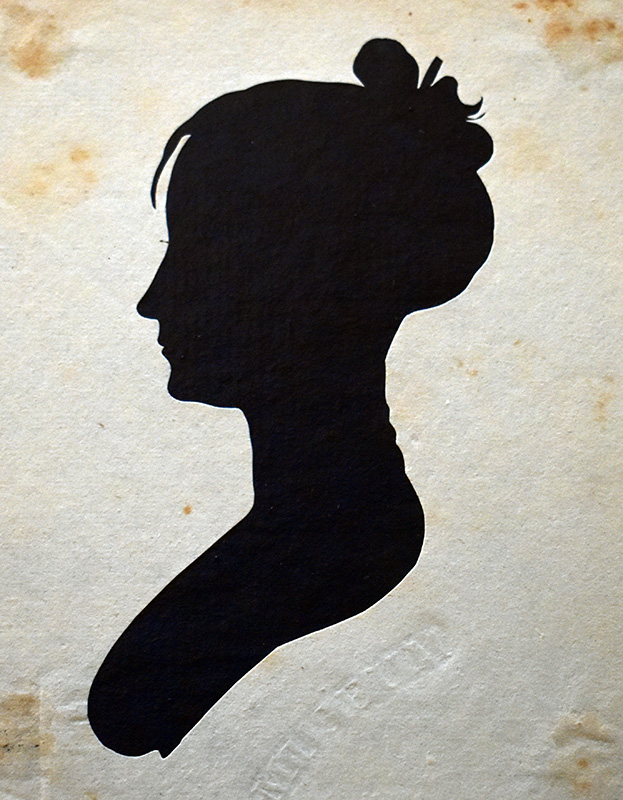
Quaker Ann Haines (1793–1869, figure 2) likely purchased the Chinese writing desk while living at Wyck. Born out of wedlock to an unknown mother and Reuben Haines II (1765–93), Ann found a welcoming home at Wyck with her cousin Reuben Haines III (1786–1831) after the untimely death of her father. She was educated at the Westtown Boarding School and lived a private, intellectual life. Ann kept detailed weather records, attended lectures at the Academy of Natural Sciences, and collected the latest scientific publications.
Ann’s curiosity and intellectual connections likely led her to visit the Chinese Museum collection when it arrived in Philadelphia. In December 1838, Quaker merchant Nathan Dunn opened the doors to this “vast and splendid Collection of Chinese Curiosities” to more than a hundred of Philadelphia’s most eminent citizens. Visitors to the museum at Ninth and Sansom Streets could be treated to a glimpse of “China in Miniature.” Contemporary accounts described the museum as a selection of rooms and vignettes filled with Chinese objects made for export, collected through Dunn’s years of international trade, including dozens of “japanned boxes, writing desks, numerous stands, and a pair of work tables.” Research suggests that Wyck’s Chinese desk was among the collection of Chinese decorative arts assembled by Dunn in Philadelphia. Although no direct correspondence has yet been discovered between the two, Haines and Dunn lived within the same close social, intellectual, and religious circles, which may have facilitated her acquisition of the desk.
The fragile desk was perhaps a surprising choice for a Quaker household that valued adaptability, reuse, and function over form. Moving the desk not long after its purchase revealed latent structural weaknesses, irritating Ann endlessly. By 1841, Ann was so frustrated by her “Chinese table” that she wished to get rid of it all together but admitted that “procrastination overruled me.” “In moving this table,” she wrote, “a leg fell out, which caused me to examine the others when I discovered… they could all be taken off without any injury,” leading her to store the desk in a closet with the legs removed.
Miraculously, the desk endured. Ann’s niece Jane Reuben Haines (1832–1911) loved the piece and specifically requested the desk during the division of Ann’s assets in 1869. She later transformed it by adding a Japanned mirror in the late 19th century and used it as a vanity. Jane bequeathed the piece to her great-niece Elizabeth Hartshorne Haines Kimber. She was careful to note its provenance, identifying it specifically as the desk that “Ann Haines bought about 1838 when the Chinese museum was established in Philadelphia by N. Dunn.” Connecting the Haines family to significant cultural events in Philadelphia was important to Jane, who proudly acted as family historian and curator of the ancestral estate at Wyck. The desk remained in the house and was included in the first museum inventory in 1973.
With the Trust’s support, Wyck contracted conservator Jonathan Stevens to restore the desk. The team elected to focus on two key areas to maximize time and resources: reinforcing the loose leg joints and stabilizing loose and flaking lacquer on the legs to enable safe handling and long-term display in high traffic public spaces. Stevens completed a deep cleaning of the desk, closely documented individual areas of concern, and began the process of reinforcing worn and faulty joinery. Stevens is in the process of consolidating flaking lacquer and filling areas of major loss.
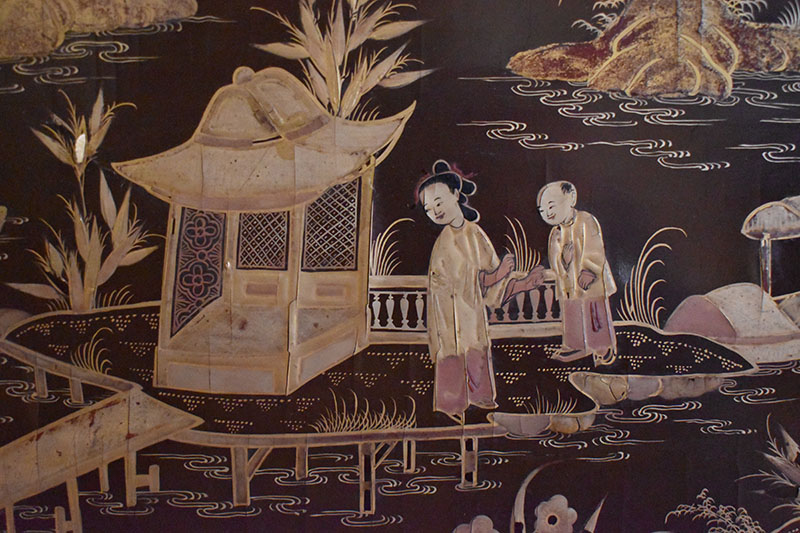
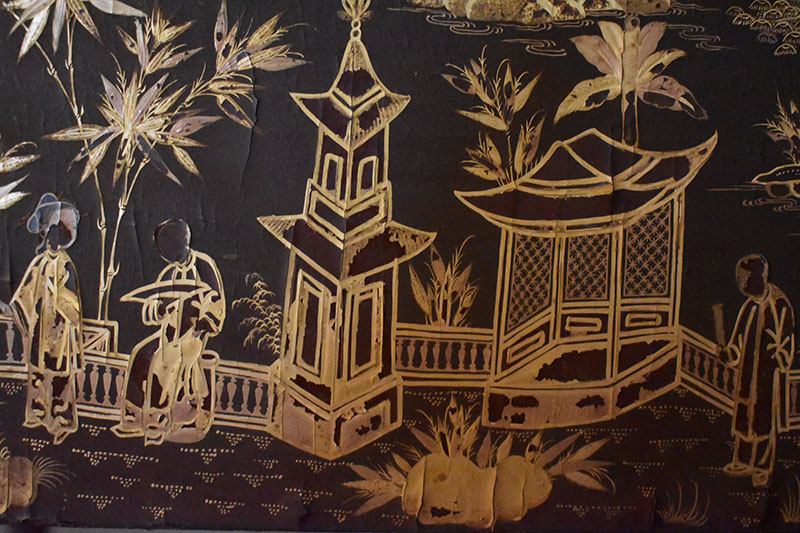
Throughout its life at Wyck, the desk has been impacted by seasonal fluctuations in temperature and relative humidity levels, which accelerated the lacquer’s deterioration. Light damage also contributed to surface degradation. For example, visible differences between the state of the lacquer on the back of the desk (figure 3), which faces the wall, and the side of the case (figure 4) show the impact of sustained light damage. A total restoration of the Wyck house exterior, with particular attention to the windows, was completed this year. The addition of new UV film on the historic glass will lower UV light and solar heat levels to better protect the desk and prolong the lacquer’s lifespan after its treatment. New light and humidity monitors are being installed on the first floor, allowing staff to better assess the long-term impact of environmental factors on the object.
Despite ongoing research into context for its construction and export, the desk itself is still a largely anonymous object. During the process of cleaning, a deep red pigment, probably vermilion, was discovered to have been added to enhance the lacquered decoration. This detail helped us identify a comparable object sold in 2005 at Sotheby’s. Chinese characters written in ink on the back of interior drawers, on the interior of the desk case, and on each of the leg tenon, reinforce the origin story that the desk was produced at scale.
In early 2026, Wyck will unveil a tour centered on the desk and other Asian export materials in the house and garden collections. The tour, accompanied by an exhibit and online companion materials, presents Wyck’s occupants as active collectors in a global marketplace of materials and ideas. The Failey Grant helped Wyck address significant, longstanding areas of damage and halt fast deterioration on the desk’s surface, allowing this important object to become a centerpiece of diverse new interpretation in the years to come.
- Will of Reuben Haines II (1794), City Archives of Philadelphia.
- Enoch Cobb Wines, A peep at China in Mr. Dunn’s Chinese collection (Philadelphia: Printed for Nathan Dunn, 1839) 2.
- Wines, A peep at China, 73; Ten Thousand Chinese Things (Philadelphia: Printed for the Proprietor [Nathan Dunn], 1839) 69.
- C.J. Wolbert & Co, and Dunn, Nathan. “Catalogue of Superior Household Furniture, Nankin and French China, Silver Plate, Elegant Engravings, &c.” (C.J. Wolbert, 1840).
- The Chinese maker likely designed the desk legs to ship disassembled from the case, and the instability referenced by Ann suggests inherent flaws in the construction or the assembly once the desk reached Philadelphia. Small tabs around the large tenon, intended to secure the leg joints in place, broke off over time. Ann Haines to Jane Bowne Haines I, August 9, 1841. American Philosophical Society, Wyck Association Collection Series II Box 25 Folder 380.
- Will of Jane R. Haines (1910), Distribution of Furniture; Jane R. Haines Estate Inventory, 1912, Wyck Association Collection, Series V Box 215 Folder 203.
- Sotheby’s, Arcade Furniture and Decorative Arts, Lot 608, 2005.
Grace Ford-Dirks is the Manager of Interpretation and Public Outreach at Wyck Historic House, Garden, and Farm. Cristina Freire was a 2025 intern at Wyck and studies history at Montclair State University. They are grateful for the additional support of the C. Dallett Hemphill Internship Grant program at the McNeil Center for Early American Studies at the University of Pennsylvania, which enabled Cristina’s 2025 internship. They also express thanks to David Barquist, Kathleen Foster, and Alexandra Kirtley, whose input in May 2024 inspired the beginning of the project.
A print version of this article was published in The Magazine of the Decorative Arts Trust, one of our most popular member benefits. Join today!