
Houston: Art and Ambition in the Bayou City
EVENTS > SYMPOSIA
SPRING SYMPOSIUM
April 14–18, 2027
OPTIONAL TOURS
GALVESTON
ROUND TOP
MID-CENTURY MODERN HOUSTON
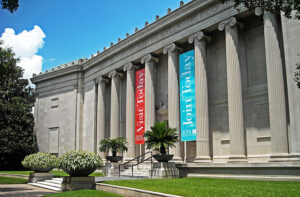
Join us in unforgettable, audacious Houston for a symposium brimming with Southern hospitality. A ramble through city streets lined with live oak and magnolias leads us to a colorful cast of private collectors, curators, and museum patrons devoted to the cultural scene along the Gulf Coast. The impact of ambition, luck, and oil fortunes is reflected across the region in the staggering collections at the Museum of Fine Arts, Houston; in the dazzling European decorative arts at Rienzi; in Ima Hogg’s celebrated American material culture collection at Bayou Bend; and in outstanding examples of Modern architecture. This adventure is not to be missed!
SYMPOSIUM ITINERARY
Thursday, April 15, 6:00 pm–9:30 pm
Welcoming Remarks and Opening Program at the Houston Grand Hotel and the Houston Public Library’s Julia Ideson Building
The Jonathan L. Fairbanks Lecture
The Architecture of Houston
Stephen Fox, Lecturer, Rice University School of Architecture
Following our opening lecture at the Houston Grand Hotel, join us for a welcome reception at the Houston Public Library’s splendid Spanish Renaissance-style Julia Ideson Building that sets the tone for our exploration of the city’s grand architecture and gracious hospitality.
Friday, April 16, 9:15 am–4:30 pm
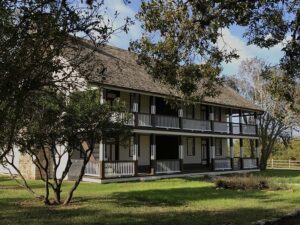
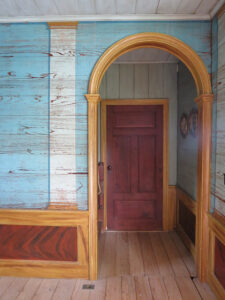
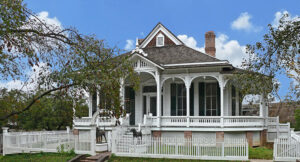
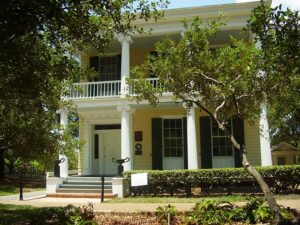
Our morning is devoted to tours of the Heritage Society at Sam Houston Park, an organization that stewards ten acres of beautiful green parkland dotted with historic properties in the heart of downtown Houston. The Kellum-Noble House is the oldest surviving building constructed in Houston and a superior example of the double-galleried Greek Revival style singular to the region. The Nichols-Rice-Cherry House was once the home of Rice University founder William Marsh Rice and stands as another excellent example of the subdued charm of Classicism. Our visit also includes the Pillot House, a petite Victorian modified for the hot summer months with full-length windows and a wrap-around porch. Each home is thoughtfully filled with an assemblage of period-appropriate furnishings and site-specific ephemera, providing unique insight into the lives of Houstonians. These sites have stood as quiet sentinels observing the phenomenal growth of Houston for more than a century, offering us a unique opportunity to step into the city’s past.
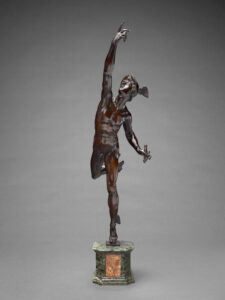
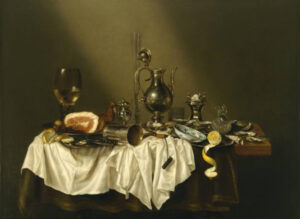
Following lunch at the Heritage Society, we depart to the Museum of Fine Arts, Houston (MFAH) for an afternoon of curator-led tours exploring encyclopedic exhibit spaces. Christine Gervais, Fredricka Crain Director of Rienzi and Curator for Decorative Arts, guides us through the European Art Galleries which span the Middle Ages through the 18th century, focusing on Northern and Southern Europe as well as Colonial Central and South America. This rich, interdisciplinary presentation features material culture across 500 years of artistic production. Daniel Ackermann, Director of Bayou Bend Collection and Gardens, hosts us in the American Art Galleries, a spectacle of painting and sculpture from the Colonial period to the mid-20th century. Elizabeth Essner, Windgate Foundation Associate Curator of Craft, is our guide in the Decorative Arts, Design, and Craft Galleries which feature jewelry, furniture, tableware, and textiles from movements including Arts and Crafts, Art Nouveau, Bauhaus, and Scandinavian Modernism. The department is particularly well-known for wares by the Herter Brothers and Louis Comfort Tiffany. Tour participants are invited to continue exploring the museum after guided tours conclude.
Saturday, April 17, 8:45 am–4:00 pm
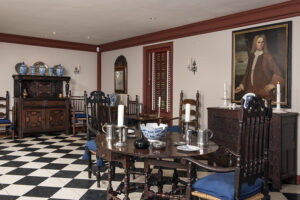
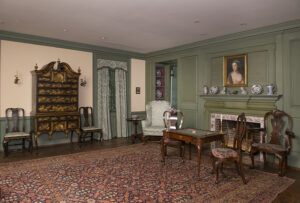
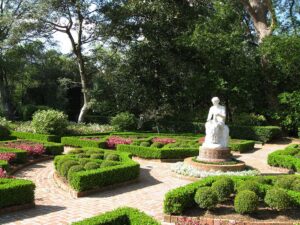
We spend the day exploring Bayou Bend and Rienzi, enjoying intimate tours of the MFAH’s renowned house museum outposts in Houston’s historic River Oaks neighborhood. Bayou Bend is situated on 14 acres of wooded gardens, beloved as much for their display of the natural beauty of native trees and shrubs as for delicate blooms of azaleas, antique roses, and rare Duchess de Caze pink camellias. The mansion, designed in 1927 by prominent Houston architect John F. Staub, combines English, Southern, and Spanish Creole architectural styles. The stately residence was built for Ima Hogg, a civic leader and philanthropist who played a key role in the development of Houston’s arts institutions, as both her home and a showcase for her world-class collection of American decorative arts. Hogg possessed a connoisseurial eye, selecting pieces not just for the fine quality of their craftsmanship, but also for their ability to reflect the tastes, values, and aspirations of Americans from Newport, Boston, Philadelphia, Charleston, and beyond. Hogg donated Bayou Bend to the MFAH in 1957, and it opened to the public in 1966. The renowned collection comprises objects made or used in the United States between 1620 and 1876.
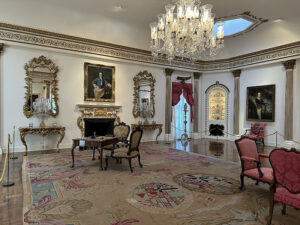
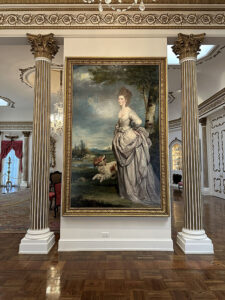
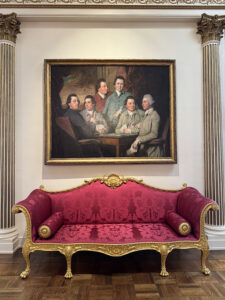
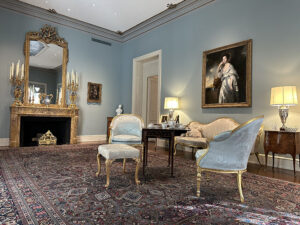
Across the Buffalo Bayou stands Rienzi, the MFAH’s house museum for European decorative arts. Originally the home of philanthropists Carroll Sterling Masterson and Harris Masterson III, Rienzi was designed by Staub and completed in 1954. Evoking Palladian design, its symmetrical single story complements its setting amid gardens designed in the 1950s by noted landscape architect Ralph Ellis Gunn. In a rich combination of formal arrangement and natural Texas woodlands, the landscape tiers gracefully downhill to the bayou. For more than 40 years, the Mastersons acquired European decorative arts, paintings, furnishings, and porcelain made from the 17th to mid-19th centuries, including one of the finest collections of Worcester porcelain in the United States, noteworthy holdings of English and European paintings, and an outstanding range of English furniture. The Masterson family gave Rienzi to the MFAH in 1997, and it opened to the public in 1999.
Sunday, April 18, 8:45 am–11:00 am in the Colonnade Room
We conclude our Symposium with four distinguished presentations that demonstrate different facets of Houston’s collections and material culture traditions.
The John A.H. Sweeney Emerging Scholar Lecture
Towards a Modern Living: Printed Textiles at the MFAH
Meagan Howard, Curatorial Assistant, Decorative Arts, Craft, and Design, Museum of Fine Arts, Houston
Texas Decorative Arts in the Bayou Bend Collection: An Overview
Bradley Brooks, Curator of the Bayou Bend Collection and Gardens, Museum of Fine Arts, Houston
Johann Jahn: A German Cabinetmaker in Nineteenth-Century Texas
Dr. Kenneth Hafertepe, Professor of Museum Studies, Baylor University
Carroll Harris Simms: A Ceramic Legacy at Texas Southern University
Elizabeth Essner, Windgate Associate Curator of Craft, Museum of Fine Arts, Houston
SPONSOR RECEPTION
Friday, April 16, 6:00 pm–8:00 pm
Decorative Arts Trust members at the Sponsor level and above will receive an invitation to this special reception. Guests will enjoy an evening of conviviality and conversation in one of the Bayou City’s distinguished venues.
FUNDRAISER FOR THE EMERGING SCHOLARS PROGRAM
Saturday, August 17, 6:00–8:15 pm
Private Residence
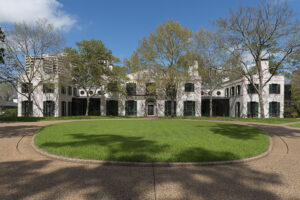
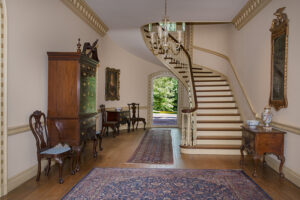
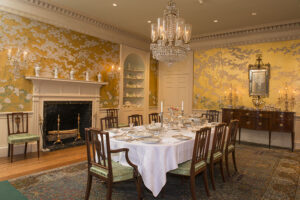
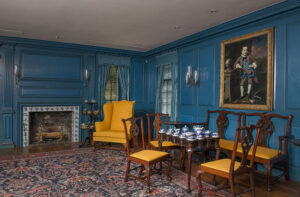
We are graciously invited to visit the home of distinguished Houston arts patrons and view their rich and eclectic collection of decorative arts and works on paper. Set within a handsome Federal Revival house, highlights of the collection include ornithological illustrations by John J. Audubon, Mark Catesby, Alexander Wilson, John Selby, and other naturalist artists; distinguished pieces of Colonial and Neoclassical American furniture attributed to the Townsend, Goddard, and Seymour family workshops; antique long rifles, powder horns, and pipe tomahawks; Chinese export porcelain; and English ceramics, including frog mugs and Staffordshire Texian Campaigne transferwares.
This intimate evening of connoisseurship and conviviality allows us to toast our hosts’ hospitality and lend support to the Trust’s efforts to encourage the next generation of curators and academics through a growing series of grants, scholarships, and internships. In 2026, over 70 graduate students and young professionals benefited from the Trust’s Emerging Scholars Program.
A tax-deductible donation of $500 per person and prior registration is required to attend this fundraiser.
Galveston
Wednesday, April 14, 8:45 am–5:45 pm
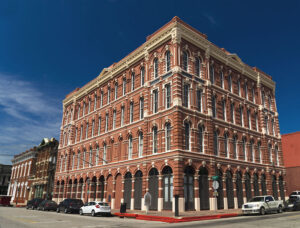
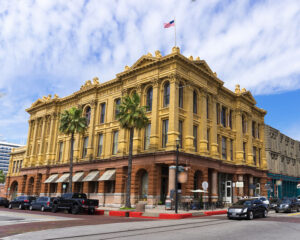
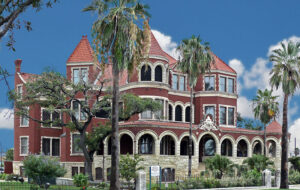
Galveston is a 19th-century port city to the southeast of Houston where Victorian architecture lines historic streets just blocks from the Gulf of Mexico. Piracy and the slave trade marred these waters in the city’s early years, and Galveston later became the birthplace of Juneteenth when freedom for enslaved people in Texas was officially announced on June 19, 1865, by US Army troops. Our day begins with rotating tours of the Bryan Museum which houses one of the world’s finest collections of American Western objects, documents, and fine art, from frontier firearms to works by Frederic Remington. The museum presents a chronological history of Texas and the American West with a special emphasis on the Spanish influences in the region. In 2015, the Bryan Collection moved to the former Galveston Orphans Home after carefully restoring this Renaissance Revival gem, rebuilt in 1902 after the devastating effects of a hurricane that destroyed much of the city. This is followed by lunch in the Strand Historic District, the cultural and commercial center of the island.
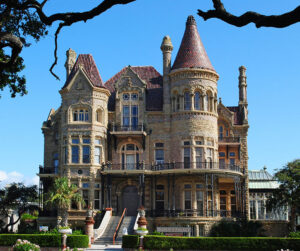
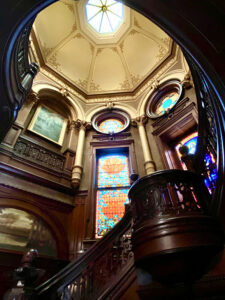
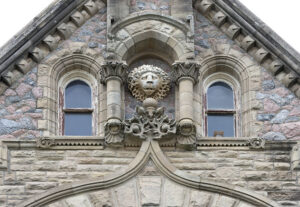
The afternoon brings us to two gems of Gilded Age Galveston. Bishop’s Palace, built between 1887 and 1892 for attorney, entrepreneur, and Texas legislator Colonel Walter Gresham and his wife Josephine, tells a story of ambition, artistry, and resilience. Although commonly described as Victorian, its true style is Châteauesque—a French Revival-inspired design made uniquely Texan through the use of colored stone, cast iron galleries, and fantastical carvings. Sienna marble columns frame the entryway, through which await soaring 14-foot ceilings, stained glass windows, and an octagonal mahogany stairwell that stretches 40 feet toward a brilliant skylight. Moody Mansion is a richly decorated Richardsonian Romanesque residence completed in 1895. One of America’s wealthiest individuals at the time of his death, W.L. Moody, Jr. purchased this 30,000-square-foot home shortly after the 1900 hurricane devastated Galveston, and he and his wife, Libbie, raised their four children here. Interiors designed by the prominent New York design firm Pottier & Stymus color every space, from the ornate ballroom to the sweeping veranda. The opulent home showcases the lifestyle of one of the most powerful families in Texas at the turn of the century. Throughout our visit to Galveston, we benefit from the insights of Stephen Fox, Lecturer at the Rice University School of Architecture.
Round Top
Thursday, April 15, 8:15 am–4:30 pm
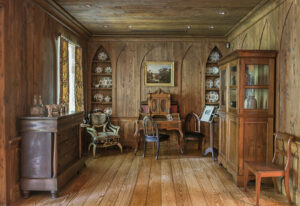
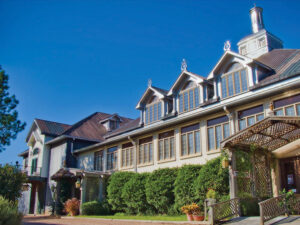
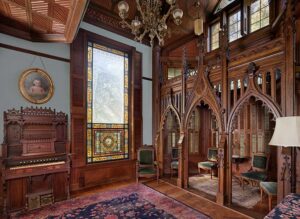
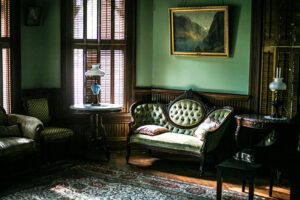
After breakfast, we depart westward to Round Top, a small but mighty town beloved for its scenic beauty, eclectic design, and celebration of the arts. For more than 50 years, this town with just 90 permanent residents has hosted one of the country’s largest antique shows, the Round Top Antiques Fair, which draws more than 100,000 visitors each fall. Incorporated in 1870 and named for a unique octagonal defense cupola on an early postmaster’s house, the town retains deep German immigrant roots and historic buildings. Our first stop is the sprawling Winedale Historical Complex, home to ten 19th-century wooden structures dotted across 225 acres. Assembled by Houston philanthropist Ima Hogg, the houses at Winedale are lavishly decked in period furnishings and an outstanding collection of Texas hand-crafted decorative art. Hogg gifted the complex to the University of Texas at Austin in 1967. Our visit, hosted by Tricia Blakistone, Site Manager, and Dr. Kenneth Hafertepe, Professor of Museum Studies at Baylor University, features tours of two of the houses at Winedale and a viewing of highlights from the furniture collection.
We enjoy a revitalizing lunch before proceeding to the Round Top Festival Institute for a tour of the internationally renowned Festival Concert Hall and exhibit spaces led by Lamar Lentz, Managing Director and Curator. The Festival Institute was founded in 1971 by James Dick, a concert pianist trained at the University of Texas and London Royal Academy of Music. He was invited to perform at the Round Top home of Ima Hogg, after which he began to envision a serene, rural institute for musical training and performances in the area. Beginning with six acres and one 19th-century school house purchased at a foreclosure sale, the Festival Institute, stewarded by The James Dick Foundation for the Performing Arts, now encompasses 210 acres and 18 buildings. The focal point of the Institute is the magnificent Festival Concert Hall, which blends acoustic elements with Gothic Revival and Texas vernacular architectural forms and details. Our tour offers insight into the design and construction of the hall, as well as the rich archival materials in the museum and music library.
POST-SYMPOSIUM OPTIONAL TOUR
Mid-Century Modern Houston
Sunday, April 18, 11:15 am–3:15 pm
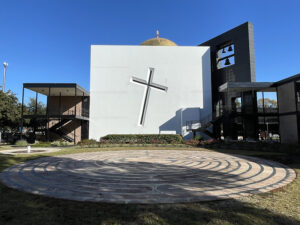
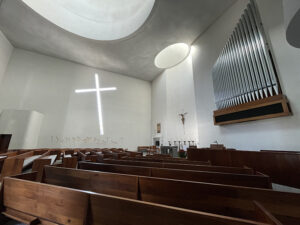
Following lunch, we embark on a walking tour of the University of St. Thomas led by Stephen Fox, Lecturer at the Rice University School of Architecture. Renowned Modern and Postmodern architect Philip Johnson completed a master plan for the campus in 1957, featuring wide green spaces and an arrangement inspired by Thomas Jefferson’s design for the University of Virginia. Academic buildings line the green, facing one another, reflecting the architect’s belief in the interdependence of all scholarly endeavors. Johnson later designed additional campus buildings in 1997 in a Postmodern style. The Chapel of St. Basil, composed of geometric forms and executed in white stucco and black granite, is located at one end of the academic mall, opposite the University’s library, representing the dialogue between faith and reason.
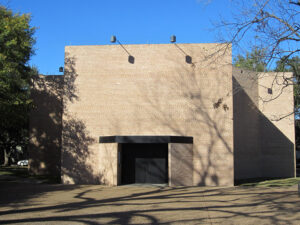
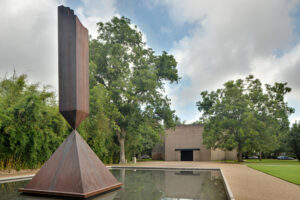
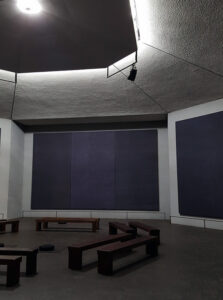
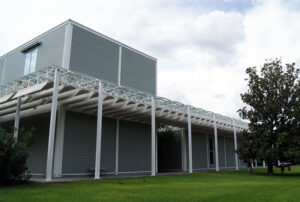
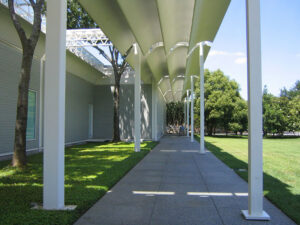
The tour concludes with the Rothko Chapel and Menil Collection. Dominique and John de Menil, two of Houston’s most influential philanthropists and arts patrons, established the Menil Foundation in 1954 to foster greater public understanding and appreciation of art, architecture, culture, religion, and philosophy. The Menils commissioned painter Mark Rothko in 1964 to assist in creating a non-denominational meditative space which would be filled with new, bespoke works by the artist. What became the Rothko Chapel was originally intended to be part of the University of St. Thomas’s campus, but today stands as a separate institution. Rothko collaborated with Philip Johnson to design the chapel, resulting in an octagonal floor plan around which the 14 commissioned paintings are arrayed in eight panels. Tour participants may remain for an independent exploration of the Menil Collection, or return with the group to the hotel.
ACCOMMODATIONS
The Houston Grand Hotel, 1919 Briar Oaks Ln, Houston, TX 77027
Special Room Rates: A block of rooms is reserved for April 13–18, 2027, starting at $259 per night. These rooms are available on a first-come, first-served basis until Tuesday, March 23. Please make your reservations as soon as possible by calling 713-840-7600 or booking online here. If you call, please indicate that you are with the Decorative Arts Trust with the booking agent. If you are attending the Pre-Symposium or Post-Symposium Optional Tours, please reserve a room for the duration of your stay in Houston.
Registration fee: $1,250 per person, which includes all lectures, tours, meals, receptions, and transportation referenced above as well as a $50 tax-deductible donation to the Dewey Lee Curtis Scholarship Fund to underwrite symposium scholarships. Participants may elect to make an additional donation through registration.
Nonprofit professional fee: $625 per person, reserved for colleagues employed by museums, historic sites, universities, or preservation organizations who focus on the decorative arts or material culture. Interested applicants should submit a CV to Thomas Wu at programs@decorativeartstrust.org by February 12, 2027.
Dewey Lee Curtis Symposium Scholarships: The Trust will offer at least two scholarships for this symposium for students and young professionals within five years of earning a degree. Named in memory of the late Dewey Lee Curtis, a decorative arts historian and founding father of the Trust, scholarships cover the full cost of symposium registration, lodging, and a modest travel stipend. Applications are due by February 12, 2027.
Optional programs: The optional programs are available at the following rates. All fees include transportation, admissions, and food and beverage as referenced above. Registration for optional programs is limited.
- Pre-Symposium Optional Tour on April 14 to Galveston: $425 per person
- Pre-Symposium Optional Tour on April 15 to Round Top: $350 per person
- Emerging Scholars Program Fundraiser Reception on April 17 at the home of a private Houston collecting couple: $500 per person, fully tax deductible
- Post-Symposium Optional Tour on April 18to Mid-Century Modern Houston: $250 per person
Membership: All participants must be members of the Decorative Arts Trust. Members at the Sponsor level and above are invited to the special event referenced above on the evening of Friday, April 16. Prior to the Symposium on Tuesday, April 13, Champion level members are invited to a private dinner with Trust leadership.
Cancellations and Refunds: All cancellations received on or before February 12, 2027 are subject to a full refund less a $100 administrative fee per person. Participants canceling from February 13 through March 12, 2027 will receive a 50% refund. Refunds will not be made after March 12.
Itinerary: The schedule, sites, and events outlined in this itinerary are subject to change as necessary.
Participation: The program is limited to a maximum of 75 members. We organize and maintain waitlists. The Trust’s itineraries are planned with care and attention to detail to ensure a memorable and rewarding experience for all participants. This itinerary includes standing for long periods of time, walking on uneven surfaces, and ascending and descending stairs without handrails. Please consider if this program is suited for your health, physical condition, and individual circumstances.