
Shapes and Motifs in Motion: Rethinking Ivory Pipe Cases Across Worlds


Click on images to enlarge them and view captions.
by Nur’Ain Taha
Ivory has long been one of the most charged raw materials of global exchange, prized for its smooth texture, lustrous surface, and capacity for fine carving. Tusks harvested in Africa and South Asia traveled to markets in Europe, the Middle East, and East Asia, where they were fashioned into devotional objects, luxury finishings, and refined accessories. Among these objects of luxury, the ivory pipe case (figure 1)—a portable yet striking item—offers a revealing window into the intersections of trade networks, cultural exchanges, and material.
Tobacco smoking spread in the 17th century, a habit that the Dutch enthusiastically adopted and continued in their colonies beyond Europe. The fragility of their clay pipes made protective cases essential, particularly given the high humidity of the weather in the tropics. When carved in precious materials such as ivory, these practical objects quickly moved beyond function, becoming refined markers of taste and sociability.
With the support of a Decorative Arts Trust Research Grant, I undertook a series of research trips to museums and archives in Sri Lanka, as well as to the Asian Civilisations Museum (ACM) in Singapore. In Colombo and Kandy, I examined museum collections and visited crafts workshops to trace the use of ivory in local artistic production and to observe how traditional carving techniques continue in other materials such as wood. In Singapore, I was able to view the only ivory pipe case housed in a public collection in Asia. Most examples are in European and American institutions. The aim of this comparative research was to situate cases within wider networks of artistic production and circulation, while also considering how they are interpreted in contemporary contexts.
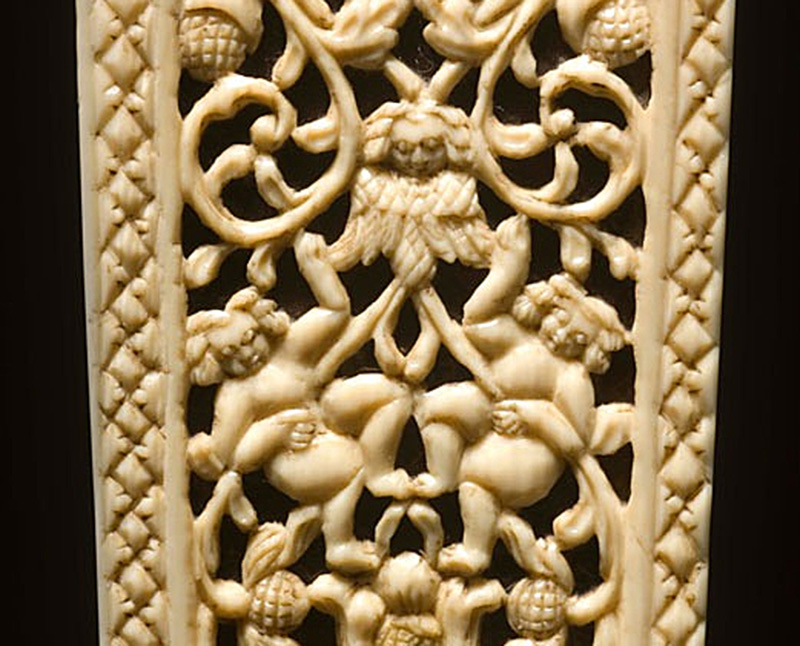
Although ivory pipe cases appear in many European collections, their absence from contemporary Sri Lankan museums is striking. Despite the island’s central role in the ivory trade under both Portuguese and Dutch rule, no ivory pipe cases are known to survive locally. This factor suggests that they were not made for domestic use but were produced largely on commission for colonial officers or as gifts. By contrast, Sri Lankan collections preserve a rich corpus of ivory objects created for local use, including combs, pill/cosmetic boxes, and even medical equipment, such as syringes. These works often display motifs also found on the carved pipe cases—most notably the liya-vẹla (vine scroll, figures 2 and 3) and the palā-peth (lotus petal)—that recur across both ivory and wooden artworks.
The long prohibition of ivory carving in Sri Lanka means that no known hereditary ivory carvers or artisans remain. Yet, carpenters trained in traditional methods continue to sustain similar techniques that echo past practices. Visits to workshops showed how common Sri Lankan motifs are still rendered in wood, revealing how these designs might once have been executed in ivory. In our conversations, local artisans also emphasized that their craftsmanship depends on learned skills as well as hereditary talent.
Motifs and patterns also traveled across oceans and inspired local artworks. An early-17th-century manuscript in a library collection in Sri Lanka contains ornamental elements typical of European print culture and provides some clues to this process. European motifs, such as putti, were reimagined on some ivory pipe cases (figure 4), appearing as the mythical creatures nāri-latā-vẹla (woman vine). Although the manuscript’s provenance is unknown, it suggests that printed materials served as important vehicles for transmitting design across regions.
Architectural and funerary remains from the Portuguese and Dutch periods further demonstrate how European motifs circulated and were adapted by local makers. At Colombo’s Wolvendaal Church, a Dutch influence appears in the iron gates adorned with lions and in the row of tombstones carved with heraldic devices and ornamental motifs—possibly the work of local artisans drawing inspiration from imported prints or models. Comparable examples survive in the National Museum of Colombo, underscoring how colonial forms were replicated, reinterpreted, and reworked within Sri Lankan contexts.
Complementing the Sri Lankan research, fieldwork in Singapore focused on a rare ivory pipe case in the ACM collection (see figures 3 and 4), which offers valuable regional insights. Rather than interpreting this object solely within a European framework, it highlights a place within Asian maritime trade networks and the circulation of ivory and other luxury materials in the region. Displayed in the museum’s “Court and Company” gallery, the pipe case is framed alongside lacquerware, mother-of-pearl, ebony, and textiles, emphasizing its role within broader regional histories of artistic production and exchanges.
These findings reveal that ivory pipe cases cannot be understood solely as European luxury goods. They were shaped by local artistry, colonial patronage, and cross-cultural circulation. This fieldwork set out to trace more ivory pipe cases across the world but also uncovered the creativity of Sri Lankan makers—a narrative often overlooked when these artworks are viewed only through the lens of European collections.
Nur’Ain Taha is a PhD student in the Department of History & Art History at Utrecht University. Her current PhD research is conducted as part of the project “The Dutch Global Age: Worldly images and Images of the World in Netherlandish Art” at Utrecht University, funded by a VICI grant from the Dutch Research Council (NWO).
A print version of this article was published in The Magazine of the Decorative Arts Trust, one of our most popular member benefits. Join today!