
Modern Echoes of Tradition: Contemporary Expressions in Textiles and Lacquer in Japan

Click on images to enlarge them and view captions.
by Yayoi Shinoda
Textile dyeing and lacquerware have long been integral to Japan’s material culture. These two enduring art forms have been closely tied to everyday life in Japan for centuries. However, as Japan underwent modernization and industrialization, patterns of clientele and patronage shifted dramatically. During the Decorative Arts Trust’s Study Trip Abroad to Japan, we had the opportunity to meet two contemporary artists, Hitoshi Maida and Nobuyuki Tanaka, who have navigated these cultural changes with acute insight and creativity.
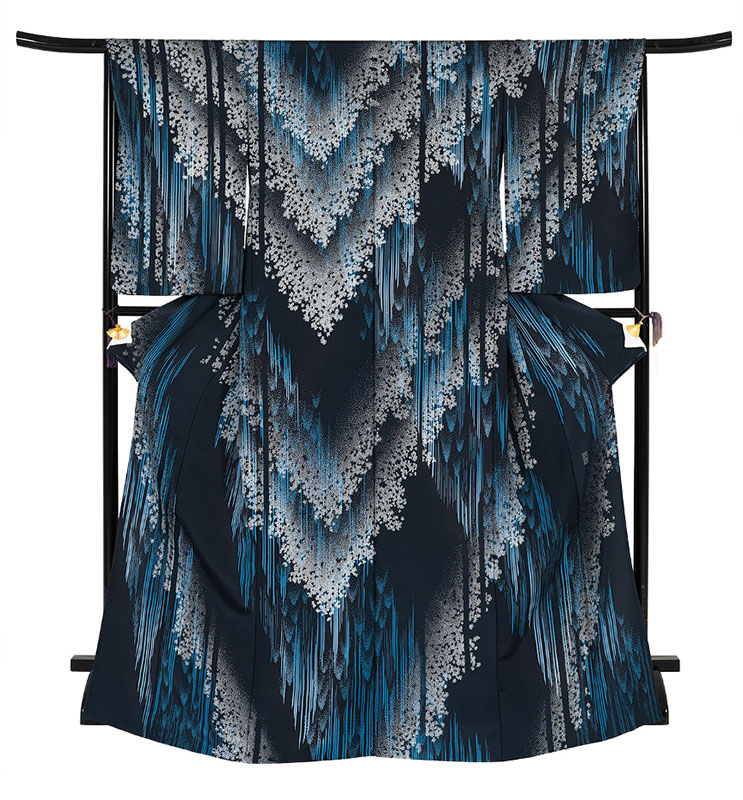
Kaga Yuzen Maida, of the Maida family workshop in Kanazawa, has specialized in yūzen dyeing—a freehand paste-resist dyeing technique—since the early 20th century. When exhibited on a kimono stand, a yūzen-dyed kimono appears like a large painting: the design unfolds across a broad plane of silk panels that form the sleeves and body. Once worn, the same design takes on a sculptural presence, gently animating with the wearer’s movements.
The connection between yūzen dyeing and painting is apparent not only in the finished kimono but also in the production process and visual language. “We take inspirations from nihonga [Japanese style painting],” explained Hitoshi Maida, the third-generation artist leading the workshop. For his recent kimono titled Moment (2023), Maida rendered the ephemeral instance when a waterfall cascades, releasing mist into the atmosphere, using dye on silk (figure 1).
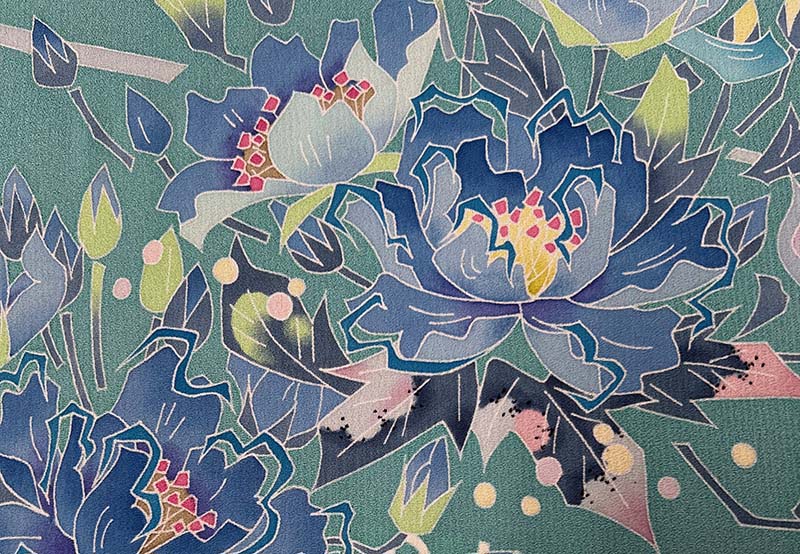
Yūzen dyeing emerged in the late 17th century and has become one of Kanazawa’s most celebrated traditions. The design is transferred onto silk using a blue colorant extracted from the dayflower (aobana) plant. Areas meant to remain undyed are outlined with a fine ribbon of resist paste, traditionally made of rice. Dyes are then carefully brushed onto the taunt silk within these boundaries, with subtle blending and shading used to give depth to the motifs (figure 2). Once the panels are dyed, they are sewn into a continuous bolt, steamed to set the colors, and then subjected to further steps, including a second application of resist paste, background dyeing, a second steaming, and rinsing. Depending on the complexity, a single kimono may take several months to over a year to complete.
The Maida artists remain committed to these traditional processes and pictorial design, but Hitoshi Maida is acutely aware of the need to adapt to changing times. “Our customers no longer wear kimono as often as before,” he shared. To engage new audiences who may view kimono as art rather than attire, the workshop now offers yūzen-dyed textiles intended for display, fashion accessories such as scarves, and decorative panels for interiors. Synthetic dyes allow for a more vibrant color palette than traditional natural ones, enhancing the dynamism of the designs and appeals to contemporary tastes.
Another time-honored material, urushi, often referred to as lacquer, is reimagined by Nobuyuki Tanaka. The medium derives from the sap harvested from the urushi tree. The versatile substance has been used in Japan for millennia as an adhesive, a material for creating sculptures, and as a protective and decorative coating for wood objects, from dining bowls to furniture. Traditional lacquer often incorporates gold and silver powders sprinkled onto the surface for a shimmering effect. Tanaka redefines urushi as a sculptural medium, pushing its expressive possibilities beyond conventional boundaries.
Tanaka employs the ancient kanshitsu (dry lacquer) technique to create large-scale sculptural works. Originating in China during the Warring State period (c. 475–221 BCE), the technique was introduced to Japan in the 7th century CE, where it was used to create lifelike Buddhist sculptures. Tanaka has reinterpreted this method to produce a wider range of forms, from monumental sculptures to organically shaped objects and sharply contoured compositions. The process begins with construction of a model, over which he applies a sheet of hemp cloth and then a coating of urushi. Tanaka repeats the layering process, often more than eight times, which results in a lightweight but remarkably durable structure. A final coat of urushi is then polished to a glossy finish.
Tanaka’s work bridges the sculptural and surface design traditions of urushi art. Tactile Memory–Traces of Red– (2023) exemplifies his conceptual and material engagement with memory and impermanence (figure 3). The towering form with curving silhouette is coated in lustrous red and black lacquer, two of the most used colors in urushi. The sculpture also references negoro, a historic style in which the top layer naturally wears away with use, revealing the surface beneath. Tanaka deliberately abrades the black surface to expose the underlying red layer, evoking the way memories resurface and recede with the passage of time through the metaphorical act of redaction.
The practices of yūzen dyeing and urushi lacquer work have withstood centuries of change, sustained by generations of skilled artists. Hitoshi Maida and Nobuyuki Tanaka carry these traditions forward—not as static inheritances but as evolving artistic fields.
Yayoi Shinoda is the Associate Curator of Japanese Art at The Nelson-Atkins Museum of Art and received a scholarship to attend the fall 2025 Study Trip Abroad to Japan.
A print version of this article was published in The Magazine of the Decorative Arts Trust, one of our most popular member benefits. Join today!