
A Nation of Artists: 250 Years of Creativity
Click on images to enlarge them and view captions.
by Alexandra Alevizatos Kirtley
In April, the noteworthy private collection of Philadelphians John and Leigh Middleton was unveiled as loans to the Pennsylvania Academy of the Fine Arts (PAFA) and the Philadelphia Museum of Art (PMA) to herald the opening of each museum’s reinstallations as well as America’s 250th.
The two-venue exhibition, A Nation of Artists: 250 Years of Creativity, presents the same themes at both institutions with a few differences. At PAFA’s recently refurbished 1876 Historic Landmark Building, an architectural gem designed by Frank Furness and instructors like Thomas Eakins, the installation is arranged thematically and includes one of their perennial strengths: the contemporary art of their graduates.
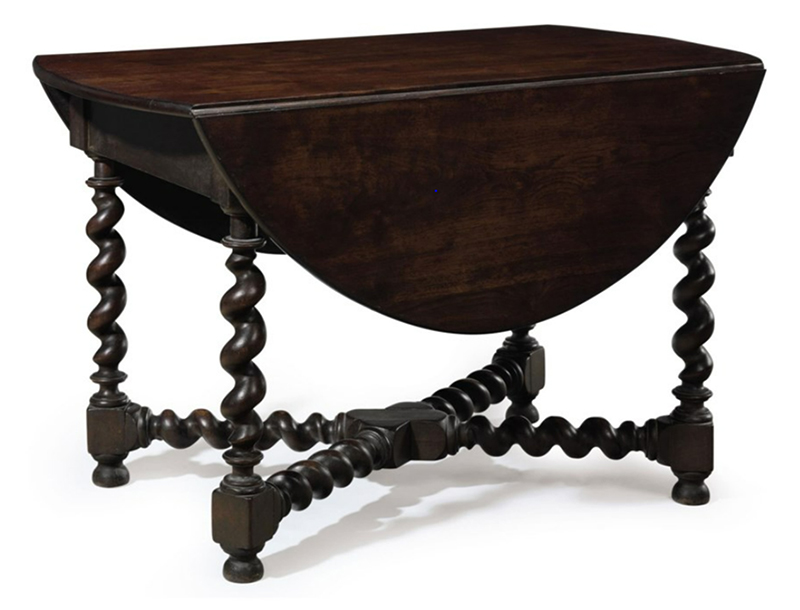
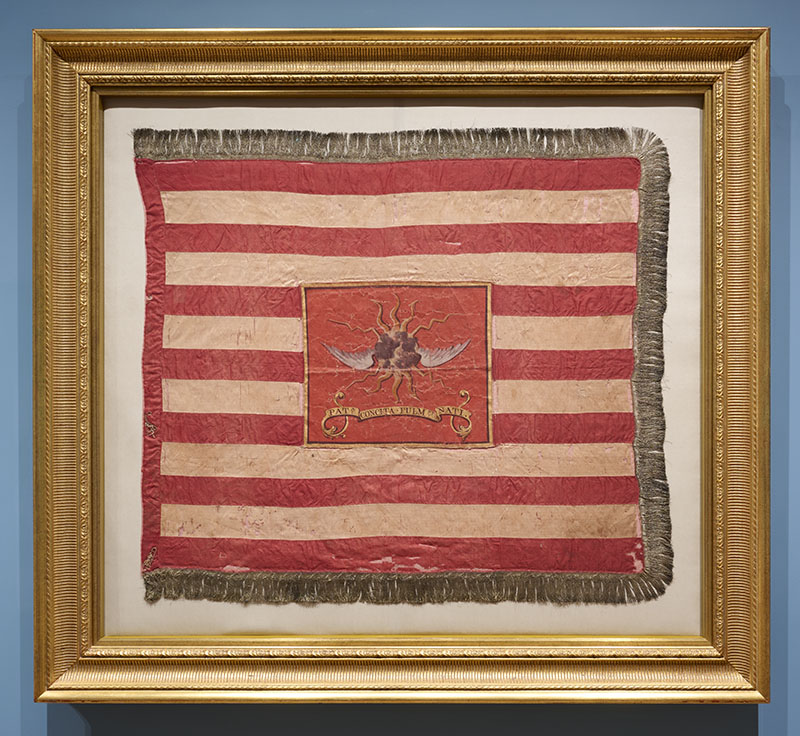
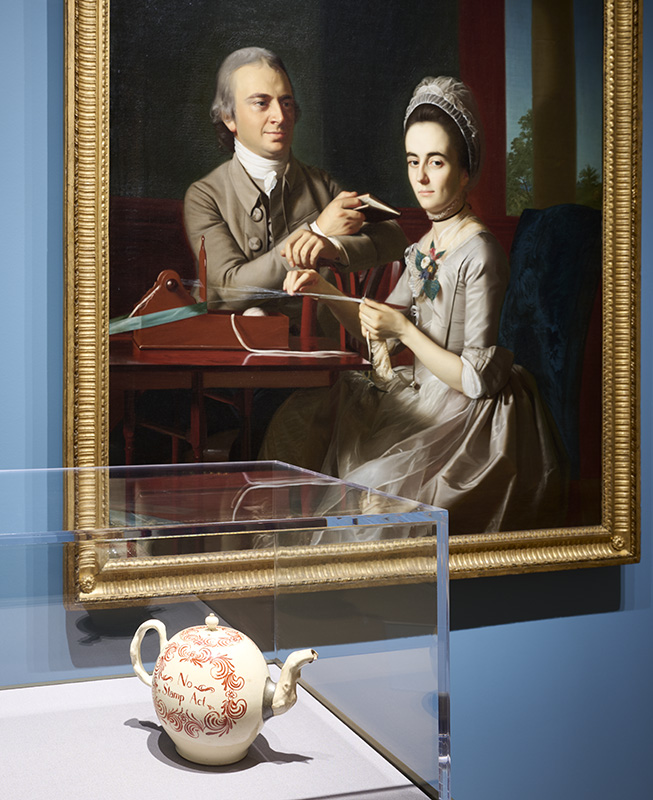
At the PMA, the presentation is chronological, starting in the museum’s galleries dedicated to early American art, which opened in 2021, and featuring about 25 loans from the Middleton Family Collection: furniture representing most of the 13 colonies (figure 1), four Revolutionary War flags (figure 2), the Stamp Act teapot (figure 3), and the Middletons’ first painting purchase—Charles Willson Peale’s monumental life-size portrait of George Washington. The PMA’s exhibition continues to the newly unveiled renovated galleries of American art dating from 1840 to about 1960 that are reinstalled alongside more than 30 paintings from the Middleton Family Collection.
The PMA’s collection presents the other major difference between the two installations: founded in 1876 as a museum and school for the industrial (meaning applied or useful) arts, the PMA’s collection was intended to be a pendant to the Academy’s collection and present arts in a mix of media from around the world at the PMA. Throughout the galleries, A Nation of Artists presents the full ensemble of the museum’s American paintings, drawings, prints, architecture, furniture, sculpture, decorative arts, textiles, and costume holdings dating from 1650 to 1960.
The plan for the reinstallation of the PMA’s American art collections in the two floors of Robert L. McNeil, Jr., Galleries has been percolating for many years, but the process for what became A Nation of Artists was devised only in October 2024—a mere 18 months before the exhibition opened. While curator David Barquist was plugging away on his special exhibition Workshop of the World: The Arts and Crafts in Philadelphia, 1876–1926 (see pp. 6–7), Kathleen A. Foster, the Robert L. McNeil, Jr., Senior Curator of American Art, and I bore down on this new project.
The word nation implies many cultures, and we wanted to signal from the outset that American art is not a single art but instead is made up of the artistic creations of many different people, underscoring the motto of the United States: E pluribus unum or out of many, one. This multiplicity also applied to the many ways American artists have learned their art over the centuries: at art schools like the Academy, which was the first professional art school in the country; at home, like Andrew Wyeth or Acoma daughters who learn pottery from their mothers; on the job, like Winslow Homer who learned to draw while working for Harper’s Weekly; or in an apprenticeship system, like cabinetmakers, silversmiths, sign painters, and numerous other artisans.
The exhibition required us to rework the PMA’s first-floor early American galleries to accommodate the Middleton Family Collection loans, and our second-floor galleries were closed, emptied of art, and gutted. These new galleries explore eight themes drawn from those we introduced on the first floor, such as globalism, technology, prosperity for some but not all, nature, science, and the building of a national identity. In the later galleries, we address the takeover of the American West—equal parts ambitious and destructive to the Indigenous people living there—as seen through the monumental landscape paintings of the 1850s to 1880s that were painted for the domestic, Gilded Age salons of urban industrialists. We also follow America’s journey onto the world stage through Realism (Eakins) and Impressionism (Garber, Hassam, Bellows, and Tarbell) between 1880 and 1920, the interest in the handmade (Arts and Crafts) and Art Pottery, and the exploration and definition of Modernity.
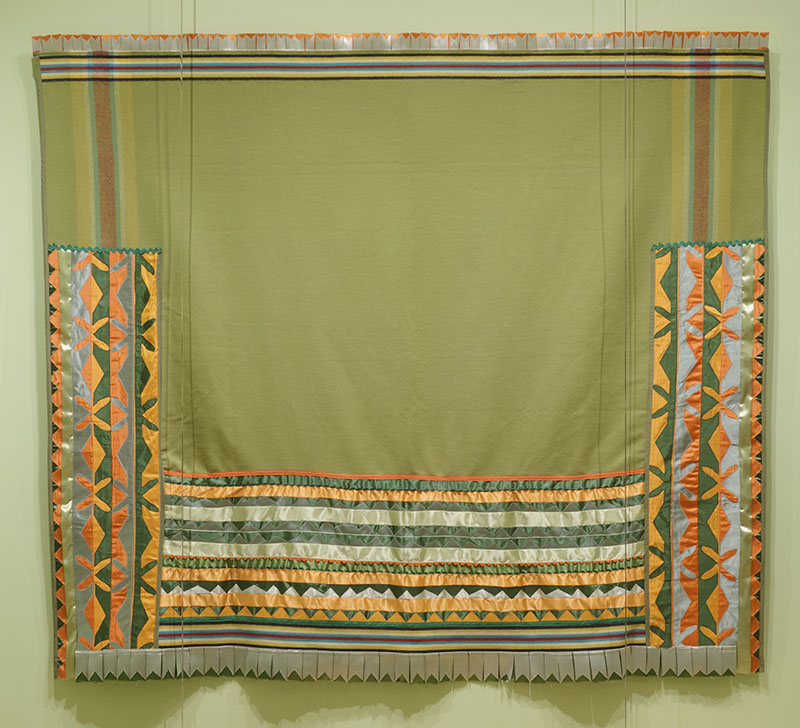
One of the most momentous outcomes of our process was the development of the museum’s first gallery dedicated to Indigenous art. Located adjacent to the mid-19th-century landscapes of the American West, the “Crosscurrents” gallery explores the Indigenous visual language that promoted modernisms now widely known and integral elements of a so-called American visual language. These new visual dialects were created when Indigenous artists from various tribes, English-speaking artists from the East, and Spanish-speaking artists from Mexico shared media and designs. This gallery was organized by Julia Hamer-Light, PhD, the Barra Fellow in American art at the PMA and a specialist in Indigenous art, and demonstrates how Lenape, Haida, Hodínöhšö:ni:h (Hoe-Dee-No-Show-Nee), Diné, Hopi, and Pueblo artists created Modern art forms by incorporating new materials, technologies, and ideas. While meeting with an advisory council of cultural representatives from the tribal nations who curated the works chosen from the PMA’s collection to be on view, one theme prevailed: they wanted visitors to know that Indigenous artists are still alive and making art. To reinforce this theme, we included a contemporary beadwork Auntie’s Purse by Randee Spruce (Heron Clan, Seneca Nation) and an Honor Blanket (figure 4) by Lenape artist Laura Watters Maynor (Delaware Tribe of Indians, Wolf Clan), representing the people native to the Philadelphia area.
A Nation of Artists is on view through July 5, 2027, at the PMA and through September 5, 2027, at PAFA. A virtual tour of this show is available at decorativeartstrust.org/250th-package.
Alexandra Alevizatos Kirtley is the Montgomery-Garvan Curator of American Decorative Arts and Manager, Center for American Art, at the Philadelphia Museum of Art.
A print version of this article was published in The Magazine of the Decorative Arts Trust, one of our most popular member benefits. Join today!