
Window to Revolution: Pennsylvania Germans and the War for Independence
Click on images to enlarge them and view captions.
by Lisa Minardi, Emily Sneff, Christopher Malone, and Sarah Bowen
GERMAN IMMIGRANTS were among the largest and most influential communities in 18th-century Pennsylvania, yet their role in the American Revolution is often overlooked. Window to Revolution: Pennsylvania Germans and the War for Independence, now on view at Historic Trappe, explores how German families in the greater Philadelphia area both experienced and helped shape the Revolutionary era. During the nation’s 250th anniversary, Window to Revolution offers a new perspective on the era by highlighting the material culture and lived experiences of one of Pennsylvania’s most influential communities.
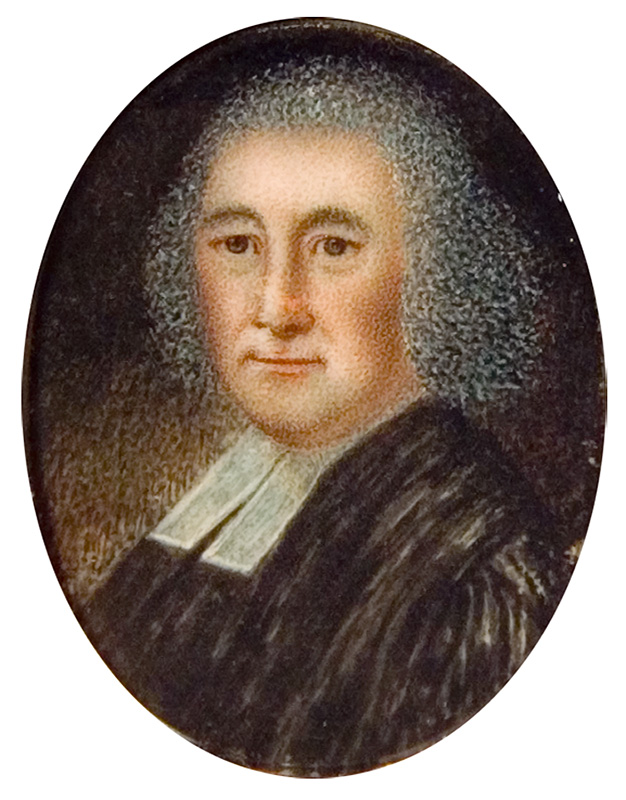
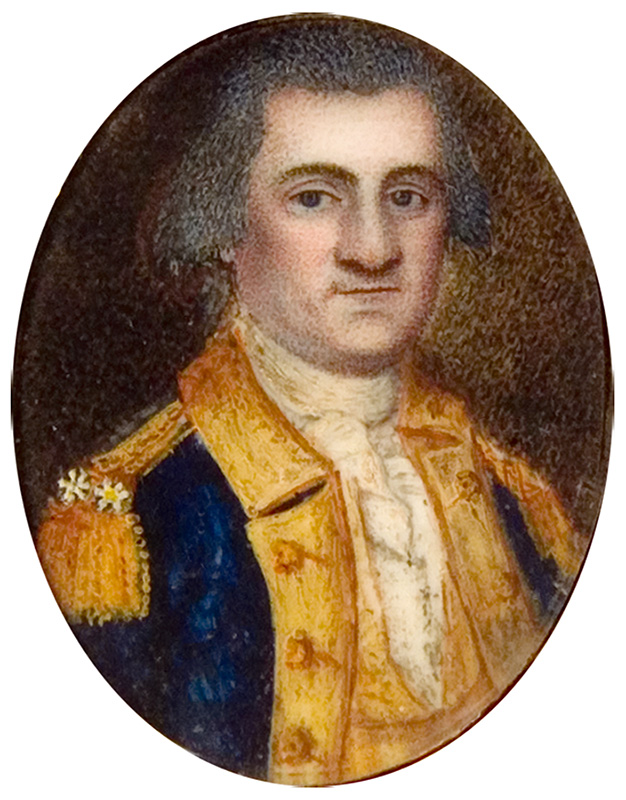
Window to Revolution brings together objects that illuminate the political, religious, and domestic lives of Pennsylvania Germans. Their diverse wartime experiences show a range of political perspectives, economic circumstances, and religious affiliations. Among the featured objects are paired portrait miniatures of Lutheran pastor Henry Muhlenberg (1711–87) in his clerical vestments and his son, General Peter Muhlenberg (1746–1807), in his military uniform (figures 1 and 2). These portraits, of a father who wanted to remain neutral and a son who wanted to fight for independence, offer a tangible reminder of how the war impacted families.
The exhibition draws extensively from the journals of Henry Muhlenberg. In his entry for July 4, 1776, he recorded the news of the Declaration of Independence. He reflected on the uncertainty of what would happen next, manifested in the Muhlenberg family’s move out of Philadelphia to Trappe one week later. Written in German, these remarkable documents are a window to the revolution, a vivid account of daily life in the region as news of independence spread and the war moved closer to Philadelphia. Through Muhlenberg’s observations, the exhibition explores how war reshaped households, communities, and religious life across southeastern Pennsylvania.
General Peter Muhlenberg quit his own pulpit in Woodstock, VA, in January 1776 and took up arms. He raised a Virginia regiment from communities of first- and second-generation German Americans, similar to the Trappe area where he grew up. Muhlenberg’s recruitment of German soldiers foreshadowed the Continental Congress’s decision in May 1776 to raise a German battalion drawn from Pennsylvania and Maryland.
Window to Revolution also features folk art and German-language imprints that present a distinctly Pennsylvania German perspective on the war. Pennsylvania German artists commemorated and documented the conflict in traditional art forms, including fraktur and redware pottery. Some were also made by Hessian soldiers who fought for the British and opted to stay in Pennsylvania and became artisans themselves.
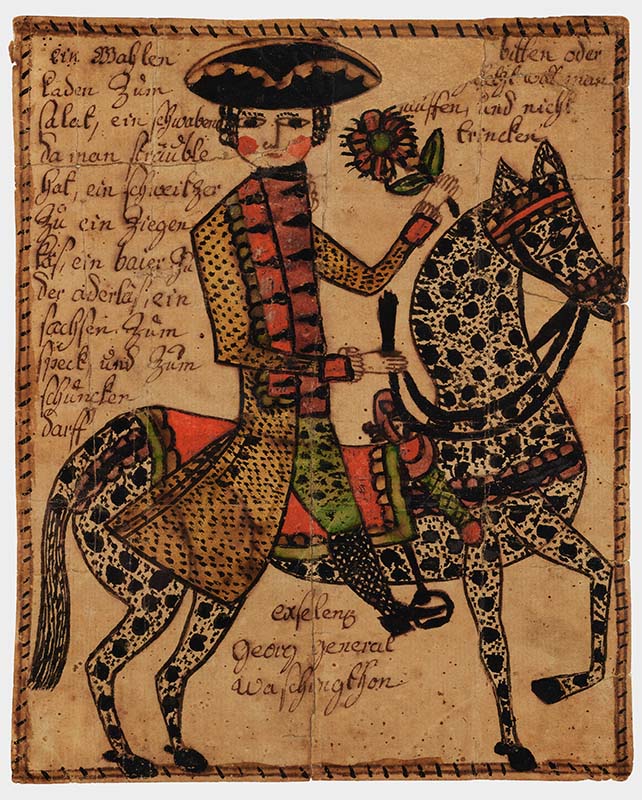
An anonymous fraktur artist who worked in southeastern Pennsylvania from about 1760 to 1785 made at least half a dozen watercolor drawings depicting Revolutionary War themes in addition to more standard birth and baptismal certificates. The most celebrated of these drawings depict George and Martha Washington, and the exhibition features a famous but rarely seen example labeled “Exselenc Georg General Waschingdon” (figure 3). Washington is not depicted as a war hero but in fanciful dress, holding a flower in one hand and the reins of the spotted white horse he is riding in the other.
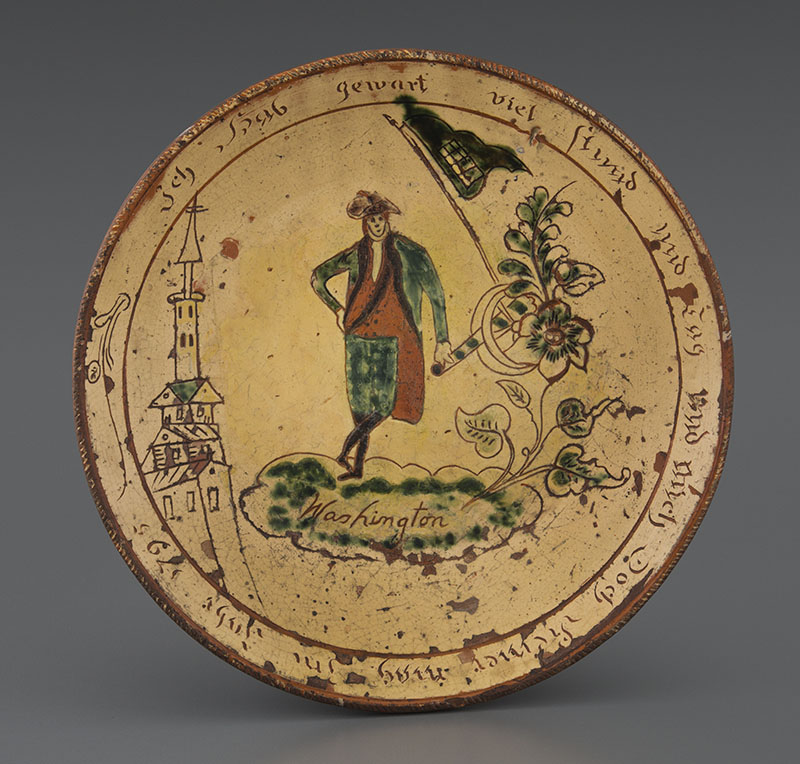
Working in clay, potter Johannes Neis decorated a redware plate with a portrait of George Washington in uniform (figure 4). With one hand on his hip and the other leaning on a stylized cannon, the image is clearly based on Charles Willson Peale’s 1779 portrait, George Washington at the Battle of Princeton. Commissioned by the Supreme Executive Council of Pennsylvania for its council chamber at the State House (now known as Independence Hall), the Peale portrait was wildly popular, with copies in demand before he even finished the painting. How Neis encountered the image is unclear, but his transformation of such a celebrated formal portrait into a more familiar and accessible medium speaks volumes about Pennsylvania Germans’ direct engagement with the patriotic symbolism of the early republic.
Window to Revolution is on view at the Center for Pennsylvania German Studies through February 27, 2028.
The co-curators of Window to Revolution are Lisa Minardi, Executive Director; Emily Sneff, Consulting Curator and Historian; Christopher Malone, Curator; and Sarah Bowen, Colonial Dames of America, Chapter II, Curatorial Assistant.
A print version of this article was published in The Magazine of the Decorative Arts Trust, one of our most popular member benefits. Join today!