
Radical Americana: 45 Artists and 25 Philadelphia-area Sites Celebrate the Semiquincentennial
Click on images to enlarge them and view captions.
by Jennifer Zwilling
Radical Americana was born out of a desire to commemorate the 250th anniversary of the Declaration of Independence and to capitalize on the Semiquincentennial in a way that paralleled the major celebrations that accompanied the Centennial, the Sesquicentennial, and the Bicentennial in Philadelphia. As an art historian, the Centennial has long been a focus of my academic interest. As a Bicentennial baby, the 200th anniversary of our country has loomed large in my personal history. The chance to contribute to the major commemorative moment of our lifetime by collaborating with other colleagues to support the artists in our city was a powerful motivator to take on a major project.
In the fall of 2024, a cohort of leaders from craft, art, history, and cultural organizations around Philadelphia gathered on the roof deck at The Clay Studio and shaped the project that would become Radical Americana. The group distributed a call for proposals that encouraged artists to research artwork from 1776, 1876, or 1976 and make new work in response. They were asked to choose one partner site to conduct research and another to exhibit finished work. The partners also had the opportunity to invite an artist to work with them. The group juried the applications and matched artists with research and exhibition sites. The subsequent group of 45 artists and 25 research and exhibiting locations launched in spring 2026 as Radical Americana (see above).
Radical Americana celebrates the sense of collaboration between cultural institutions in Philadelphia. Many of us have worked together at various organizations, and our strong relationships allowed us to trust each other while striving toward a shared goal: to extol the creativity that has thrived in Philadelphia for more than 250 years. Radical Americana is a citywide experience across Philadelphia’s diverse neighborhoods that honors the critical role of artists in shaping our nation’s history and in leading our cultural discourse today. The programming around the exhibitions and a symposium in November 2026 unite people to discuss the continued relevance of the Declaration’s ideals. Our hope is that the Radical Americana project will spur collective, imaginative problem-solving to illuminate innovative ways of building a future where people from all cultural and economic groups have an equal share in Philadelphia’s vibrant community.
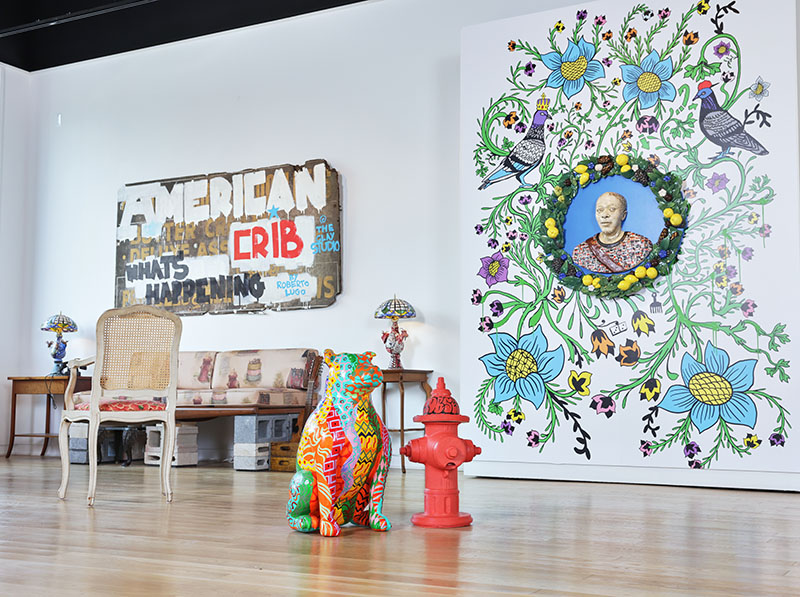
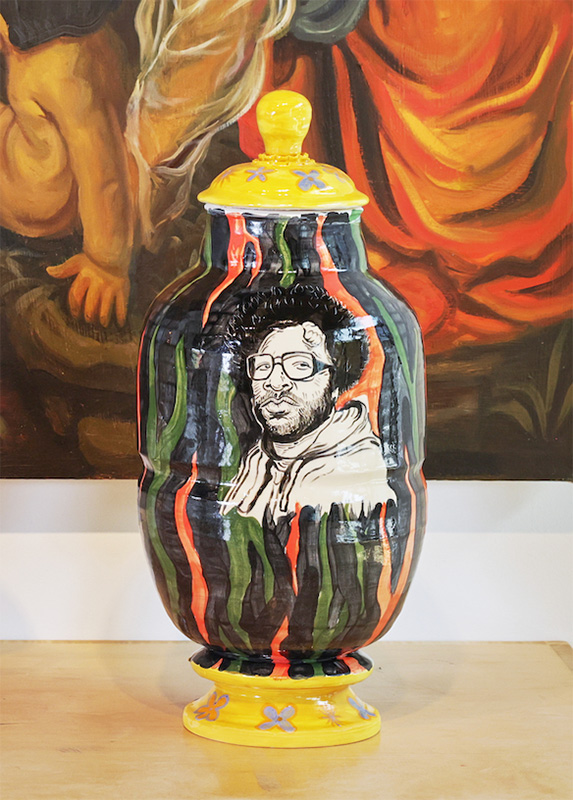
At The Clay Studio, our keystone Radical Americana exhibition is Roberto Lugo’s American Crib: What’s Happening? (figure 1). Lugo represents the core of what Radical Americana aims to celebrate: taking inspiration from the past to tell important truths about today’s society. The son of Puerto Rican immigrants, he grew up in Philadelphia, finding creativity where he could, in graffiti and looking up to Philadelphia musical heroes like Questlove (figure 2) and Black Thought of The Roots. When he found ceramic art, he pursued it with dedication through college and graduate school, where he immersed himself in the history of art. He used that knowledge to fuel new creations positioning Civil Rights Movement leaders and hip-hop artists in place of monarchs, politicians, and war heroes on triumphant urns and elaborate teapots.
Lugo created an imagined living space at The Clay Studio that commemorates his Philadelphia roots and cultural heritage and welcomed guests. The artwork incorporates research undertaken at the Philadelphia Museum of Art to emphasize the expanding dimensions of his storytelling. Visitors are invited to relax on the sofa, have a cup of tea, read a book from his library, and be inspired. This deeply personal reflection on America’s socio-political landscape celebrates the power of art to communicate. Lugo mixes historical pottery traditions with pop culture, humor, and critical clarity to address complex issues, including cultural identity, mental health, social justice, and the resilience of underrepresented communities. American Crib is a poignant reflection on Lugo’s personal history and his hopes for a better world.
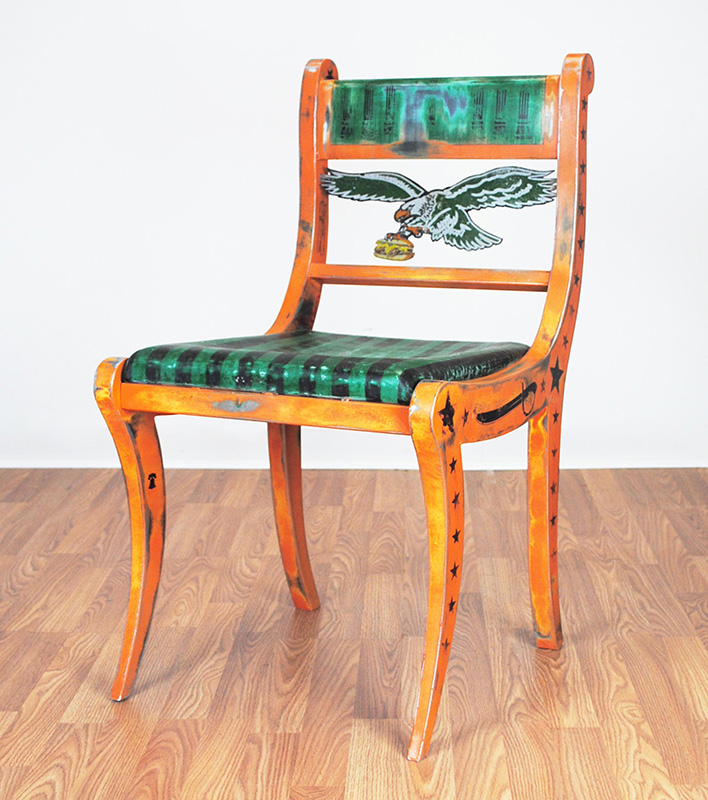
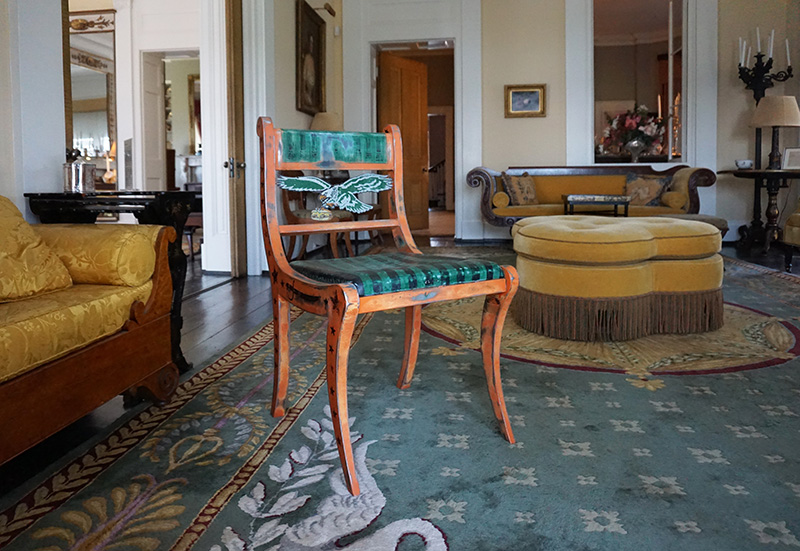
Sophie Glenn’s contribution to Radical Americana is Philly Jawn (figures 3 and 4), exhibited at Andalusia Historic House, Garden & Arboretum. A metalworker and furniture maker based in Reading, PA, Glenn conducted her research at the Wharton Esherick Museum. She reinterprets historic furniture designs in steel to celebrate and give voice to women in both the woodworking and metal fields. Philly Jawn is a cheeky reference to a klismos chair, a style popularized by American furniture-makers in the early 19th century, with the American bald eagle replaced by an eagle carrying a cheese-steak, connecting Philadelphia’s football team and iconic sandwich.
Andalusia is an excellent example of Greek Revival architecture, and therefore a fitting location for Glenn’s take on a klismos chair derived from ancient Greek models. Andalusia was the home of the affluent, politically active Biddle family for nearly 150 years. The Greek Revival style is often cited as a celebration of the democratic ideals of the new United States, and Nicholas Biddle commissioned Thomas U. Walter, a leading proponent of that mode, to design an addition to a residence built in 1797 for his father-in-law John Craig.
The use of Greek architectural elements and decorative design was meant to represent the rights of the people referred to in the Declaration. Glenn emphasizes the spirit of democracy with references to the spirit of Philadelphia. These are illustrated by a slightly gritty surface treatment with tattoo-like images of the Liberty Bell, graffiti, and a nod to Claes Oldenburg’s 1976 monumental Clothespin that stands next to City Hall. When displayed amidst the high style parlor of Andalusia, Philly Jawn inspires a powerful point of conversation, asking the visitor to consider how the spirit of our city continues a discourse about democracy today. Glenn expanded on these themes in a recent Object Share sent to members.
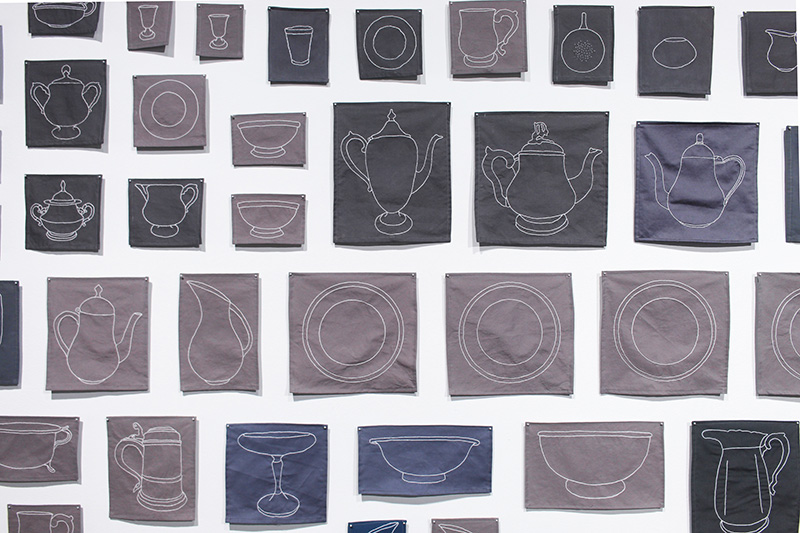
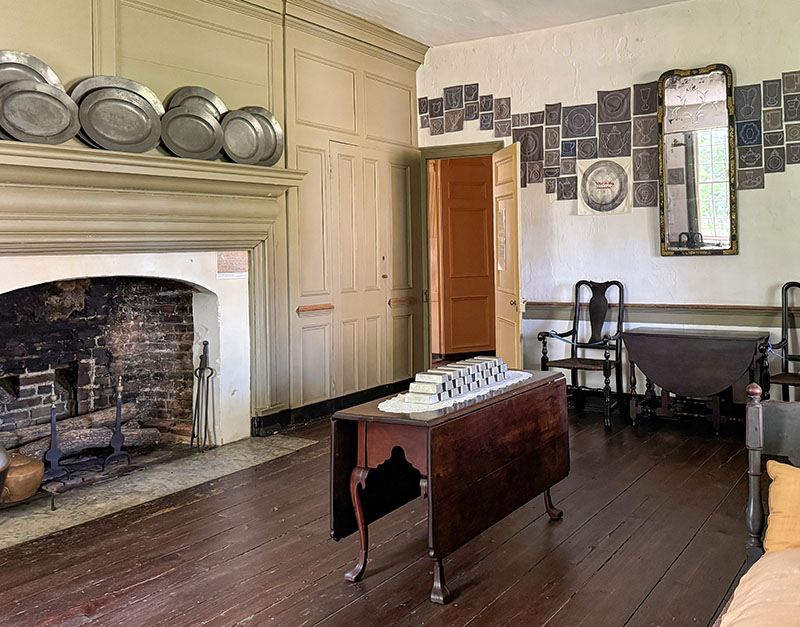
Stenton, the historic house built by James and Sarah Logan in 1730, is the site of Belle-Pilar Fleming and Bri Murphy’s project, Sadware (figures 5 and 6), for Radical Americana. Serving as the home to the Logan family for six generations, Stenton holds the history of early Philadelphia. Logan was secretary to William Penn and was de facto leader of the colony while Penn was in England for long periods. Stenton is dedicated to preserving the history of the inhabitants of the house and how they lived, including Dinah, an enslaved woman who saved the house from fire during the British occupation of 1777.
Sadware is an appropriate contemporary work of art for display at Stenton, a house where the decorative arts help tell the stories of the people who lived there. Fleming and Murphy use pewter and the objects made from it to tell stories of familial inheritance, class, and consumerism in the United States. Introduced to the American colonies in the 17th century, not long before Philadelphia was chartered, pewter reached the height of its prevalence in the early 19th century. The relative low cost of the material compared to silver allowed families across economic strata to own beautifully designed objects for everyday use in greater numbers than ever before. Both Stenton’s curators and the Sadware artists examine how decorative arts can reveal stories about history, ourselves, and our country.
Philadelphia has been home to talented artists working in various mediums for centuries, from Indigenous weavers to European silversmiths. They helped build the city to be what it is today. Radical Americana highlights Philadelphia’s unique position as a place where diverse artists can live and work, where creativity can spur innovation for the future, and where viewing and participating in the arts can initiate respectful civic discourse. We hope that the artistic output of Radical Americana and the 2026 Semiquincentennial will have an equally positive impact on our cultural heritage for decades and centuries into the future.
Jennifer Zwilling is the Curator and Director of Artistic Programs at The Clay Studio. She extends special thanks to Trinity Dubois, Exhibitions Coordinator; John Vick, Executive Director at Andalusia; Laura Keim, Curator at Stenton; Sarah Archer, consulting curator; and the staff at The Clay Studio. Radical Americana was supported by a Dean F. Failey Grant from the Decorative Arts Trust.
Radical Americana Partners
Andalusia Historic House, Gardens, & Arboretum; Biello Martin Studios; The Clay Studio; Cliveden of the Historic Trust; The Colored Girls Museum; Dina Wind Art Foundation; Glen Foerd; The Free Library of Philadelphia Rare Book Department; Historic Yellow Springs; Historical Society of Pennsylvania; InLiquid; John James Audubon Center at Glenn Mill; Museum for Art in Wood; No. 5 Butchie Alley; Philadelphia Museum of Art; Planned Parenthood; Reilly Memorial; Stenton; Taller Puertorriqueño; William Way LGBT Community Center; Winterthur Museum, Garden & Library
Participating Artists
Natessa Amin; Michael Biello; Viola Bordon; Naya Lee Chang; Adam Chau; Scarlett DeLorme; Jessica Eldredge; Belle-Pilar Fleming; Sophie Glenn; Jody Graff; Janna Gregonis; BA Harrington; Justin Jain; Duwenavue Santé Johnson; Lyla Kaplan; Jacintha Kruc; Aimee Koran; Miranda Lopez; Roberto Lugo; Charlotte Lindley Martin; Caitlin McCormack; Monna Morton; Bri Murphy; Dennis Ritter; Hagudeza Rullán-Fantauzzi; Terri Saulin; Angelique Scott; Katie Strachan; Rosalind Sutkowski; Kristen Neville Taylor; Jonathan Wahl; Samara Weaver; John Y. Wind
A print version of this article was published in The Magazine of the Decorative Arts Trust, one of our most popular member benefits. Join today!