
Philip Trammell Shutze: Atlanta’s Consummate Collector
Click on images to enlarge them and view captions.
by Michael Rose
In 1982, Atlanta History Center received a generous bequest from Philip Trammell Shutze:
During my lifetime, I have collected furniture, porcelain, books, and items of decorative arts that mean a great deal to me. I wish to bequeath this collection in a manner that is most likely to assure its continued preservation, maintenance, and enjoyment—and display the collection in Swan House, which was designed by me.
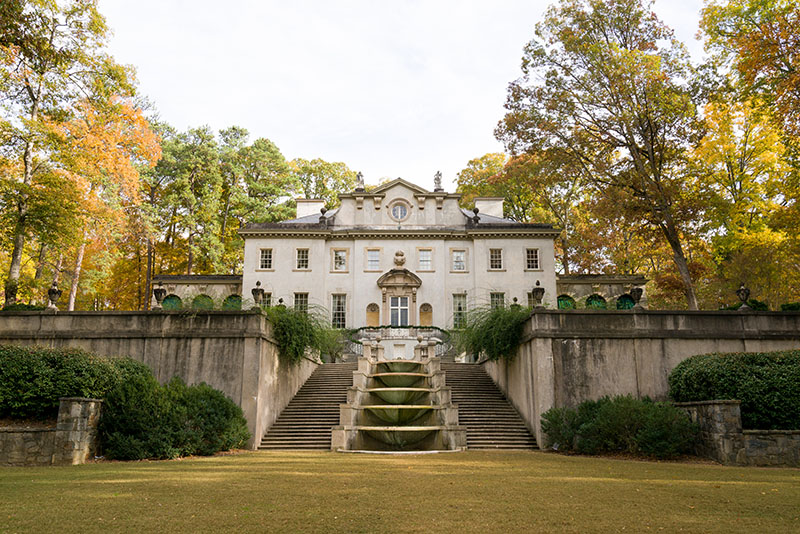
As participants in the Trust’s Spring 2026 Symposium in Atlanta learned, although Shutze was known as a talented architect, he was also a prolific collector. In the space of only a few years, he assembled decorative arts holdings that might have taken most people a lifetime to build but can be explored and appreciated at Swan House (figure 1) per his wishes.
In an essay from 1974, Shutze noted the inspiration of patrons of the arts who, as he said, “furnished the key” to unselfishly promoting the fine arts, architecture, crafts, and other pursuits. He observed that the foremost was “the magnanimous Mr. du Pont and his extraordinary gift to the nation of a museum of decorative arts at Winterthur.” Shutze lamented within Atlanta, “so few see how badly we are in need of a museum of decorative arts.”1
Shutze was almost 60 years old when he started to seriously build a collection. He commenced at a modest pace but later bought with furious activity that reached its zenith in the early 1950s. This passion was a dominating force in his life.
By 1953, he had purchased more than 700 ceramics, primarily Chinese export and English pottery and porcelain, approximately 100 pieces of (predominantly) American furniture, as well as numerous paintings and engravings, other decorative objects, and a 1,700-volume library. His particular love of ceramics pours forth in the accumulation of receipts and correspondence. The voluminous communication makes for fascinating reading as it reveals the personalities involved.
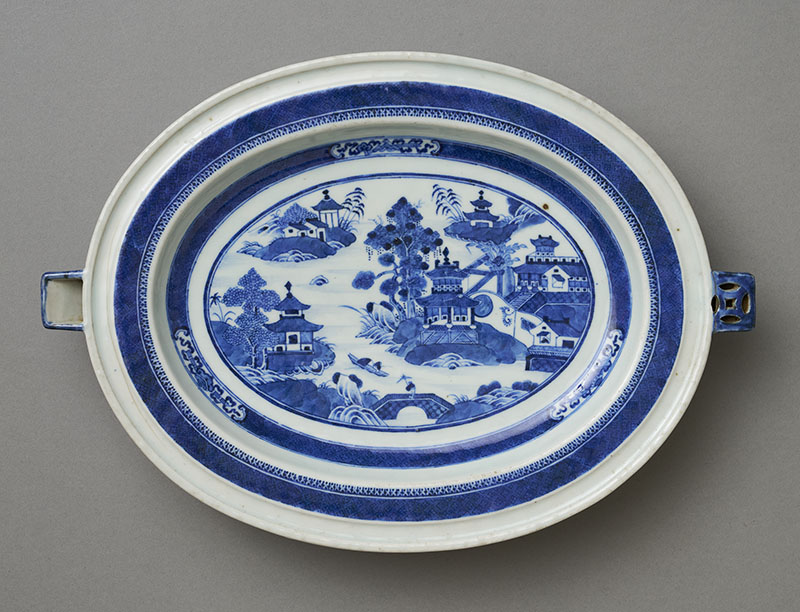
He began with the pursuit of a complete set of Chinese export blue and white Canton porcelain and assembled a dinner service piece by piece. His earliest letter referring to Canton is to the Boston Antique Shop, whose gallery he visited in May 1949. Shutze requested six custard cups, a small tureen, a sauce boat, and one dozen plates, and asked to know about “any unusual and pretty shapes.”2 In those few years, Shutze accumulated 327 items of Canton and Nanking pattern service wares (figure 2) for everyday use. He was also eager to acquire export wares designed specifically for the American market.
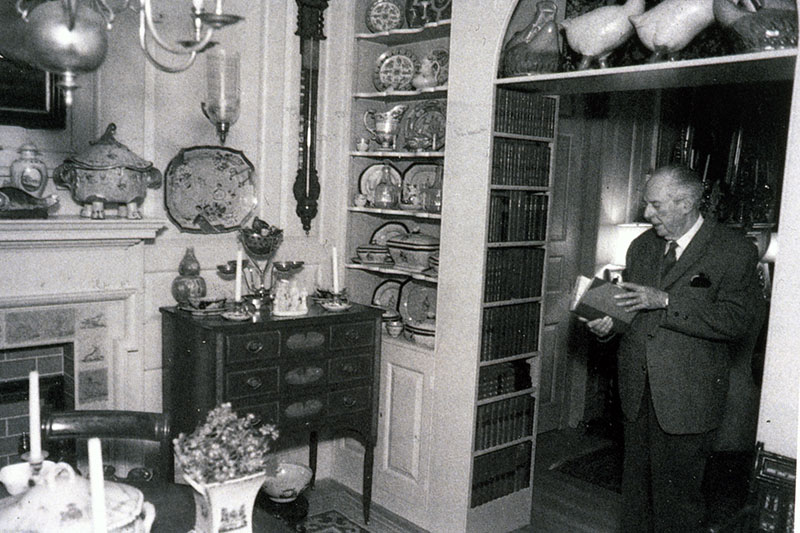
As he approached retirement, he moved into a two-bedroom, 1,280-square-foot apartment in September 1958 (figure 3). Shutze did not really cook, so he repurposed his oven and dishwasher as ceramics storage. And since he never had guests occupying the second bedroom, he used the bathtub for storage as well.
In his letters, often referring to ads in The Magazine ANTIQUES or Connoisseur, he was relentless in questioning dealers regarding correctness and authenticity. In fact, Shutze read his monthly issue of ANTIQUES the way someone today might browse clothing catalogs as he shopped his way through print ads from the nation’s top dealers. In reverse, Shutze often sent sketches of what he wanted, illustrating his informed pursuit of a known artifact. He was very specific and in most cases located exactly what he sought.
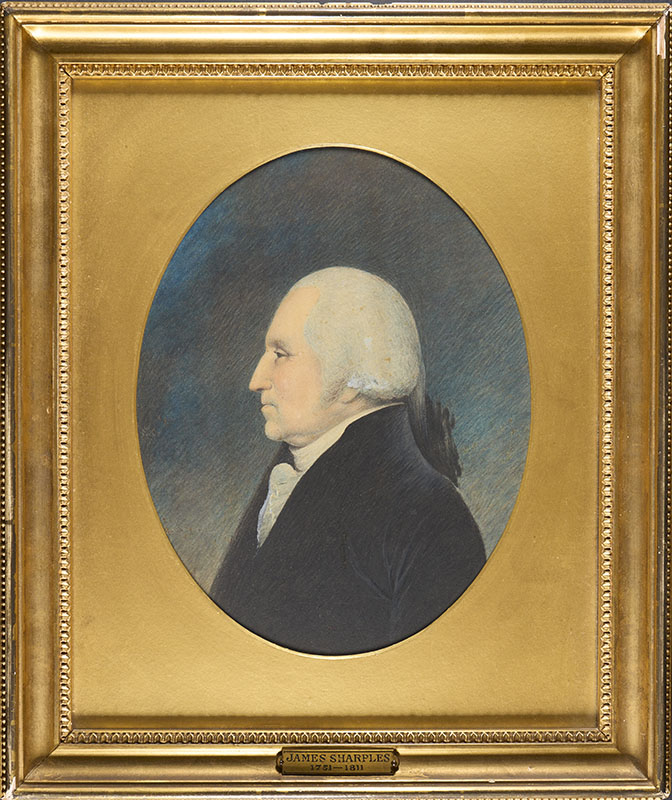
Auction catalogues offered another way for Shutze to add to his collection, and he was an early subscriber to the New York auction house, Parke-Bernet. He studied the materials carefully and noted prices and occasional comments in the margins. As Shutze’s flurry of collecting ended, his final indulgence was a Parke-Bernet sale in early 1954 when he purchased 13 exceptional lots, including a James Sharples pastel of George Washington (figure 4). Afterward, Shutze’s occasional purchases tapered off nearly completely by 1970.
In his aforementioned 1974 essay on decorative arts, Shutze advised that, to become a knowledgeable collector, an individual required rigorous study—not only by visiting galleries and museums but by absorbing books and related publications. It is evident through his notes, correspondence, and the list of
his purchases that he sought to emulate the collectors who not only assembled notable decorative arts of their own but influenced museums in the first half of the 20th century through the generosity of their donations.
Shutze followed that example by providing Atlanta History Center with the records of his architectural career, his rare book and research libraries, and his splendid collection to share with the public. We, who are the recipients and who remain the stewards of his collection, acknowledge Philip Trammell Shutze as Atlanta’s Consummate Collector.
- “The Decorative Arts,” Philip T. Shutze, 1974, Philip T. Shutze Papers, MSS 498, Kenan Research Center at Atlanta History Center.
- Philip T. Shutze to F.A. Stainforth, Boston Antique Shop, May 25, 1949, Shutze Papers, MSS 498.
Michael Rose is the Harvey Mosely Smith Curator of Decorative Arts and Special Collections at Atlanta History Center. Decorative Arts Trust members visited Atlanta History Center and Shutze’s Swan House during the Spring 2026 Symposium in Atlanta.
A print version of this article was published in The Magazine of the Decorative Arts Trust, one of our most popular member benefits. Join today!