
The Midlands: Country Houses of the English Heartland
STUDY TRIP ABROAD
September 12–20 and September 25–October 3, 2027
OPTIONAL EXTENSION
London and Kent: The Fabric of English Taste
September 20–25
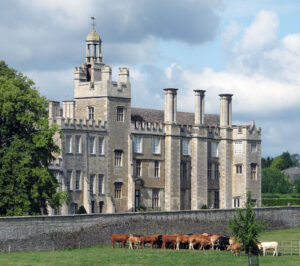
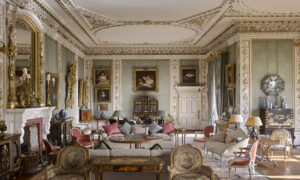
Explore Northamptonshire, Bedfordshire, and the surrounding counties during a fall Study Trip Abroad to central England. We visit a splendid range of country houses where we have special access and where impressive collections are complemented by conservation studios and gardens. The itinerary is headlined by such storied residences as Burghley, Althorp, and Drayton. Two special installations at the Victoria and Albert Museum serve as the anchor of a London-based extension that also features important historic houses in Kent, including Knole and Penshurst Place. The Decorative Arts Trust is famed for our unforgettable excursions to Britain, so mark your calendar for this opportunity to benefit from the warm welcome and insight of curators, conservators, and homeowners.
There is still availability for Tour 2 (September 25–October 3), but Tour 1 (September 12–20) and the Optional Extension (September 20–25) sold out during advance registration, a benefit of our members at the Ambassador and Champion levels. Please email programs@decorativeartstrust.
ITINERARY (subject to amendment)
September 12 and 25
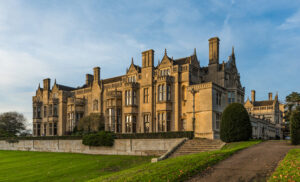
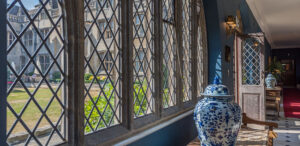
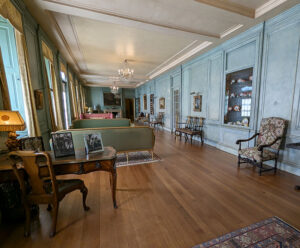
Tucked away in the rolling green expanse of England’s Midlands, Rushton Hall Hotel and Spa awaits our arrival. Conveniently situated amid the constellation of important houses that comprise the first stretch of our journey, Rushton Hall is itself a Medieval marvel set within 25 acres of formal grounds and parkland. The Hazelton family bought the property in 2003, restoring and converting it for luxury accommodations that combine the best of historic character and modern comfort. We will gather in the Library for a welcome reception and introductory lecture by Megan Aldrich, decorative arts and country house historian. Afterward, we will continue for a festive opening dinner.
Overnight: Rushton Hall
Included: R, D
September 13 and 26
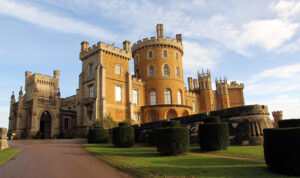
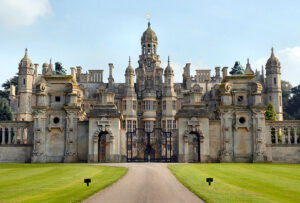
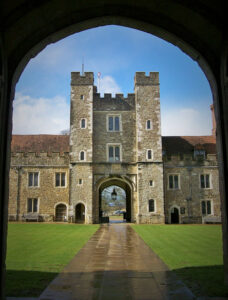
In the morning, we depart northward to Belvoir Castle for a private visit by kind arrangement with the Duke of Rutland. This castellated country house is both ancient and new, having been rebuilt in the 16th century, then again by Inigo Jones’s pupil John Webb in 1668 after the English Civil War. In 1801, James Wyatt completed an exterior remodel that showcases the romantic setting imbued in the region’s grandest Elizabethan houses. Belvoir synthesizes a projecting tower, Gothic windows, and rib-vaulted entrance hall with the design forces of later centuries seen in 18th-century hand-woven silks and the famous Don Quixote tapestry series from Paris’s Gobelins Royal Manufactory. We enjoy lunch before continuing for a private tour of sprawling and magnificent Harlaxton Manor. Completed in 1851 for wealthy Nottinghamshire businessman Gregory Gregory, the spectacular architecture combines Gothic, Jacobethan, and Baroque elements. A forest of turrets, spires, and chimney stacks rises above a more traditional Elizabethan plan, executed in dressed Ancaster limestone and brick. The gardens feature French terraces, a Dutch canal, and a 19th-century conservatory containing tropical plants, some of which were donated by the Royal Botanical Gardens at Kew. The picturesque mile-long drive over an ornate bridge up to the Manor completes the fairytale effect. In the afternoon, we return to the hotel for a convivial pub dinner.
Overnight: Rushton Hall
Included: B, L, D
September 14 and 27
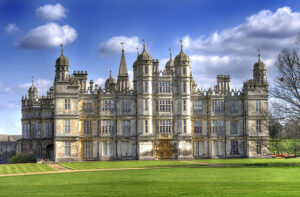
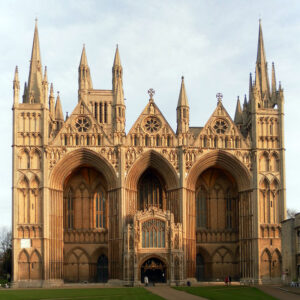
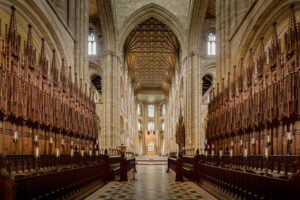
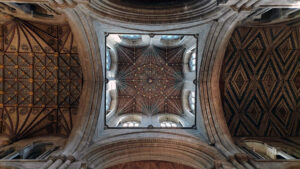
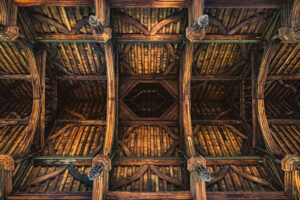
Burghley House is one of the largest and finest houses of the Elizabethan age. Designed and built between 1555 and 1587 for Sir William Cecil, later 1st Baron Burghley, Lord High Treasurer to Queen Elizabeth I, his interest in Classical architecture is evident in the house’s round-arched loggias and tidy symmetry. The work of master plasterer Edward Martin adorns the ceilings, and the delicate woodcarving of Grinling Gibbons and Jonathan Maine decorate the walls and overmantels. Collection highlights include 16th-century Flemish paintings, 17th-century furniture bedecked in marquetry, and late-17th-century Japanese porcelain. We enjoy lunch onsite before visiting the Family Apartments with Curator Jon Culverhouse and the Furniture Conservation Workshops with Conservator Anthony Beech. We swap the grandeur of Burghley for the magnificence of Peterborough Cathedral, which was founded as a monastic community in 654 CE. The current structure was built in the 12th century, but the striking early Gothic portal with a trio of soaring arches is a 13th-century addition that hides the earlier Norman façade. The nave’s 13th-century decorated wooden ceiling survives, making it unique in Britain and one of only four in the whole of Europe. The tomb of Katharine of Aragon, Henry VIII’s first wife, draws many visitors, as do the spectacular library and archives.
Overnight: Rushton Hall
Included: B, L
September 15 and 28
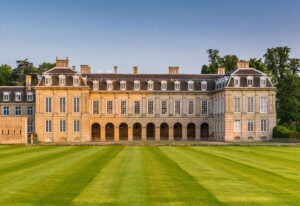
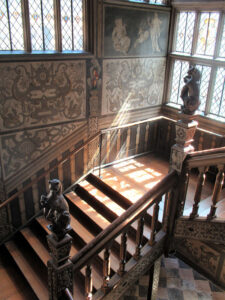
A brief jaunt eastward brings us to Drayton House for a private visit with Archivist Bruce Bailey, by kind permission of Mr. Charles Stopford Sackville. Begun in 1328, the house retains a great deal of its Medieval fabric and character, with a gate tower emblazoned with the coat of arms of Lord Peterborough added in the early 1650s. The house was transformed in the Baroque style in the late 17th and early 18th centuries, when its unique spiral cantilever oak staircase was added. Our invitation includes the opportunity to partake in a private lunch. We then depart to Boughton House by kind arrangement with the Duke of Buccleuch and Queensberry. Its urbane and sophisticated north façade with mansard roof and bands of rusticated stone betrays the Francophile tastes of the 1st Duke of Montagu. Ambassador to the court of Louis XIV in the 1660s and 70s, Montagu furnished his country seat with the latest in French glamor. Dazzling decorative arts abound, including a pair of Meissen swans, japanned chairs, walnut furniture upholstered in plush red velvet, and a Boulle writing table given by Louis XIV to the 1st Duke. At the nearby Summerfield + Scott workshop, we conclude the day with a drinks reception followed by a presentation about rush harvesting and craft traditions in the region.
Overnight: Rushton Hall
Included: B, L, R
September 16 and 29
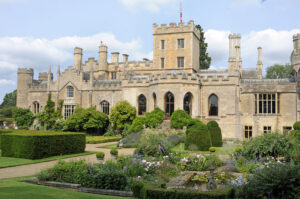
We are welcomed at Elton Hall for tours of the house and garden with the home’s current steward, Alexandra Proby. Her parents undertook massive restoration projects beginning in the 1980s, updating the infrastructure, conserving much of the paintings and furniture, and enhancing the garden. Today the exterior represents generations of additions and expansions in successive styles. The oldest part of the house is a 15th-century tower that rises above the main block. The interior holds a rich collection of Sèvres porcelain and 18th-century French furniture, including a set of Louis XVI chairs covered with scenes from the La Fontaine in Beauvais tapestry. We share a private lunch with our host before departing westward to Deene Park, by the kind invitation of Charlotte and Robert Brudenell. Early-16th-century additions complement the Medieval origins of this rather serious-looking castellated house, the facade of which is softened by a two-story porch with Classical pilasters and frieze carvings of mermaids and cupids. This was the home of Lieutenant-General James Thomas Brudenell, 7th Earl of Cardigan, who commanded the Light Brigade during the Crimean War. His swashbuckling portrait hangs over the fireplace, alongside a rich suite of family portraits, heraldic stained glass, and a collection of equestrian paintings. After dining with our hosts, we return to the hotel for our final evening in the embrace of Rushton Hall.
Overnight: Rushton Hall
Included: B, L, D
September 17 and 30
Once a Tudor manor, Lamport Hall is architecturally noteworthy for a 1655 revamp executed by the aforementioned John Webb. The influence of Inigo Jones’s Banqueting House in London is evident in the rusticated stonework and alternating semicircular and triangular window pediments. Charles Isham inherited Lamport in 1846 and developed a whimsical and much-admired rockery in the gardens over the next two decades. We travel to Cottesbrooke Hall for lunch hosted by Mr. and Mrs. Alastair Macdonald-Buchanan. One of several Midlands houses that claims to be the inspiration for Jane Austen’s Mansfield Park, this elegant brick home contains a fine collection of hunting pictures celebrating the exploits of the famous Pytchley Hunt. We enjoy an afternoon tour of the garden at Coton Manor. Laid out on terraces sloping down from a 17th-century residence, the gardens were created in the 1920s and further developed by successive generations. The site is beloved for its bluebell wood, wildflower meadow, and free-roaming flamboyance of flamingos. Fawsley Hall Hotel and Spa welcomes us for the remainder of the program. Another country house of note, the Great Hall was commissioned in 1537 by Sir Edmund Knightley. The surrounding parkland was overhauled in the 1760s by famed landscape architect Capability Brown. Our day concludes with dinner together at the hotel.
Overnight: Fawsley
Included: B, L, D
September 18 and October 1
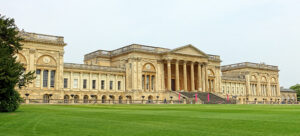
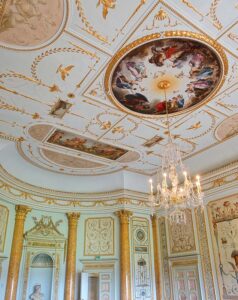
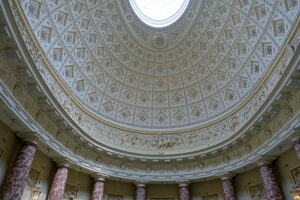
A morning of private touring at Claydon House introduces the stunning fragment of what was once an expansive mansion, much of which was demolished in the 1790s. Claydon contains some of the finest Rococo interiors in England. Principal designer Luke Lightfoot, a talented London stonemason and woodcarver, provided the elaborate internal decoration. Ceilings, overmantels, doors, and alcoves are encrusted with his spellbinding work. Herons, swans, and mythical wyverns with their barbed tails are perched around the house. In the Chinese Room, tiny bells hang from a carved pagoda overlooking bamboo furniture imported from Canton in 1800. After a revitalizing lunch, we travel to Stowe House and Gardens. One of the largest dwellings in England, Stowe presides over one of the country’s most culturally significant landscape gardens. The estate was acquired in the 16th century by the Temple family whose wealth, like many landed families of the region, derived mainly from sheep farming. In the 1740s, Head Gardener Capability Brown pioneered the English landscape garden format here, introducing grassy vistas, serpentine bodies of water, and informal planting schemes. His Grecian Valley transformed what was once treeless pasture into a sweeping naturalistic vista, complete with the Temple of Concord and Victory at its head.
Overnight: Fawsley
Included: B, L
September 19 and October 2
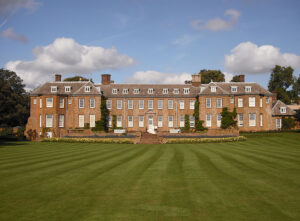
Broughton Castle is a moated and fortified manor house set in meticulously manicured parkland that has remained in the hands of the Lords Saye & Sele since the late 15th century. Built of warm, rustic Hornton ironstone, the Medieval chapel and Elizabethan interiors are accentuated by Mannerist carving and Classical plasterwork, and the upstairs gallery bears Georgian influences with its bold wallpapering and chinoiserie furnishings. Following a fortifying lunch at Broughton, we make our way to Upton House and Gardens. This c. 1695 country house turned hunting lodge is now home to an outstanding collection of paintings that date from the 14th to the 19th centuries, including internationally important works by Pieter Bruegel the Elder, George Stubbs, and William Hogarth. After returning to the hotel for a brief rest, we venture to Althorp for a grand finale by kind arrangement with the 9th Earl Spencer. This glorious house contains its late-16th and late-17th framework, but the refaced brick and tile exterior with decorative pilasters illustrate the hand of Henry Holland, working on behalf of the 2nd Earl in the 1780s. Intricate plasterwork ceilings by John Woolston hover above notable collections of furniture by George Seddon, comfortably arranged for modern use yet complementing their rich historic contexts. This closing salvo includes a private farewell dinner at Althorp, where we reflect on our journey through the best country houses of England’s heartland.
Overnight: Fawsley
Included: B, L, D
September 20 and October 3
Guests transfer to Heathrow Airport for stateside connections or continue to London for the Optional Extension (Tour 1 only).
Overnight: London
Included: B
OPTIONAL EXTENSION London and Kent: The Fabric of English Taste
September 20
We are welcomed in London at the Lalit Hotel. This imposing 19th-century private school turned chic contemporary haven boasts arresting views of the city from its perch near Tower Bridge. Jenny Saunt, Senior Curator of Furniture and Woodwork at the Victoria and Albert Museum, sets the stage with a welcome lecture. Afterward, we enjoy an out-of-hours visit and drinks reception at 40 Leadenhall Gallery, the exhibition space for the artisans at Cockpit Arts. Established in 1986, Cockpit is a charity and gathering place for independent artists and craftspeople. The more than 175 makers at Cockpit’s two locations produce ceramics, carved wood and stone, marbled paper, leather goods, and more. Our evening concludes with dinner at an excellent restaurant just steps from the hotel.
Overnight: London
Included: R, D
September 21
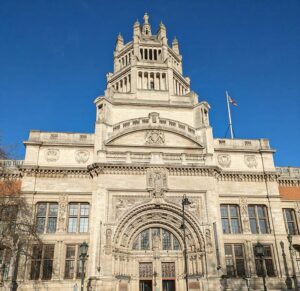
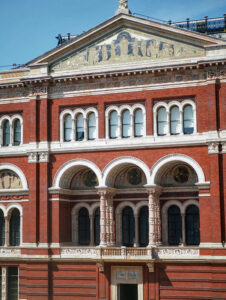
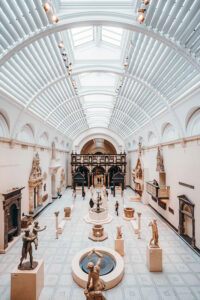
We benefit from a lengthy stop at the Victoria and Albert Museum for curator-led tours of two momentous decorative arts installations. Jenny Saunt is creating an exhibit, supported in part by the Decorative Arts Trust, that reanimates 17th-century furniture through reproduction upholstery produced in partnership with the Royal School of Needlework. After lunch, we have the chance to tour Chintz, scheduled to open a few days prior to our visit. The exhibition looks across four centuries of creativity to rediscover the story of this coveted, contentious material from its origins in southern India to its feverish use in 18th-century English interiors to contemporary interpretations. We return to our hotel in advance of the evening’s activities. The London Glassblowing Studio welcomes us for an after-hours drinks reception and glassblowing demonstration by Tim Rawlinson, Creative Director. London Glassblowing is one of the country’s longest-running hot glass studios and holds one of its most distinguished glass art galleries.
Overnight: London
Included: B, L, R
September 22
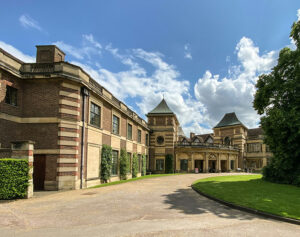
We depart southward to Kent to continue our education in England’s finest country houses. Now in the care of the National Trust, Knole is situated on 26 acres of gardens and fields with another thousand that make up the area’s last remaining Medieval deer park. From Sir James Fiennes to the Archbishop of Canterbury to King Henry VIII to many generations of the Sackville family, each subsequent owner has added to the house’s size and complexity, resulting in a multilevel labyrinth. Rare 17th-century furnishings grace the interior, including state chairs upholstered in rich textiles connected to the aforementioned project at the Victoria and Albert Museum. We enjoy private tours of the house and Conservation Studio, where conservators care for the National Trust’s treasures. After lunch, we continue to Eltham Palace, a 14th-century royal residence transformed into a masterpiece of Art Deco design. Originally given to Edward II in 1305, the house hosted members of the monarchy for more than 200 years until Henry VIII directed his attention and resources to Hampton Court. In the 1930s, Virginia and Stephen Courtauld leased the property from the Crown and commissioned budding architectural firm Seely & Paget to design a stylish residence that retained as much of the historic palace as possible. The result is a unique synthesis of Medieval and Modern. Upon returning to the hotel, we make a brief trek to a highly regarded restaurant for a private dinner.
Overnight: London
Included: B, L, D
September 23
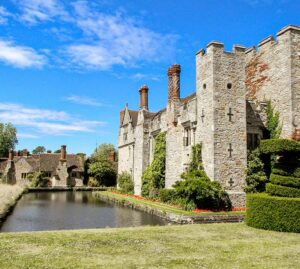
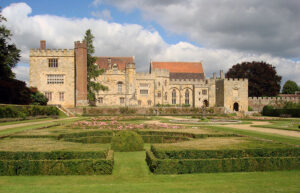
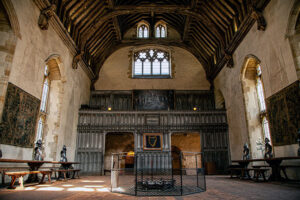
We journey southward once more to Hever Castle, a 13th-century country house that was the childhood home of Anne Boleyn, second wife of Henry VIII and mother of the future Elizabeth I. The panelled rooms contain fine furniture and tapestries, as well as a spectacular assemblage of Tudor portraits, and two prayer books that belonged to Boleyn and bear her inscriptions. Much of what is visible today is the result of the remarkable efforts of William Waldorf Astor, who restored and expanded Hever in the early 20th century, adding a Tudor village and an Italian garden complete with Classical statuary. We depart for Penshurst Place for lunch and a visit with Head of Collections Nicola Stitchman. This Elizabethan family home retains its original Medieval hall and kitchen wing, showcasing early domestic architecture. Despite 19th-century renovations, 17th-century furnishings fill the house, including a state bedchamber with a green velvet canopied bed and lavish tapestries from Brussels. Extensive formal gardens are divided into ten rooms, with blooms varying throughout the change of seasons.
Overnight: London
Included: B, L
September 24
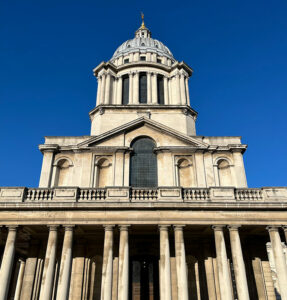
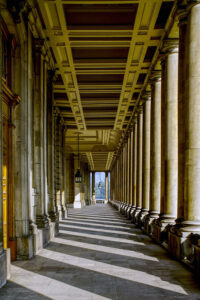
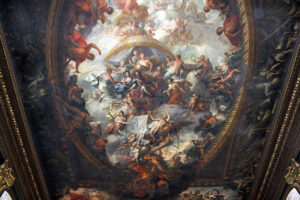
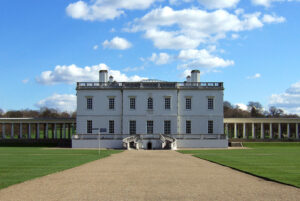
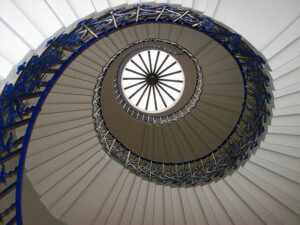
On our final morning of the extension, early risers may wish to take a short walk to Bermondsey Antiques Market, where dealers set out their wares every Friday. The stalls reward a leisurely browse, with silver, ceramics, glass, jewelry, and other treasures among the finds. From the hotel, we depart by coach to the aforementioned Cockpit Studios for demonstrations of the training, materials, and techniques that shape the makers’ work. We continue to Greenwich for a private lunch at the Old Royal Naval College. The riverside complex, designed by Sir Christopher Wren and Nicholas Hawksmoor, originally housed retired sailors and later trained naval officers. We then walk through the grounds to the Painted Hall, conceived as the sailors’ dining room. Sir James Thornhill spent 19 years painting its walls and ceilings, and a recent conservation project has returned his magnum opus to its former glory. On the ceiling of the Lower Hall, William and Mary preside over an assembly of allegorical figures, part of a Baroque decorative scheme that celebrates Britain’s growing naval and commercial power. Our final visit is a private tour of the Queen’s House, commissioned in 1616 by Anne of Denmark, wife of James I, and completed by Charles I for Queen Henrietta Maria. Inigo Jones brought the symmetry and proportions of the Italian Renaissance to Greenwich, designing the villa to straddle the road that separated the Tudor palace from its park. After the Restoration, Charles II added two rooms that gave the house its square plan.
The National Maritime Museum’s art collection (on view at the Queen’s House) includes unrivaled holdings of early Dutch and English sea paintings. We gather for a closing dinner, raising a glass to the remarkable places we have explored and the company in which we discovered them.
Overnight: London
Included: B, L, D
September 25
Guests transfer to Heathrow airport for stateside connections or enjoy a relaxed morning before joining their fellow travelers for the beginning of the main program in the Midlands (Tour 2 only).
Included: B
Land Arrangement Cost: $10,300 per person, based on double occupancy for 8 nights. For the Optional Extension, $5,975 per person, based on double occupancy for 5 nights.
Included in Trip Cost: Hotel accommodations in 4-and 5-star hotels; 8 breakfasts (B), 7 lunches (L), 2 receptions (R), and 5 dinners (D) for the Main Tour; and 5 breakfasts, 4 lunches, 2 receptions, and 3 dinners for the Extension. Private coach transportation; local guides; admission in museums, historic houses, and gardens; gratuities for professional guides and coach drivers; porterage; and private airport transfers for arrivals on the days immediately preceding the Main Tours and Extension as well as departure days (Tour 1: September 11, 12, and 20; Tour 2: September 24, 25, and October 3; Extension: September 19, 20, and 25). For those who wish to extend their stay we can arrange extra nights at the hotels listed for an additional cost.
Not Included in the Trip Cost: Airfare, airport transfers other than specified above, alcoholic beverages other than when provided, personal expenses, and trip insurance are not included. Transatlantic airfare is not included. Please do not make your airline reservations until you have received written confirmation of your registration from the Trust.
Reservations: A deposit of $2,500 per person for the Main Tour and $1,000 per person for the Extension is required at time of registration. Reservations and deposits are taken on an as-received basis. You will receive written confirmation from the Trust when we receive your registration.
Single Supplement: The single supplement is $1,500 for the Main Tour and $975 for the Extension, to be paid with the final balance.
Final Payment: Will be due by May 7, 2027.
Membership: Membership at the Sponsor level is required for participation in Study Trips Abroad. Your membership contribution is tax-deductible. If an increase in your membership level is necessary, the Trust will invoice you for the appropriate level upgrade with your final payment.
Contribution: A $500 donation to the Trust per person is required for Study Trips Abroad. This gift is fully tax deductible and helps support the Trust’s mission and programs.
Itinerary: The schedule outlined in this itinerary is contracted at this time but subject to change as necessary.
Participation: The trip is limited to a maximum of 25 members and requires a minimum of 20. The trip will be canceled if under-subscribed, and deposits will be refunded.
Activity Level: The Trust’s Study Trip Abroad itineraries are planned with care and attention to detail to ensure a memorable and rewarding trip for all participants. This itinerary is strenuous and includes standing for long periods of time, walking on uneven surfaces, and ascending and descending stairs without handrails. Please consider if this program is suited for your health, physical condition, and individual circumstances.
Cancellation and Refunds: If you must cancel your reservation, you are urged to do so as soon as possible in writing to the Trust. All cancellations are subject to an administrative fee of 10% of the Land Arrangement Cost ($1,030 fee per person). Processing fees for online payments are nonrefundable. All deposits are refundable (less the administrative fee) on or before March 5, 2027. Cancellations arriving on or before June 4, 2027, are subject to a full refund less the deposit. Cancellations arriving on or before July 2, 2027, will receive a 50% refund. Cancellations arriving on or before July 30, 2027, will receive a 25% refund. There will be no refunds for cancellations received after July 30, 2027, The Decorative Arts Trust strictly adheres to its cancellation policy to offset costs incurred prior to the commencement of a program and therefore no exceptions can be made.
The Trust strongly encourages all participants to purchase travel insurance to protect against cancellations due to illness, injury, and other disruptions.
If you have questions about the Terms & Conditions of this program, please email programs@decorativeartstrust.org.