
Enlivening Ancient Vessels: Interactions with Roman Bronze Figural Balsamaria
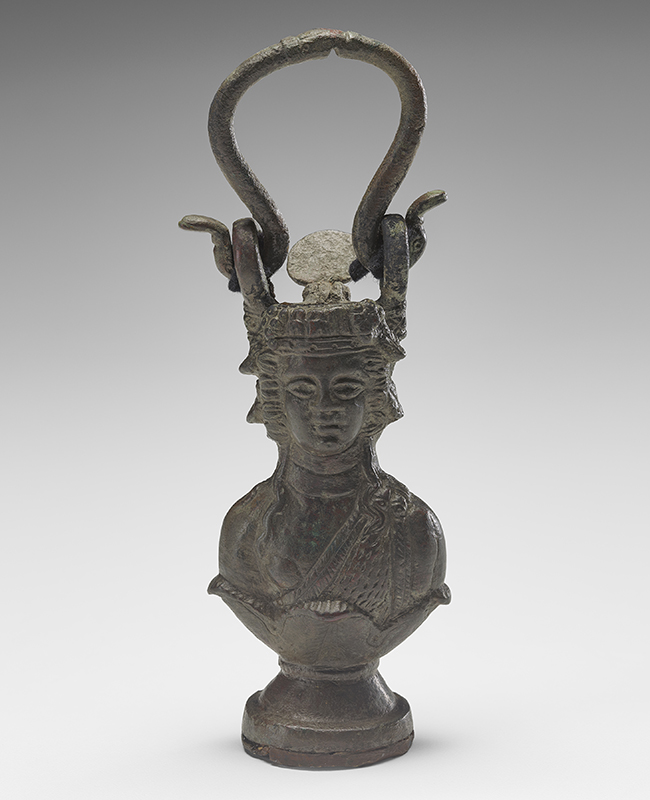
Click on images to enlarge them and view captions.
by Arielle Suskin
Thanks to the support of a Decorative Arts Trust Research Grant, I spent three weeks traveling to several institutions on the East Coast to study Roman bronze figural balsamaria for my dissertation in Art History at Case Western Reserve University. Balsamaria (singular balsamarium) are a somewhat enigmatic genre of Roman metalwork. They are small containers in the shape of human heads or busts, ranging from approximately two to eight inches tall, typically featuring hinged lids and applied handles.
The vast majority of balsamaria have been excavated from Roman provincial contexts, particularly in areas of major military activity. The focus of my research is to identify which groups of people within the liminal spaces of Roman border communities used these vessels and why. In order to complete such a complex task, I needed to understand their construction and how ancient Romans interacted with a balsamarium, information I could only gain through examining the vessels first-hand.
I studied examples at the Brooklyn Museum; Harvard Art Museums; the Museum of Fine Arts, Boston; the RISD Museum; the Virginia Museum of Fine Arts; and Yale University Art Gallery. The opportunity to analyze a significant quantity and range of balsamaria was an incredible experience.
The objects varied greatly in style and often in iconography, and I gained insight into their construction and different artisans’ strategies for incorporating the lid and handles. Most of the detail work was rendered in the mold, before the balsamaria were cast in bronze through the lost-wax casting method. Although no molds for balsamaria have been found in the archaeological record, their hollow bodies and separately soldered bases reveal their construction. After casting, the metalworkers articulated the handles alongside important details like eyes and locks of hair through chasing. The inclusion of decorative elements may have been at the discretion of the artisan, but the ornamentation was clearly important.
Bronze figural balsamaria have been found in archaeological excavations throughout the Mediterranean and from Portugal to Bulgaria. The leading theory is that balsamaria were containers for perfumes or oils and incorporated in bathing kits. Researchers are still determining the contents. Organic compounds degrade over time, and the few balsamaria found in archaeological contexts with surviving residue produced different results, such as a fat, an oil, and a powder, all of which were used as perfume bases in antiquity. The variation in materials may be related to regional preferences, just as the variety of balsamaria styles indicates local production in the many Roman provinces.
More than half of the balsamaria that I studied depict Bacchus (figure 1), the Roman god of wine and celebration, and Dionysos to the Greeks. Even though the style varied from naturalistic plasticity to schematic rendering, they consistently showed the same iconographic elements: a youthful god with long hair, a wreath with ivy and/or grapes from which the handle lugs extended, and a garment worn over the proper right shoulder. Depictions of Bacchus vary widely across the Roman empire, so the consistency of iconography among these balsamaria is compelling and may indicate a ritual significance. Many of the Bacchus balsamaria are said to be from Egypt (figure 1), but similar vessels have been found elsewhere in the empire.
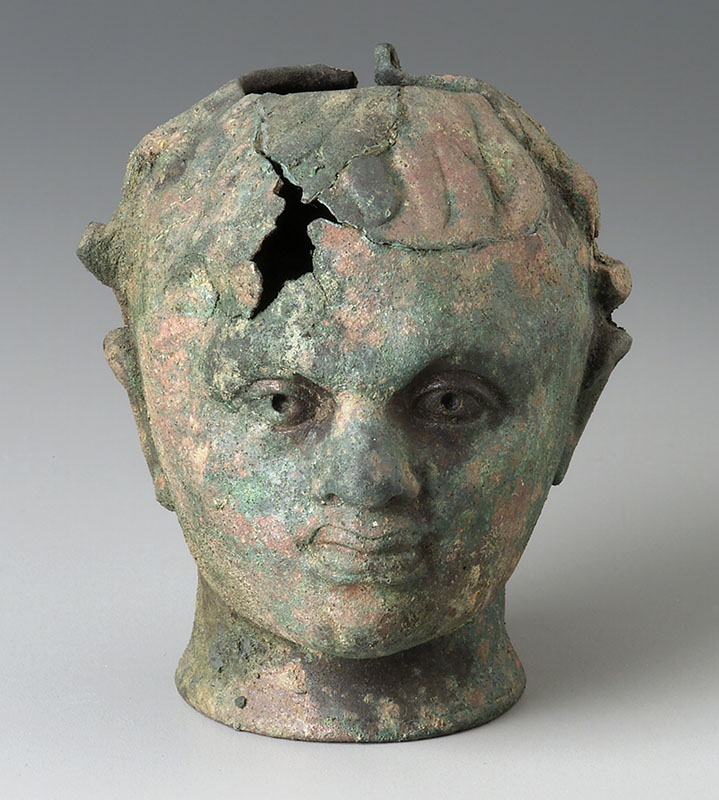
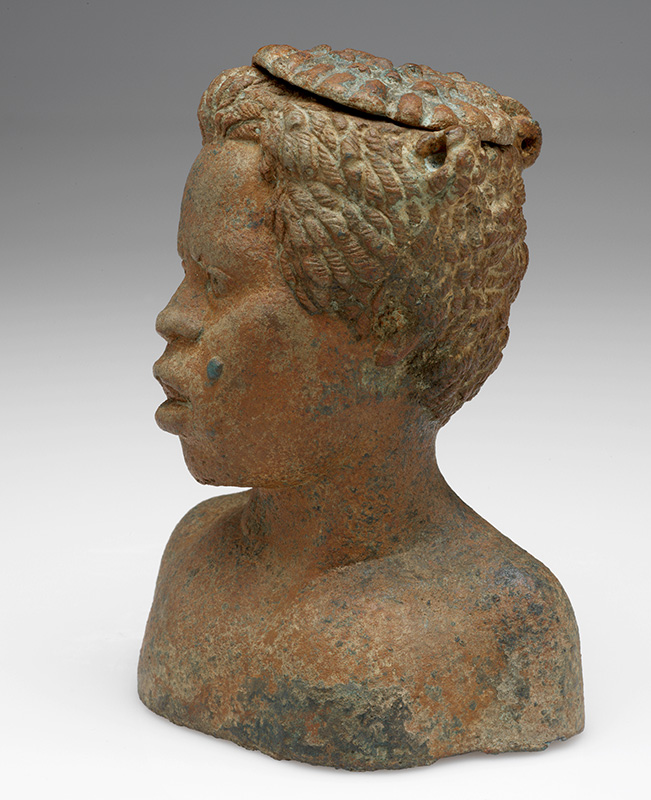
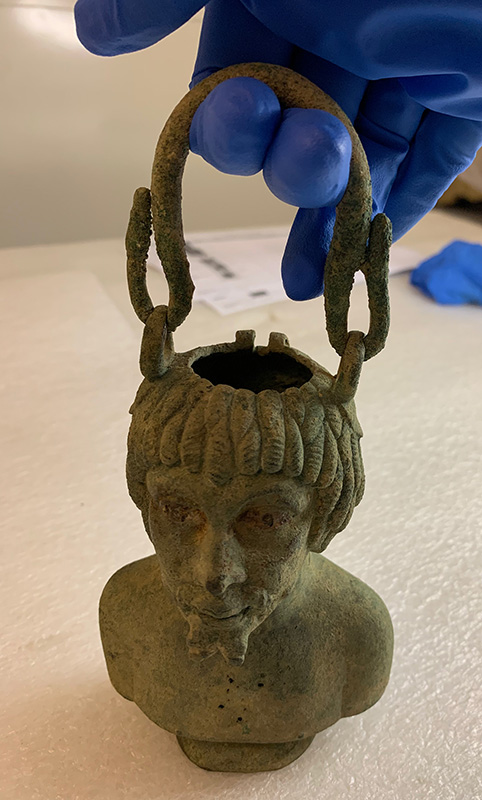
In addition to Bacchus, balsamaria often depict his mythological followers, such as Silenoi, satyrs, fauns, and the rare female maenad. A balsamarium in the Museum of Fine Arts, Boston (figure 2) is identified as a satyr, but also strongly resembles balsamaria that depict very young children. Several balsamaria present images of Aethiopian men or youths (figures 3 and 4). Aethiopian was a term used in Greco-Roman antiquity to describe people or peoples from the region south of Egypt and the end of the known world. They are often presented as enslaved figures but could also embody “the exotic” or connote associations with cults in Roman Egypt. I aim to connect these various iconographies.
I also endeavored to understand how individuals may have interacted with these vessels. There are no surviving depictions of bronze figural balsamaria in use. Each balsamarium showed clear evidence of wear on the handle lugs. The handles are too small to accommodate an adult hand (see figure 4), and Romans must have adopted a particular way of carrying them. Most of the comparable balsamaria were recovered from grave assemblages, but wear patterns indicate these vessels were used in life.
The ability to interact with so many balsamaria was invaluable to my research. I am grateful for this opportunity to work with the variety of museum professionals who care for these objects and to visit the wonderful institutions where they reside. I now have a much better understanding of how these small but complicated vessels were made, and how ancient people may have interacted with them.
- Majewski, Kazimierz. “Brazowe Balsamaria Antropomorficznew Cesarstwie Ryzmskim.” Archeologia: Rocznik Panstwowego Muzeum Archeologicznego w Warszawie i Polsikego XIV (1963): 95–126.
- Nenova-Merdjanova, Rossitsa. “Roman Bronze Vessels as part of instrumentum balnei.” In Roman Baths and Bathing: Proceedings of the First International Conference on Roman Baths held at Bath, England 30 March–4 April 1992. Journal of Roman Archaeology (1999). Supplementary series Number 37.
- Marti, Valérie. “De l’usage des balsamaires anthropomorphes en bronze.” Mélanges de l’École française de Rome. Antiquité 108 no.2 (1996): 979–1000.
Arielle Suskin is a PhD candidate in Art History at Case Western Reserve University.
A print version of this article was published in The Magazine of the Decorative Arts Trust, one of our most popular member benefits. Join today!