
Northern India: A Confluence of Color and Ornament
EVENTS > STUDY TRIPS ABROAD
STUDY TRIP ABROAD
January 30–February 11 and February 16–28, 2027
Join us for a dazzling journey through Delhi, Jodhpur, and more in our first ever Study Trip Abroad to India. From Agra’s wondrous Taj Mahal to the Pink City of Jaipur, together we explore the artistic and architectural legacy of western and northern India, tracing centuries of courtly patronage, mercantile wealth, and devotional expression. We visit Mumbai’s colonial façades and rock-hewn cave temples, the sandstone citadels of Rajasthan, and the glittering lakeside palaces of Udaipur, encountering decorative arts in their original cultural contexts. Museums, artisan ateliers, and private collections illuminate India’s layered aesthetic traditions where weaving, metalwork, miniature painting, and stone carving continue to thrive. Expert-led tours and conversations with craftspeople provide deeper insight into both historic masterworks and living traditions. Along the way, we savor regal cuisine in historic settings, where flavors tell tales of dynasties past. This carefully orchestrated experience blends grandeur, heritage, and indulgence, inviting you to engage with India’s splendor as never before.
REGISTRATION FULL
This program is sold out. Please contact us at programs@decorativeartstrust.org to join the waitlist.
ITINERARY (subject to amendment)
January 30 and February 16
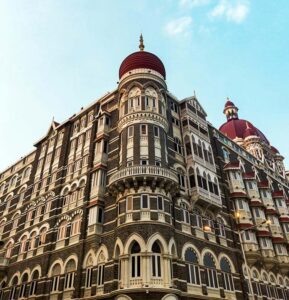
Our introduction to India begins in Mumbai, a vibrant coastal city saturated in style and sophistication. The country’s financial capital, this port city overlooks the Arabian Sea and is perhaps best known as the home of the Bollywood film industry. With 16 million people occupying a curving promontory, bustling hardly describes its lively market and street food scene. We gather at the historic Taj Mahal Tower, an iconic luxury hotel built in the ornate Indo-Saracenic style. The Taj Mahal Palace opened in 1903, and the Tower Wing was added in 1973. Overlooking the Gateway of India and Mumbai’s historic harbor, the Tower offers the perfect place to reflect on the artistic and mercantile history of India’s western seaboard, long a gateway for trade and cultural exchange. A welcome lecture frames our exploration of Indian decorative arts, after which we gather for opening drinks and dinner in this picturesque locale—an elegant prelude to the journey ahead.
Overnight: Mumbai
Included: R, D
January 31 and February 17
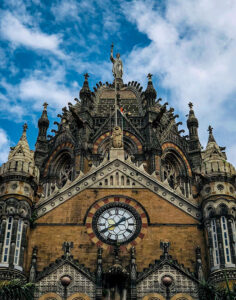
Our morning exploration of the city illuminates its role within the British Empire and global trade networks. Mumbai, formerly Bombay, was originally composed of seven islands gradually unified through land reclamation between the 17th and 19th centuries. Its prosperity soared with the opening of the Suez Canal in Egypt in 1869, revolutionizing trade between India and Europe.We then visit the Chhatrapati Shivaji Maharaj Vastu Sangrahalaya (formerly the Prince Albert Museum), which houses collections spanning art, archaeology, and decorative arts, including Indus Valley artifacts, Indian miniature paintings, sculptures from ancient and medieval sites, and sections of textiles, metalwork, ceramics, and arms and armor. We greet the city at the Oval Maidan, a recreational green space in South Mumbai lined with UNESCO-recognized Gothic Revival and Art Deco architectural ensembles. After enjoying lunch at the Sea Lounge, a chic local eatery boasting Art Deco accents and contemporary British and Indian fare, we travel by private boat across the harbor to the Elephanta Caves. Ascending 120 steps permits us to explore these monumental 5th- and 6th-century rock-hewn sculptures dedicated to Shiva, and reveal an early Hindu sculptural tradition of extraordinary power and refinement.
Overnight: Mumbai
Included: B, L
February 1 and February 18
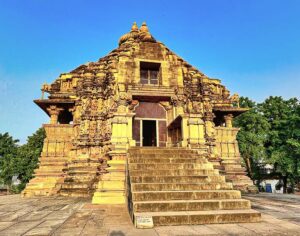
We depart Mumbai via a brief flight to Udaipur. Views from the air reveal the city’s wonderfully romantic setting beside the blue waters of Pichola Lake, glimmering against the green of the surrounding landscape. We check into our luxury accommodations at the Raas Devigarh, an 18th-century palace-turned-hotel, and enjoy lunch. Traveling into the Aravalli Hills, we visit the temple complexes of Nagda and Eklingji, whose intricately carved marble and sandstone structures illuminate early Rajput devotional architecture. At Nagda, a grand incised painting of a lotus flower representing spiritual enlightenment floats overhead on the temple ceiling, and at Eklingji, the four-faced black marble lingam (Chaturmukha) is a sight to behold. Dating to the 8th and 10th centuries, these sacred sites reflect the religious and artistic patronage that has shaped the region’s identity since antiquity. Dinner is served at the Devigarh’s elegant Indo-European restaurant for a companionable evening spent overlooking the mountainous scenery.
Overnight: Udaipur
Included: B, L, D
February 2 and February 19
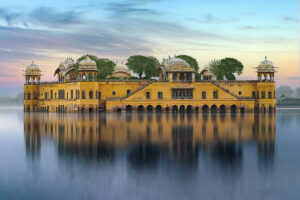
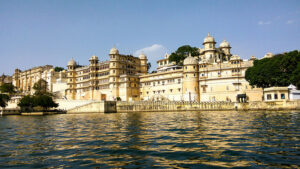
At Udaipur’s City Palace, we explore one of India’s largest, most well-preserved royal complexes, continually expanded over nearly four hundred years by successive rulers of the Mewar dynasty. Rising in tiers above Lake Pichola, its mirrored chambers, painted apartments, and mosaic courtyards reflect generations of tumultuous Rajput rule. The palace’s museum showcases the legacy of centuries of the Mewar dynasty rule, patronage, and artistic excellence through a collection ranging from sculptures, arms and armor, and paintings, to photographs, textiles, ceremonial objects, and maps. Our familiarization with regal architecture continues over lunch at Taj Fateh Prakash Palace, another repurposed palace initially built to receive and impress distinguished guests. Its grand halls, period furnishings, and commanding views across the lake reinforce the performative dimension of hospitality within a courtly setting. We then enjoy a lake cruise to Jag Mandir, a 17th-century island palace developed as a summer retreat and site of diplomatic reception. The marble pavilions, arcaded courtyards, and sculpted elephants at the water’s edge offer insight into courtly leisure and ceremonial display. In the evening, we return to our hotel for dinner and a farewell to Udaipur.
Overnight: Udaipur
Included: B, L, D
February 3 and February 20
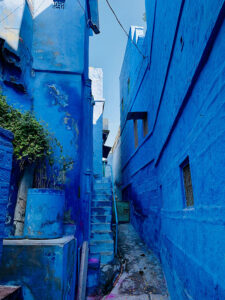
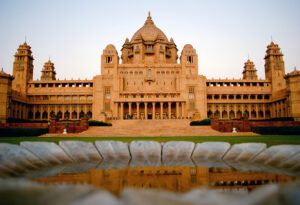
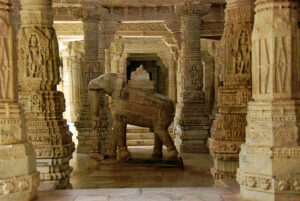
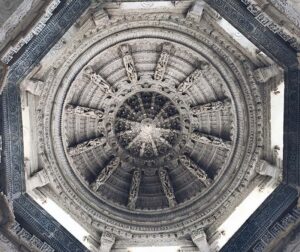
Driving north toward Jodhpur, we pause at Ranakpur to visit its 15th-century Jain temple complex, a masterpiece of sparkling white marble distinguished by 1,444 uniquely sculpted pillars. Commissioned by a merchant under the patronage of a local ruler, the temple exemplifies western India’s synthesis of devotional craftsmanship and mercantile patronage. Its domed halls and delicately pierced stone screens create a calibrated interplay of light and shadow, reinforcing the meditative character of the space. Continuing north, we journey from the undulating verdant hills of southern Rajasthan to the golden, rolling sand plains approaching the Thar Desert, stopping along the way for lunch at Mountbatten Lodge, a colonial relic of opulent luxury in a scenic, rugged landscape. By late afternoon we reach Jodhpur, at the eastern edge of the Thar. Known as the “Blue City” for the indigo-washed houses clustered beneath its fortifications, Jodhpur was the principal seat of Marwar, once the largest princely state in Rajasthan. Founded in 1459 by Rao Jodha as a strategic desert capital, the city prospered by controlling caravan routes linking Delhi and Gujarat. We check into our stately lodgings at the Raas Jodhpur Hotel before enjoying dinner in the walled city.
Overnight: Jodhpur
Included: B, L, D
February 4 and February 21
Situated atop a rocky outcrop overlooking Jodhpur, Mehrangarh Fort dominates northwestern India’s desert skyline, presenting formidable architecture softened by exquisitely decorated interiors. Within its palace apartments, we enjoy close examinations of royal textiles, arms, miniature paintings, and decorative arts preserved by the former ruling family. Nearby, the beautiful marble cenotaph known as the Jaswant Thada memorializes the Maharaja Jaswant Singh II. The pavilion is composed of thin sheets of intricately carved Makrana marble, which glows and appears almost translucent in the sunlight. For lunch, we step away to Khas Bagh, an ultra-chic oasis inspired by the Imperial legacy of a bygone era, with open courtyards and verandas with arches. We return to the Old City to see the royal cenotaphs and a guided walking tour reveals layers of urban craft traditions before a convivial dinner.
Overnight: Jodhpur
Included: B, L, D
February 5 and February 22
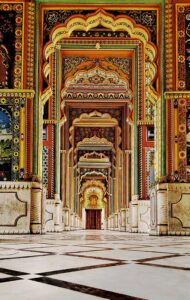
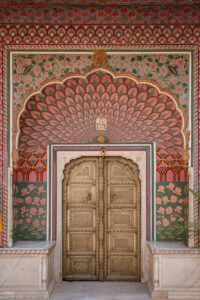
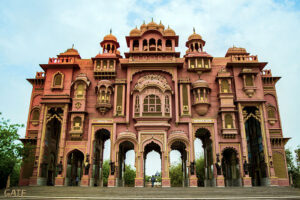
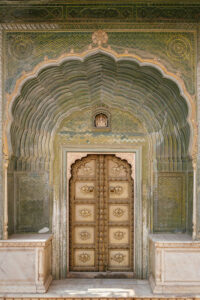
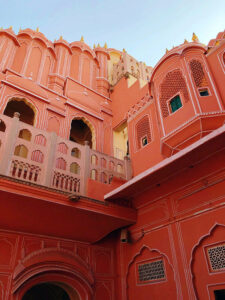
Bidding farewell to Jodhpur, we fly east to Jaipur. “The Pink City” was first rendered rose in 1876 in anticipation of a visit from the Prince of Wales (later Edward VII). The color, a marker of hospitality in Indian culture, was invited to stay after the Prince’s departure, and it remains an iconic feature today. Rigorously planned by Maharaja Sawai Jai Singh II in the 18th century, this capital city was laid out according to principles of Vastu Shastra (Indian feng shui) and urban order with its gridded streets and uniform façades reflecting both intellectual ambition and political authority. Upon arrival, we venture to the Gyan Museum for out-of-hours access to its conservation studios, where we study select highlights from this exceptional family collection of court textiles, jewelry, ceremonial objects, manuscripts, and archival material. Viewed in close context and with insight into ongoing preservation efforts, the material offers a lens into the refinement and ceremonial life of Jaipur’s elite culture. The Gaitore Ki Chhatriyan are a collection of royal cenotaphs that celebrate lineage, valor, and spiritual transcendence. Among the most evocative examples of Rajput architecture, these marble structures are particularly ornate and showcase delicate carving techniques with floral motifs and court scenes. Our day concludes with dinner together before retreating to our suites at the Samode Havli Hotel. Built in the mid-19th century as the private townhouse of the influential Rawals of Samode, noble vassals who once held the post of Prime Minister in the royal court of Jaipur, the property has been lovingly preserved and restored by the same family, now transformed into one of India’s most atmospheric boutique hotels.
Overnight: Jaipur
Included: B, L, D
February 6 and February 23
We ascend to the hilltop complex of Amer Fort, where mirrored halls, painted chambers, and carved gateways exemplify Rajput architectural theatre at its most self-assured. Courtyards and ceremonial spaces demonstrate how spectacle and sovereignty were expressed through material richness and spatial choreography. The Anokhi Museum of Hand Printing will provide a focused study of block-printing traditions, natural dye techniques, and the contemporary revival of handcraft. Through close examination of tools, textiles, and process, we come to understand how technical precision and collaborative labor sustain this enduring practice. Lunch is served at The Johri, set within a sensitively restored haveli in the old city. The afternoon is devoted to visits to distinguished artisan studios, where we encounter jewelers, textile specialists, and craftspeople working within Jaipur’s long-standing mercantile networks, thereby creating an opportunity for curated shopping. Our day concludes at the City Palace, residence to the Jaipur royal family. Dinner at Sarvato on the panoramic terrace combines the pleasure of admiring the Pink City with the subtleties of Rajasthani cuisine.
Overnight: Jaipur
Included: B, L, D
February 7 and February 24
At the City Palace Museum, we examine royal manuscripts, ceremonial textiles, arms, and regalia that illuminate the city’s cosmopolitan court culture. These objects were commissioned, collected, and preserved by successive rulers, showcasing a balance between Rajput traditions and Mughal refinement, as well as the global trade networks that brought luxury materials and artistic ideas to the region. With this intimate viewing, we gain a clearer understanding of the development of Jaipur’s distinctive visual identity. We then tour state-of-the-art jewelry workshops, observing contemporary craftsmanship grounded in historic design traditions, from stone selection and setting to enameling and finishing. Lunch is served at 51 Shades of Pink, a restaurant located within the 18th-century former palace of the Maharaja, and whose name and decor is an ode to the Pink City. The afternoon continues with curated visits to artisan studios specializing in miniature painting and textile production, where hereditary techniques remain central to Jaipur’s craft legacy.
Overnight: Jaipur
Included: B, L
February 8 and February 25
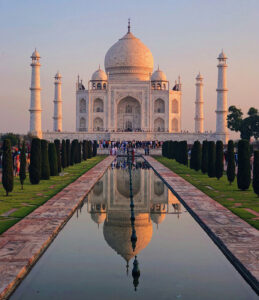
Traveling east to Agra, we devote our morning to a family-run parchin kari workshop, where artisans demonstrate the marble inlay technique similar to pietra dura that was perfected under Mughal patronage. Using hand-cut semi-precious stones set into white marble, this painstaking process reached extraordinary refinement in the 17th century and remains central to Agra’s artistic identity. After lunch, we proceed to one of the most celebrated monuments in the world: the Taj Mahal. Commissioned in 1632 by the Mughal emperor Shah Jahan as a mausoleum for his wife Mumtaz Mahal, the complex was conceived as an imperial statement of devotion, authority, and aspiration. The symmetrical garden plan evokes the Qur’anic vision of paradise, while the luminous marble surfaces shift in tone with the changing light. At sunset, as the crowds thin and the façade takes on a roseate glow, we study the building’s refined calligraphy, low-relief carving, and intricate floral inlay–ornament integrated so completely into the architecture that structure and surface become inseparable. The building’s balanced design, precise craftsmanship, and manipulation of light achieve a synthesis of architecture and ornament widely regarded as one of the supreme achievements of Islamic architecture. We revel in the shared experience over a hearty dinner of North Indian cuisine.
Overnight: Agra
Included: B, L, D
February 9 and February 26
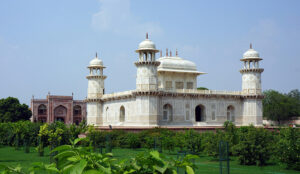
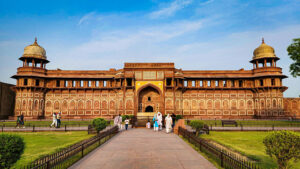
Our first stop of the day brings us to the red sandstone ramparts of Agra Fort, begun by the emperor Akbar in the 16th century and later refined by his successors. Within this fortress’s palaces and audience halls, we trace the evolution of Mughal architecture from robust, martial expression to the marble elegance associated with the reign of Shah Jahan. From the fort’s riverfront terraces, the distant profile of the Taj Mahal offers a poignant reminder of imperial ambition and personal devotion. We continue to the Tomb of Itimad-ud-Daulah, often called the “Baby Taj.” Commissioned in 1622 by Empress Nur Jahan for her father, this jewel-like mausoleum marks a pivotal moment in Mughal design: the transition from red sandstone to white marble and the confident use of parchin kari inlay. Its delicately pierced screens, painted ceilings, and finely cut stone panels anticipate the aesthetic refinement later perfected at the Taj Mahal. After lunch, we travel onward to Delhi, a city layered with successive capitals from the Delhi Sultanate and Mughal courts to the imperial urbanism of the British Raj and the institutions of modern India. Broad ceremonial avenues laid out in the early 20th century intersect with much older neighborhoods, underscoring Delhi’s role as both political center and cultural crossroads. Upon arrival, we check into The Imperial New Delhi, an Art Deco landmark whose colonnaded façades and museum-quality collections evoke the city’s late-colonial chapter.
Overnight: Delhi
Included: B, L
February 10 and February 27
The capital city of India has two distinct personalities: Old Delhi, energetic with its winding alleys, colorful shops, and noisy street traders; and New Delhi, built by the British in 1911 for unabashed imperial display. Our morning focuses on the former, as we explore Chandni Chowk and the surrounding Mughal-era lanes, tracing the mercantile networks that shaped the city’s commercial and artisanal life. We travel to Jama Masjid, Shah Jahan’s great congregational mosque, a defining monument of Mughal urban design. Elevated above the surrounding streets, its vast courtyard, red sandstone façades, and marble domes articulate both imperial authority and civic devotion, anchoring Old Delhi’s ceremonial core. In the afternoon, our focus shifts to New Delhi, where the grand imperial capital planned by Sir Edwin Lutyens and Sir Herbert Baker reveals a distinct architectural dialogue between Classical monumentality and Subcontinental form. We conclude at the National Crafts Museum and Hastkala Academy, whose collections foreground India’s regional textile, metal, and wood traditions, situating living craft within a national narrative. We close with dinner at The Spice Route, one of India’s most iconic and celebrated culinary destinations, whose menu is inspired by the historic trading corridors of the Malabar Coast, Sri Lanka, and Southeast Asia, providing a fitting setting for reflection on the artistic traditions encountered throughout the journey.
Overnight: Delhi
Included: B, L, D
February 11 and February 28
Guests depart for stateside connections or continue with independent travels.
Included: B
TERMS & CONDITIONS
Land Arrangement Cost: $14,425 per person, based on double occupancy for 12 nights.
Included in Trip Cost: Hotel accommodations in 4-and 5-star hotels, 12 breakfasts (B), 11 lunches (L), and 9 dinners (D) for the Main Tour. Private coach transportation; domestic airfares in economy class with 25kg luggage; local guides; admission in museums, historic houses, and gardens; gratuities for professional guides and coach drivers; and porterage. For those who wish to extend their stay we can arrange extra nights at the hotels listed for an additional cost.
Airport Transfers: VIP greeting on arrival in Mumbai and private transfer to the hotel will be provided on the day immediately preceding the tour and the first day (January 29 and 30 for Tour 1, February 15 and 16 for Tour 2). Private transfers for departing flights from Delhi will be provided on the departure day (February 11 for Tour 1, February 28 for Tour 2). Participants wishing for a private transfer upon arrival or departure from an airport outside of the itinerary or on another day will incur a supplementary cost, priced upon request.
Not Included in the Trip Cost: Airfare, airport transfers other than specified above, alcoholic beverages other than when provided, personal expenses, and travel insurance are not included. Transatlantic airfare is not included. Please do not make your airline reservations until you have received written confirmation of your registration from the Trust.
Reservations: A deposit of $3,500 per person is required at time of registration. Deposits are subject to a $1,000 administrative fee in the event of cancellation. Please see “Cancellation and Refunds” for more information. Reservations and deposits are taken on an as-received basis. You will receive written confirmation from the Decorative Arts Trust when we receive your registration.
Single Supplement: The single supplement is $3,100 to be paid with the final balance.
Final Payment: Due by August 28, 2026. Invoices for balance payments will be mailed in July.
Membership: Membership at the Sponsor level is required for participation in Study Trips Abroad. Your membership contribution is tax-deductible. If an increase in your membership level is necessary, the Trust will invoice you for the appropriate level upgrade with your final payment.
Contribution: A $500 donation to the Trust per person is required for Study Trips Abroad. This gift is fully tax deductible and helps support the Trust’s mission and programs.
Itinerary: The schedule outlined in this itinerary is contracted at this time but subject to change as necessary.
Participation: The trip is limited to a maximum of 25 members and requires a minimum of 20. The trip will be canceled if under-subscribed, and deposits will be refunded.
Activity Level: The Trust’s Study Trip Abroad itineraries are planned with care and attention to detail to ensure a memorable and rewarding trip for all participants. This itinerary is strenuous and includes standing for long periods of time, walking on uneven surfaces, and ascending and descending stairs without handrails. Please consider if this program is suited for your health, physical condition, and individual circumstances.
Cancellation and Refunds: If you must cancel your reservation, you are urged to do so as soon as possible in writing to the Trust. All cancellations are subject to a $1,000 administrative fee per person. Deposits are non-refundable after June 26, 2026. Cancellations arriving by October 23, 2026 are subject to a full refund less the deposit. Cancellations arriving by November 27, 2026 are subject to a 50% refund. Cancellations arriving by December 18, 2026 are subject to a 25% refund. There will be no refunds for cancellations received after December 18, 2026. The Decorative Arts Trust strictly adheres to its cancellation policy to offset costs incurred prior to the commencement of a program and therefore no exceptions can be made.
Travel Insurance: Our tour operator, Ampersand Travel, stipulates the following:
It is a condition of booking with us that all participants hold appropriate travel insurance covering the full duration and nature of the trip. We strongly recommend comprehensive cover and would prioritise the components of a policy as follows:
- Medical cover & repatriation – Essential. Comprehensive international medical insurance, including emergency evacuation and repatriation, is non-negotiable. In the unlikely event of serious illness or accident, private treatment or evacuation can be extremely costly. If participants already hold international medical insurance, please ensure it provides full worldwide cover for the duration and activities of the trip.
- Cancellation & curtailment – Advisable but optional. This protects the financial investment should a participant be unable to travel or need to return home unexpectedly. Some clients choose to accept this calculated risk and effectively self-insure. We are comfortable with either approach.
- Baggage & personal possessions – Secondary. In practice, claims can be time-consuming and reimbursements modest. We therefore regard this element as discretionary.
In summary, robust medical cover is mandatory. Other elements should be considered according to individual risk appetite. We do not require proof of insurance; however, by proceeding with the booking, participants confirm that appropriate cover will be in place prior to departure. Responsibility for ensuring adequate insurance rests entirely with the participant.
If you have questions about the Terms & Conditions of this program, please email programs@decorativeartstrust.org.