
“Arts of Fire” at the Legion of Honor in San Francisco


Click on images to enlarge them and view captions.
by David Oakey
The evolution of the decorative arts has always been inextricably tied to the development of humanity’s ability to manipulate its environment. The manufacture of glass, enamel, ceramics, and metalwork all require the ability to heat material to extremely high temperatures, but the resultant objects give little suggestion of the infernos in which they were forged.
The kiln, a large oven used for subjecting man-made objects to these high temperatures to elicit desirable changes to their chemical compositions, was of course central to this process. Their name is derived from the Latin word culina, for kitchen, and they began as simple pits in the ground. Early civilizations across the world relied on brick-built models. The Romans could produce glass from beach sand using kilns that could hit 1000°F. By 2000 BCE, the Chinese had developed ones capable of firing at 1800°F, a crucial ingredient in their ability to produce the hard-paste porcelain that fascinated but eluded European cultures for centuries.
The four objects in this article are sequenced in the ascending order of temperatures required to create them, and are drawn from the collection of the Legion of Honor, which Decorative Arts Trust members visited during the recent Fall Symposium in San Francisco. One of the earliest pieces of decorative art at the museum perfectly demonstrates the process of champlevé (raised field) enamel. The c. 1210 reliquary casket, or châsse, from Limoges, France, was made to contain a holy relic of the English saint Thomas Becket (figure 1). This technique relies on channels and reserves being cut into the copper substrate, which could then be filled by colored glass powder. The sections of copper were fired in a small kiln for just long enough for the powdered glass to melt. With no thermometers or gauges, half the enameler’s skill was knowing how long to leave the piece in the kiln. The trick was to hit a perfect temperature that would fuse the glass powder but not melt the metal substrate. On silver, the glass would melt between 1360 and 1420°F, but on gold and copper, it could go up to 1510°F. Individual colors required separate firings, and each panel would be manufactured separately and then attached to the casket’s oak frame. The production of such an extravagant object was a lengthy and complex process.
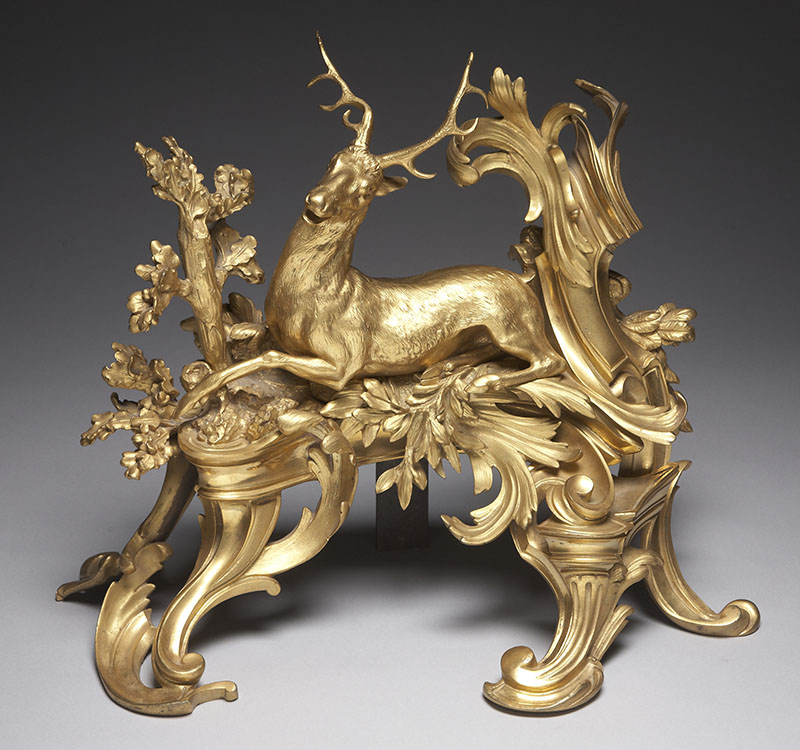
The melting point of bronze nears the temperature of liquid lava, generally about 1470–1900°F. Bronze is usually an alloy of copper and tin, with various other metals. Tin makes the alloy harder and resistant to corrosion and gives it a lower melting point. The use of bronze for decorative objects reached something of an apogee in 18th-century France, when specialist bronze makers used sand-casting to produce mounts applied to furniture, or the lost-wax process to create stand-alone bronzes-d’ambleument, such as the Legion’s pair of firedogs in the form of a boar and stag (figures 2 and 3). Such pieces would be enhanced further by a cisleur (or chiseler), who would use tools to add contrasting details and nuance, especially creating burnished or smooth areas, and matte or grained surfaces.
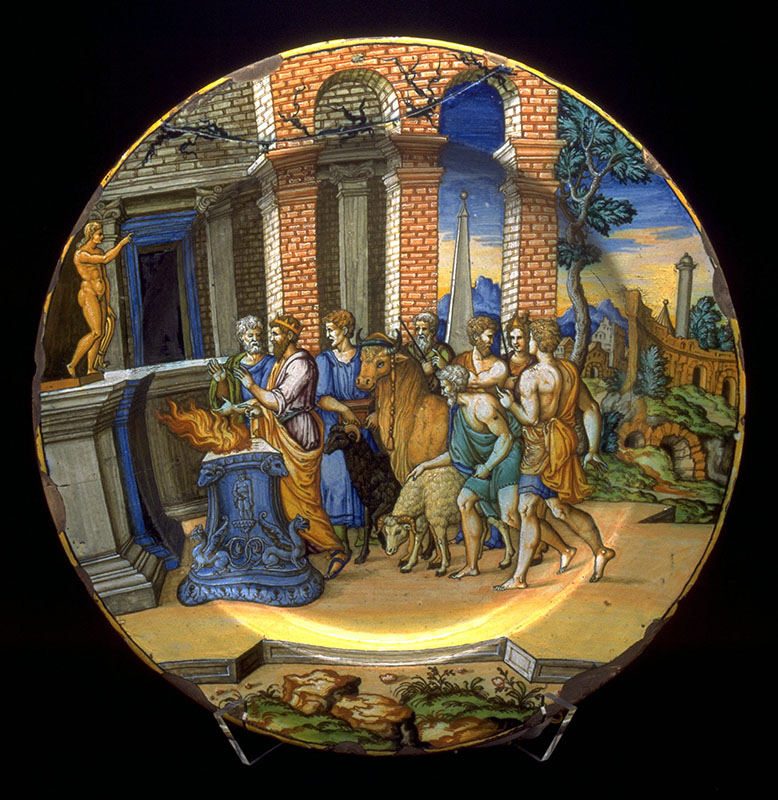
Earthenware ceramics tend to be fired at 1650–1800°F in a wood-fired brick kiln, a temperature not dissimilar to that used to melt bronze. One of the many highlights of the Legion’s porcelain gallery is a mid-16th-century Majolica charger with a scene from the Fable of Psyche (figure 4). The earthenware body is porous and water-absorbent. This material is usually subjected to a two-stage firing process. After the initial high temperature firing, the object is coated with a white tin glaze, and then the characteristic majolica colors are applied, requiring several subsequent firings at lower temperatures which fuse the glaze and colors to the earthenware body. The colored glazes were based on metallic oxides of varying toxicity: cobalt for blue, copper for green, antimony for yellow, manganese for purplish-brown, and tin for white.
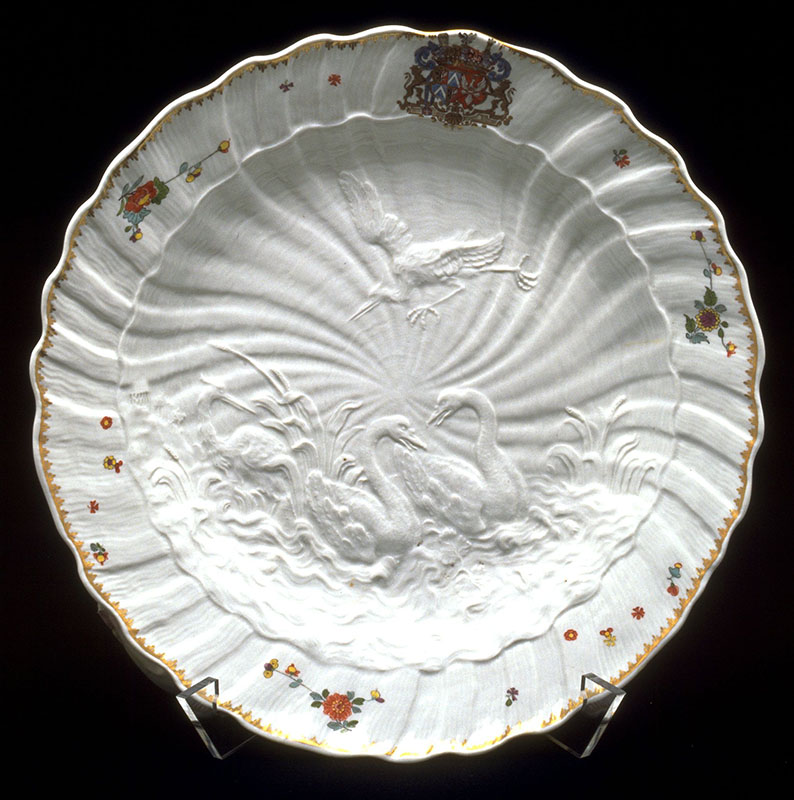
At the top of our temperature chart is true hard-paste porcelain, which needs to be fired at around 2400°F for all the necessary chemical reactions to take place, a temperature similar to that required to melt pure steel. The high heat vitrified (fused together) the essential ingredients of clay, feldspar, and quartz to create a product that was light, hard, bright white, glassy, and translucent. Meissen was the first European factory to crack the recipe for true porcelain produced in China. The patron of the factory, Elector of Saxony Augustus the Strong, who referred to this material as “white gold,” was porcelain-crazy.
A platter from the Swan Service was devised specifically to show off the blinding whiteness that this special type of porcelain could boast (figure 5). The Swan Service was made for the First Minister of the Electorate of Saxony, Heinrich von Brühl, between 1737 and 1742. At a mind-boggling 2,200 pieces, it was among the largest ever produced in the 18th century.
These objects remind us of the trials and tribulations, experimentation and ingenuity, and astronomical cost both human and financial that went into reaching and then manipulating the scorching white-hot heat that could fashion these resplendent creations that reside in our museums today.
David Oakey is the Curator in Charge of European Decorative Arts and Sculpture at The Fine Arts Museums of San Francisco, which includes the Legion of Honor and the de Young.
A print version of this article was published in The Magazine of the Decorative Arts Trust, one of our most popular member benefits. Join today!