
Novel Nature: How a Maritime Byproduct Defined the Elite 17th-Century Interior

Click on images to enlarge them and view captions.
by Lauryn Smith
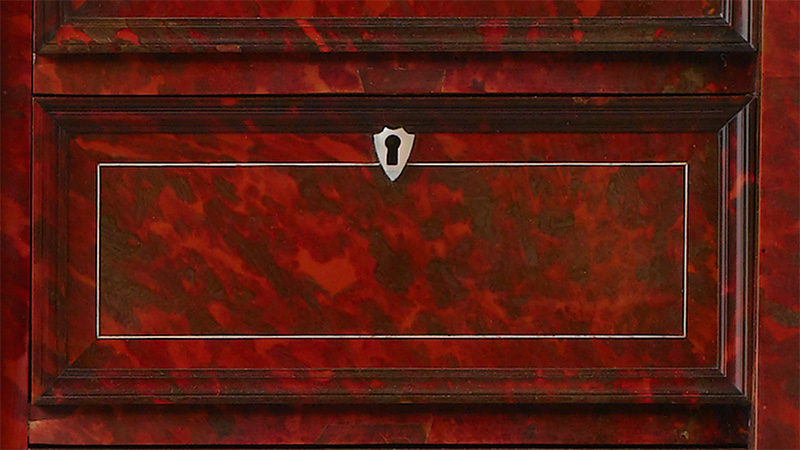
While visiting the Rijksmuseum during the Decorative Arts Trust’s Study Trip Abroad to the Low Countries, participants were frequently surrounded by materials signifying luxury, power, and prestige. We found ourselves particularly captivated by the vibrant reds and golden browns of tortoiseshell veneers. Tortoiseshell surged in popularity during the 17th century, adorning furniture ranging from monumental kasten to cabinetry encasing dolls’ houses. Far from an isolated fad, the material’s iconic mottled pattern (figure 1) is timeless, remaining a staple of contemporary design, from high fashion to everyday eyewear.
Although European objects embellished with tortoiseshell date back to the 1st and 2nd centuries CE, the explosion of the material’s popularity in the 16th and 17th centuries was born out of a waste not, want not mentality. As Dutch and other European colonial networks expanded eastward and westward, sailors spending months at sea turned to fishing to supplement their diets. They frequently consumed turtles, primarily the Hawksbill and Green species, which were then believed to be endlessly abundant. Extant prints depict early turtling practices in the tropical waters off the east coast of the Americas. The discarded shells from these maritime meals soon became novel raw material for artisans. Cornelius van Dyk, a figure deeply embedded in the trade of New Netherland (now New York), detailed this intersection of subsistence and craft in his publication, Osteologia (Amsterdam, 1680). He described the various turtle species found in the Americas and noted the qualities and characteristics of their shells and the potential uses, including lanterns, tobacco boxes, and combs.
Van Dyk may have documented the turtle as a natural resource of the Americas, but it was the skilled artisans of Antwerp and Amsterdam who transformed the material into a luminous status symbol for Europe’s elite. In these Early Modern global trade hubs, highly specialized craftsmen manipulated turtle shells to grace extraordinary furniture, decorative artworks, and accessories. The process of turning a hard shell intended to protect the soft flesh of an animal into a delicate veneer was a feat of chemistry and patience. The plates (or scutes) were first cleaned and separated from the turtle’s skeleton, boiling them until they became pliable. Once softened, they were flattened under a heavy press and fused into seamless sheets. The fiery red coloring was a clever artifice. Because the heated shell is translucent, craftsmen could stain the underside with red pigment or line it with colored paper or gold foil. This technique highlighted the shell’s natural mottled patterns and created the iconic, dramatic contrast with the other materials used.
A stellar example is an Antwerp-made cabinet in the Rijksmuseum (figure 2). Its ornate façade integrates precious imports: marble, ivory, tortoiseshell, ebony, and rosewood. The glowing red tortoiseshell is enhanced by the dark, rich ebony wood that frames the individual paintings on each drawer. The stand’s four Black figures, clad in tobacco leaves, create an explicit iconographic link to the Dutch trade in enslaved people. By blending African imagery with indigenous American elements, these figures served as allegorical representations of the Americas and the story of the colonial trade routes that funneled natural resources—and people—into elite European interiors.
The founding of the Dutch West India Company in 1621 strengthened the nation’s hold over the Americas and the Caribbean, securing strategic hubs like Curaçao and Brazil. Tortoiseshell-veneered furniture displayed within the palace of Amalia van Solms-Braufels and Frederik Hendrik, Prince of Orange, spoke to their immense wealth and served as a visual reminder of their patronage and financial stake in the Dutch trading companies that elevated the Dutch Republic to a preeminent global power.
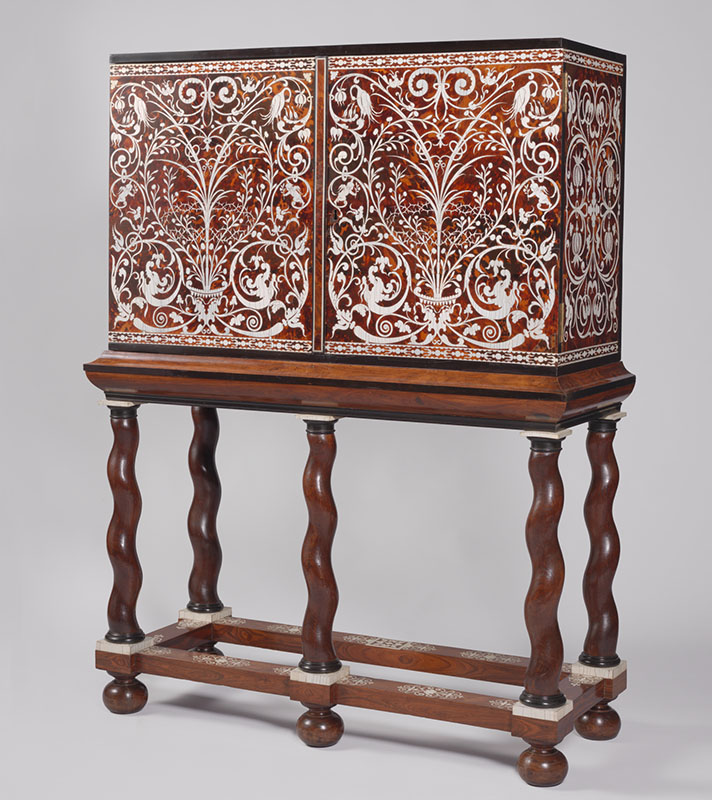
In The Hague, elite cabinetmakers catered to this aristocratic clientele. A spectacular cabinet crafted for the widowed Amalia by Willem de Rots (figure 3) illustrates this dynastic ambition. Beyond its aesthetic appeal, the tortoiseshell—inlaid with ivory on a rosewood stand—served as a political manifesto for the exclusive audience visiting the Oude Hof at the Noordeinde Palace. The profusion of marquetry on the exterior incorporates a poem, extolling the success of the House of Orange. This intimate tribute confirms Amalia’s role as the architect of a material legacy fueled by the Republic’s global reach.
For all its luminous magnetism, the beauty of tortoiseshell is inextricably linked to an intricate narrative of colonialism and maritime trade. Within the princely couple’s apartments, tortoiseshell was further imbued with the weight of power. In the hands of artisans like de Rots, a raw, nautical byproduct of colonial expansion was transformed into a sophisticated language of dynastic prestige, allowing cultural agents like Amalia van Solms-Braunfels to embed her ambitions into the very fabric of her private apartments.
- Cornelis van Dijk, Osteologia, of Nauwkeurige geraamt beschryving van verscheyde dieren, nevens hare historien, vol. 1 (Amsterdam: Jacob van Meurs, 1680), 156–57.
- Charlotte Hoitsma, “Chapter 4 Owning the ‘Exotic’: a Case-Study of Images of Africans in Seventeenth-Century Netherlandish Applied and Decorative Arts,” in The Globalization of Netherlandish Art (Leiden, The Netherlands: Brill, 2024).
- Reinier Baarsen, “Wilhelm de Rots and Early Cabinet-Making in the Hague,” The Burlington Magazine 150, no. 1263 (June 2008): 372–80.
- Lauryn Smith, Material Ambition: The Cabinets of Amalia van Solms-Braunfels and the Shaping of the House of Orange-Nassau (forthcoming).
Lauryn Smith is the Assistant Curator at the Frick Pittsburgh. She received the Frances and Beverly DuBose Foundation Scholarship to attend the Study Trip Abroad to the Low Countries in March 2026.
A print version of this article was published in The Magazine of the Decorative Arts Trust, one of our most popular member benefits. Join today!