
“My Dinner Set from China”: Charles Manigault’s Chinese Export Porcelain







Click on images to enlarge them and view captions.
by Chad Stewart
In the decades following the American Revolution, Charleston, SC, stood at the cultural, social, and economic center of one of the young nation’s wealthiest regions. The vast resources wielded by the slave-owning planter and merchant classes facilitated the acquisition of expensive, refined objects including splendid furniture, silver, art, and imported Chinese porcelain.
Although many wealthy South Carolinians acquired and used Chinese porcelain, few could claim the distinction of actually having traveled to Asia and directly commissioning their dinnerware. Charles Izard Manigault (1789–1874) did just that in 1821. The expansive 381-piece service he commissioned is one of the most coveted, well-published, and thoroughly documented orders ever made for the American market. Thanks to Manigault’s prolific record-keeping habits, we know an unusual amount of detail about how his porcelain service came to be.
Manigault was a fifth-generation South Carolinian whose Huguenot forebears immigrated to the Lowcountry in the late 17th century as part of a large influx of French Protestants fleeing escalating hostility in Catholic France. By the time he was born, Manigault’s family had fully assimilated into elite society and was one of the wealthiest and most influential in the American South, with vast affluence built on the industrial cultivation of rice grown by hundreds of enslaved Africans on Lowcountry plantations. Manigault, who spent much of his youth in Philadelphia, did not dream, however, of devoting his life to the role of gentleman planter. With a desire to build a career as a merchant, he set his sights on Asia and its alluring commercial possibilities.
In preparation for a mercantile future, Manigault, a recent graduate of the University of Pennsylvania, went to work for the Philadelphia firm of Joseph Sims (1760–1851) in 1815. He described Sims’s commercial establishment as “a first rate counting house” where he “got considerable knowledge in mercantile affairs.” After two years learning the business, Manigault felt his educational needs were adequately satisfied. He decided to take a chance on his ambitions and started planning an extended trip to China.
Shortly before his departure from Philadelphia, Charles sat for a portrait by Thomas Sully (figure 1) at the request of his mother, Margaret Izard Manigault (1768–1824), who worried she may not see her son again and wanted a likeness to remember him. The confident 22-year-old is depicted aboard a ship on stormy seas with dark clouds gathering above him with “arms folded, and in deep thought” as Manigault described. The portrait, a visual record of Manigault at the exact moment he ventured to China, foreshadowed things to come. Like the seas, his commercial adventures would be choppy.
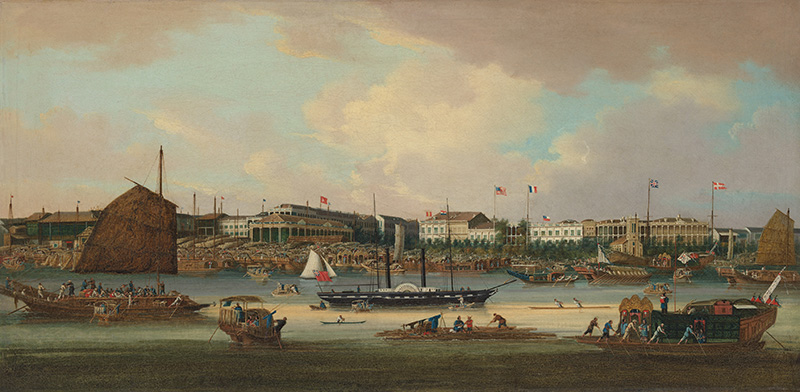
Boarding the London Trader in Philadelphia on May 25, 1817, Manigault would not return to American shores for another six years. Occupying what he described as “a dark cabin below deck,” he endured over 120 days at sea before arriving in Canton (now Guangzhou) on September 27, 1817. The bustling port that greeted him was a hive of activity, the only official outlet for Chinese goods bound for far-flung markets during the Qing dynasty (1757–1842). Situated at the mouth of the Pearl River, which provided navigable access to the Chinese interior, Canton’s waterfront (figure 2) was populated by Hongs, or factories, with exclusive authority to transact trade with international merchants. Commerce was heavily regulated with foreigners’ movements tightly controlled within the district.
Upon arrival, Manigault sought out his sister’s brother-in-law, Benjamin Chew Wilcocks (1776–1845), then serving as the American Consul in Canton, “in order to assist him in his mercantile affairs.” In addition to two years of experience in Philadelphia, Manigault came equipped with $10,000, his share of the estate of his late father, Gabriel Manigault (1758–1809), all in silver dollars. He held “the firm conviction that Mr. Wilcocks, having 20 years of mercantile experience in that country could put me in the way of doubling” the sum. However, he was “doomed to disappointment” and lost all of his money on his first voyage from China to the Isle de France (present-day Mauritius), where he arrived on February 8, 1818. He did not fully grasp the exchange rates at play, selling his cargo for “the depreciated paper money of that place, and the return cargo, produce of that island suitable to China (cloves, ebony wood, & c.) sold also at a loss.” Although Charles was disappointed by the inauspicious start of his career, he did acquire a French servant during his visit to Isle de France, who accompanied Manigault through his remaining travels in Asia and back to the United States.
Thereafter, Charles would serve as a supercargo for other merchants, earning five percent commission for safely escorting cargoes and seeing them properly disposed of at their destinations. These voyages “generally placed a respectful little sum” in his hands. However, his money always “leaked out, gradually” due to the necessity of splitting his commission with reputable local merchants in each port to avoid being taken advantage of as a new face in a foreign land.
The first step in the creation of Manigault’s porcelain service came by way of a trip to Australia as a supercargo escorting goods on an English ship leaving Canton. The merchant, who Manigault did not name, “feared to send it to such a place of rogues and thieves without a supercargo in charge of it,” and asked Wilcocks if Manigault could accompany his goods to Australia. He arrived in Port Jackson (now Sydney Harbor) on April 6, 1820. After selling the cargo and receiving his commission, he waited many months for passage back to China among “the scum of the Earth, in vice and iniquity.”
While in Australia, Manigault had his coat of arms engraved, which he used as a bookplate (figure 3). In 1754, Charles’s grandfather, Peter Manigault (1731–74), was the first member of the family known to have commissioned arms for this purpose. Henry Yates (1716–62) engraved and signed that device when Peter was establishing himself in London as a gentleman barrister following studies at the Inner Temple. Where his grandfather’s arms were a heavily stylized Rococo explosion (figure 4), Charles chose a more restrained Neoclassical approach, the design guided by the skilled engraver, Samuel Clayton (c. 1783–1853), whom Manigault remembered as a “talented convict” who “had been too tricky at home to remain.” The Irish-born Clayton was transported from Dublin to Australia after an 1815 conviction for alleged participation in a forgery scheme. According to Manigault, Clayton “…asked whether I had a brother older than myself. In that case, said he, the ‘laws of heraldry’ require that a half moon must be engraved on your arms immediately below the crest to indicate that you are a second brother.”
The resulting arms incorporated elements of his grandfather’s precedent, namely the three hooded falcons (falcons symbolizing an eager pursuit of a goal; the hoods denoting a power being deliberately controlled or contained) and the Latin motto Perspicere quam ulcisci (to look forward rather than to avenge). As referenced above, Clayton added the crescent, denoting Charles’s status as second son. These familial motifs were set against a badge-shaped shield surmounted by a waist-up figure known as a demi-savage, representing a wild, untamed spirit, a symbolism that surely resonated in the mind of the young Manigault while abroad. Although family tradition suggests that the figure was inspired by the indigenous people of Australia, Clayton’s figure (with a feathered headdress, bow, and sheath of arrows) was likely modeled after contemporary personifications of America as a Native American, possibly utilized to represent the Manigault’s multi-generational lineage in the Americas.
Manigault’s bookplate and the porcelain later ornamented with the device (figure 5) survive as the most enduring visual and material legacy representing his generation of the family. This is ironic given the utter disdain he and his mother expressed for Australia and its people. Upon learning that her son was in Australia, Charles records that Margaret Manigault wrote “she felt deeply for my disappointments, but expressed herself humiliated and afflicted that one born and educated as I was, with the hope of bettering his condition should be induced to go in commercial business to such a degraded place as Botany Bay.”
Charles departed Australia via Botany Bay on September 10, 1820, and was back in Canton on February 11, 1821, following a delay in Batavia (now Jakarta, Indonesia) along the way. He was in and out of Canton several times in 1821 and likely commissioned his expansive armorial porcelain service during one of these stopovers. Manigault was joining a well-established Western tradition by commissioning armorial porcelain, but such services were rare in the American South. He was likely influenced by the extensive time he spent in the Mid-Atlantic, where armorial motifs were slightly more common. The adaptation directly from his bookplate also placed Manigault’s porcelain within a larger pattern of inter-continental image transfer. Export porcelain scholar David Sanctuary Howard estimates that 15–20% of Chinese services were derived specifically from armorial bookplates, even though Charles was unique in being able to convey the design directly by hand to the place of manufacture in China.
Creating a bespoke service of this size would have taken significant time and skill. Porcelain was produced inland in Jingdezhen, China, where the essential ingredients were in abundance, including deposits of white clay, known as kaolin; china stone, a feldspathic rock sometimes known as petuntse; and the vast forests that fueled the kilns. The undecorated hard-paste porcelain blanks were then shipped to Canton (Guangzhou) where they were decorated according to the purchaser’s request prior to export. After Manigault selected the quantity of pieces and range of forms to be included in the service, his order was likely produced in this manner. He did not commission any special forms for the set, which was assembled from the standard elements in stock. His porcelain was probably ready for export by the time of his departure from China on December 19, 1821. He arrived in Philadelphia by May 19, 1823, completing a circumnavigation of the globe that had included stops in no fewer than 30 locations.
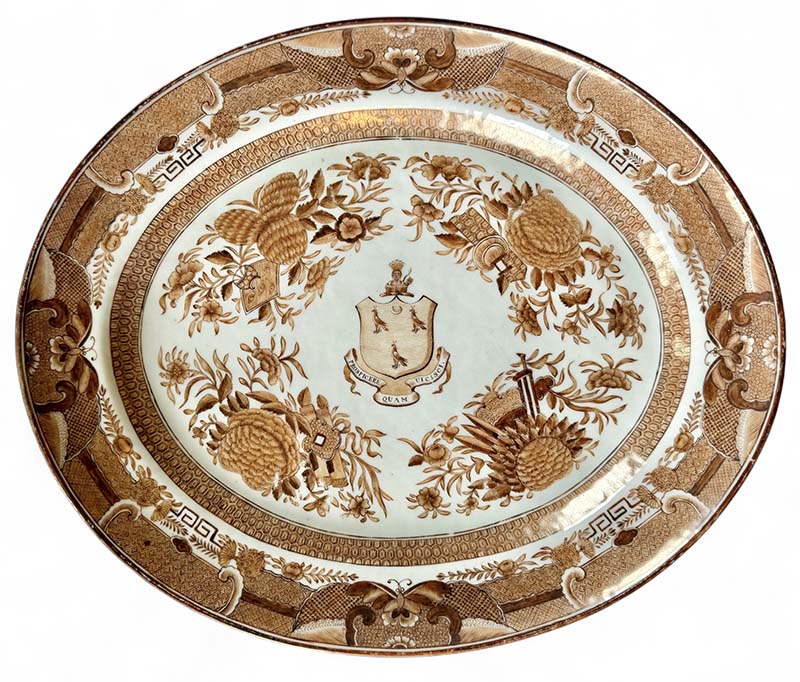
Manigault’s porcelain was decorated in the popular pattern referred to by collectors as Fitzhugh, which was executed in brown, or sepia, overglaze enamels (figures 6 and 7). The design took its name from members of the Fitzhugh family of England who served in the British East India Company in the 18th century and shipped great quantities of porcelain in the pattern back home. The sepia colorway was popular with Americans but much less common than variants like underglaze blue. The border of the Manigault service is what is referred to in the antiques trade as “true” Fitzhugh, featuring a “stylized design of butterflies, geometric patterns, chinoiserie, vegetation and octagonal designs resembling a honeycomb.” Four evenly spaced clusters of vegetation with symbols correlating with the four seasons and four genteel accomplishments (music, the game weiqi, calligraphy, and painting) surround the Manigault arms, which stand in place of a more typical central medallion.
Even though Manigault did not record the source of the service in Canton, later in life he created a hand-written inventory of its contents (figure 8). Charles’s listing of 381 pieces of porcelain synthesizes dinner and dessert services and could have accommodated a multi-course meal for at least two dozen diners in high early-19th-century style. He lists the quantity of each form with a notation of the quantity of the total number of pieces represented by that form. The items listed include:
4 dozen large flat plates
3 dozen large soup plates
3 dozen small flat plates
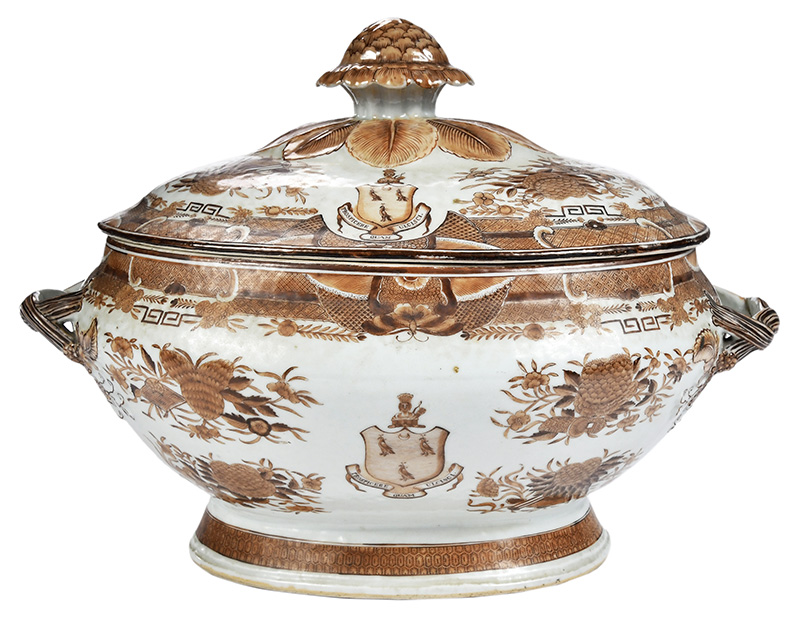
2 large tureens and saucers (figure 9)
4 sauce tureens and saucers
2 fish dishes
1 salad bowl
2 beef stake [sic] dishes
8 vegetable dishes, 4 square and 4 oval dishes (figure 10)
2 22″ dishes
4 18″ dishes
8 16″ dishes (figure 6)
8 14″ dishes
8 12″ dishes
8 fruit dishes (figure 11)
2 cream pots
2 cungee [sic] bowls
1 punch bowl and stand
2 dozen teacups and saucers
2 dozen coffee cups and saucers
2 dozen hot water plates (figure 12)
Added later is an entry for:
2 dozen custard cups and covers
Of the 381 pieces referenced in Manigault’s inventory, 159 have been documented, representing 20 different forms. The variety is impressive, but the forms represented in the service were all common to large sets of early-19th-century porcelain. Fish dishes were a relatively new addition, however, and the hot water plates (figure 12) were likely a special request by Charles, augmenting a more typical set. The fruit dishes (figure 11) represent a form modeled off of a Sevres dessert service. Of particular interest is the reference to two “cungee” bowls, which are listed as six pieces and thus likely included lids and saucers. Congee is an Asian rice porridge, and Manigault commemorated the bowls’ affiliation with this specific dish in the inventory.
The extent of the service speaks to the refinement of Manigault’s table in Philadelphia upon his return from Asia and, from 1825 onwards, in Charleston, where he rented a house following his advantageous marriage to Elizabeth Heyward (1808–1877). Their combined wealth allowed the couple to spend considerable time in Europe with their young family (figure 13) and to acquire a permanent residence at 6 Gibbes Street in Charleston in 1837. Even though Manigault did not find success in the China trade, he eventually built a life as a successful planter in South Carolina. The porcelain service acquired as a young traveler with mercantile ambitions was both a relic of an unrealized dream and a symbol of a life of wealth, privilege, and gentility achieved despite his early stumbles.
Manigault died intestate at the age of 79 on April 30, 1874, with his son Louis (1828–99) filing the estate for probate on June 25. The porcelain is not mentioned in the probate record, but the service appears to have passed to Louis and then to his daughter Josephine Manigault Jenkins (1863–1932), with some components possibly divided between his other children. The elements inherited by Josephine’s heirs passed to succeeding generations, the service further split along the way. Given the size of the original order, Josephine and her children likely retained enough components for a functional dinner set before the quantities were further reduced.
The largest quantities of the Manigault service are owned by the descendants of Charles’s first cousin Arthur Middleton Manigault (1824–86). It is not known if Charles, Louis, or another family member sold a significant quantity of the porcelain to their Manigault relative. Curiously, Charles listed dollar amounts ($16 and $10, respectively) beside hotplates and custard cups at the bottom of his inventory. These figures may indicate a supplemental purchase or, more likely, a sale to other family members. In fact, all 20 extant hot water plates are in the possession of Arthur Middleton Manigault’s descendants. Mary Huger Manigault (1870–1948), Arthur’s daughter, owned some of the porcelain by the early 20th century. Her name and Tradd Street address appear on the underside of a sauce tureen cover and fruit plate. Mary likely passed the porcelain to her nephew Edward Manigault (1896–1983), whom she helped raise after his mother died in 1900. The descendants of Edward and his wife, Mary Pringle Hamilton Manigault (1897–1987), have supplemented their inherited collection in recent decades with acquisitions, assembling almost 100 pieces.
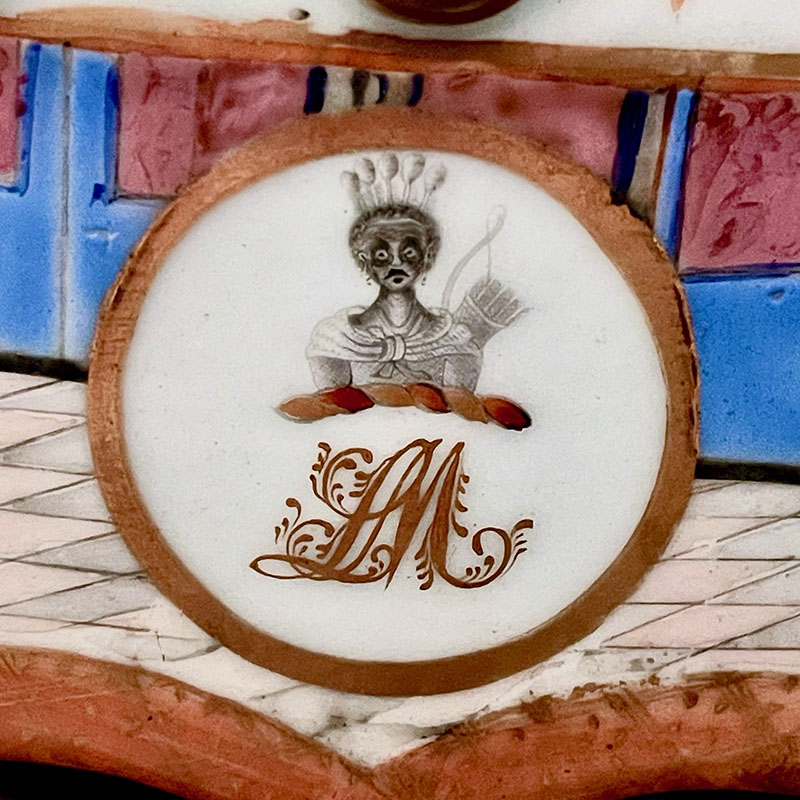
Remarkably, Charles’s Fitzhugh service is not the only one he sent back from China. A smaller, similar sepia Fitzhugh service was made for his aforementioned brother, Gabriel, and was probably among the gifts Charles sent home from Asia (figure 14). That service, monogrammed with Gabriel’s initials within a garter belt crested with the demi-savage.26 The motif was further used by Charles’s son, Louis, on mid-19th-century porcelain purchases, including a set of garden stools (figures 15 and 16), acquired during his own well-documented trip to China in the 1850s.
The Manigault porcelain remains one of the most important commissions shipped from Asia to America. The uniquely well-documented service offers a glimpse into the eally-19th-century geopolitical vortex of artisanship, taste, and sensibility. Manigault’s inventory, reproduced here for the first time, sheds light on the refinement and material requirements of the planter-class table; and in both its creation and diaspora,the service illustrates the fortunes of an American family over two centuries.
- Charles Izard Manigault, Journal, p. 67. Private Collection.
- Charles Izard Manigault, “Description of Paintings Belonging to Charles Manigault.” Private Collection. From a copy in the possession of the Gibbes Museum of Art, Charleston, SC.
- The conditions he endured during the voyage are recorded among other reminiscences in Manigault, “Description of Paintings.” His departure from Philadelphia and date of arrival in Canton are also recorded in Charles Izard Manigault, “List of my voyages and dates,” 1817-1824. Charleston Library Society, Charleston, SC.
- Manigault, “Descriptions of Paintings.” His date of arrival is recorded in Manigault, “List of my voyages and dates.”
- Manigault, “Descriptions.” See also: footnote 20.
- Manigault, Journal, p. 67.
- Manigault, “Descriptions.”
- Manigault, “List.”
- Manigault, “Descriptions.”
- Manigault, Journal, p. 87.
- Ibid.
- Manigault included a sketch of the inverted crescent as it appears on his bookplates and porcelain in the lines of his journal. Manigault, Journal, p. 87.
- Charles Knowles Bolton, Bolton’s American Armory: A Record of Coats of Arms Which Have Been in Use Within the Present Bounds of the United States, 2nd ed. (Baltimore, MD: Baltimore Heraldic Book Co., 1964), p. 108.
- The demi-savage crest does not appear on Peter Manigault’s 18th-century bookplate but had likely gained use within the Manigault family by 1817, when the motif appears on the handles of silver flatware ordered by Charles’s older brother, Gabriel Henry Manigault (1788–1834). See Thomas Bamford II, Tablespoon, c. 1817, London, England. Silver. The Charleston Museum, Charleston, SC. 2016.12.2.
- Manigault, “Descriptions.”
- Manigault, “List.”
- Ibid.
- Another American example similar to the Manigault service was owned by the Goldsborough family of Maryland. See: David Howard and John Ayers, China for the West: Chinese Export Porcelain and other Decorative Arts for Export illustrated from the Mottahedeh Collection (London, UK: Sotheby Parke Bernet, 1978), p. 518.
- David Sanctuary Howard, Chinese Armorial Porcelain, Vol. 2 (Chippenham, UK: Heirloom & Howard, 2003) pp. 48-49.
- Manigault records the date of his arrival in Philadelphia as May 17, 1823 in his “List of my voyages and dates.” However, “Mr. Charles Manigault, and servant” are recorded as arriving in Philadelphia on May 19, 1823. See: “Port of Philadelphia–May 19,” The Philadelphia Inquirer, May 19, 1823.
- Herbert, Peter, and Nancy Schiffer, Chinese Export Porcelain: Standard Patterns and Forms, 1780-1880 (Exton, PA: Schiffer Publishing Limited, 1975) p. 37.
- Although there appear to be different hands represented, Manigault’s handwriting may have evolved over time when he revisited and updated the list. The final pencil notations may represent the hand of his son Louis. Manigault, “My Dinner Set from China, 1821.” Private collection.
- Undoubtedly, other examples, and possibly additional forms, remain undocumented in descendant and other private collections.
- Probate Record for Charles Manigault, June 25, 1874, South Carolina Room, Charleston County Library, Charleston, SC.
- In addition to the private collections mentioned above, examples from the Manigault service can be found in the collections of The Charleston Museum, the Museum of Early Southern Decorative Arts, Colonial Williamsburg, the Historic Charleston Foundation, Winterthur Museum, and the Reeves Museum of Ceramics at Washington and Lee University. Many of the examples in these collections are documented as having been acquired from descendants of Josephine Manigault Jenkins.
- Gabriel Manigault’s service appears to have been supplemented by a descendant with similar pieces in orange Fitzhugh.
- For information about the life of Louis Manigault, see: Annie Jenkins Batson, Louis Manigault: Gentleman from South Carolina (Roswell, GA: Wolfe Publishing, 1995).
Chad Stewart is the Curator of History at The Charleston Museum and owes special thanks to the following people for their generous assistance in the research for this article: Robert Gribbin, Robert Leath, Pierre Manigault, Patti Manigault, Anne West, Jennifer McCormick, Valerie Perry, Maggie Claytor, Elizabeth Ryan, Margaret Garrett, Andrew Brunk, Molly Silliman, Lisa Hughes, Monica Scott, Ron Fuchs, Kim May, and Lea Lane.
A print version of this article was published in The Magazine of the Decorative Arts Trust, one of our most popular member benefits. Join today!