
Mexico City: From Ancient Civilizations to Modern Marvels

Click on images to enlarge them and view captions.
by Dennis Carr
IN NOVEMBER and December, the Decorative Arts Trust traveled to Mexico City, with side trips to the cities of Puebla de los Ángeles and San Juan Teotihuacán. Mexico City, like the archaeological strata of Rome, is built on layer-upon-layer of history. From the ancient city that the Mexica (or Aztecs) called Tenochtitlan, to the colonial capital of the Viceroyalty of New Spain, to the megalopolis of today, with some 23 million residents, it is a city of layers and complexity.
These layers are visible today through the historical collections in the city’s sprawling compendium of museums and cultural institutions. Trust members had the opportunity to experience extraordinary sites that highlighted past and present in this incomparable city.
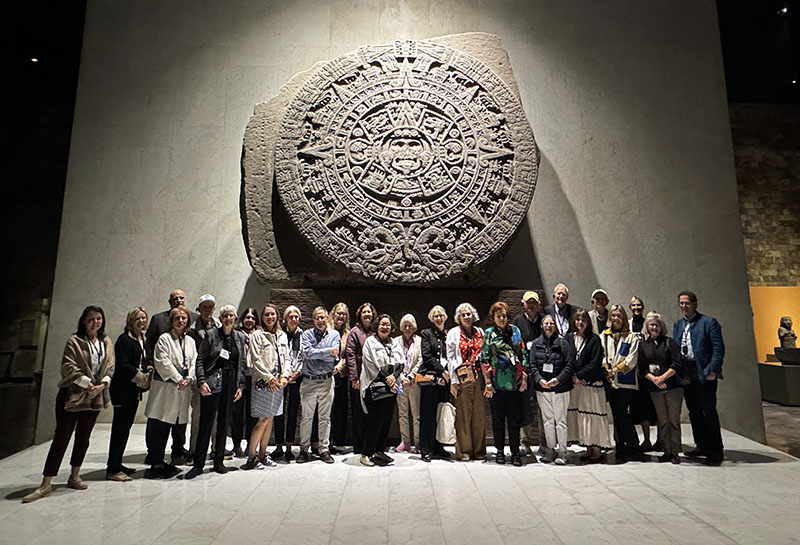
On the edge of the toney Polanco neighborhood is Chapultepec Park and the National Museum of Anthropology. Time feels compressed in a place like this—the museum’s striking modern building is filled with ancient objects that still resonate today and feel alive in the city’s psyche. The Sala Azteca (Aztec Hall) contains perhaps the most famous Aztec sculpture, the Sun Stone (figure 1). Most visitors think that it is a calendar, and in many ways it is. But the time it measures is not just in days or years, but in epochs. We are currently living in the fifth world, or sun, the four previous worlds having been created and destroyed before it.
The Aztec empire itself was rocked by the arrival of the Spanish conquistadors into central Mexico in 1519. What was once among the largest empires in Mesoamerican history was reduced to rubble when the Spanish, after three years, overthrew Mexica rule, only to establish an empire of its own. The Aztec empire used the eagle (or aguila) as its symbol, as did the Hapsburgs of Europe with its double-headed eagle, which ruled Spain and, therefore, Mexico in this period.
Signs of both empires are everywhere even today in the city. A giant Mexican flag (with the image of an eagle perched atop a cactus at its center) flies over the Zócalo, or main square of the city. Adjacent are the city’s cathedral and the presidential palace, which were built on the ruins of the former Aztec capital. Workers discovered the Sun Stone buried here as they were repaving the plaza in 1790. It was also the site of the former market called El Parián, where goods imported from Asia and Europe began arriving in the 16th century.
Among the largest imports at the time were Chinese blue and white porcelains, which arrived by the tens of thousands aboard the Manila Galleons that sailed yearly from the Spanish port of Manila in the Philippines. These imports spawned an industry in the city of Puebla, which became home to the famous talavera potteries. Skilled potters created local versions synthesizing the Chinese blue and white aesthetic with the style of Islamic pottery and the tin-glazed earthenware made contemporaneously in places like Talavera de la Reina in Spain or Delft in the Netherlands. Our groups saw both the modern-day potteries, still active in Puebla after nearly 500 years, and also historic works in collections such as the Museo Franz Mayer in Mexico City (figure 2). One example at the Franz Mayer is a large basin, or lebrillo, that shows footprints and hoofprints leading up a road, a symbol often found on early colonial documents that preserve pictographic writing and mapping systems from the pre-Hispanic codices. Many colonial objects demonstrate how Indigenous culture was still very much alive, although now part of a multilingual, hybrid artistic context that included European modes of representation.
In the 20th century, especially following the Mexican Revolution of 1920, artists like Diego Rivera sought to revitalize Indigenous culture. A collector of archaeological objects himself, Rivera was inspired by the folkways and artistic traditions. Rivera collected some 60,000 pre-Hispanic objects, which are now housed in his private museum, called the Anahuacalli, which we visited.
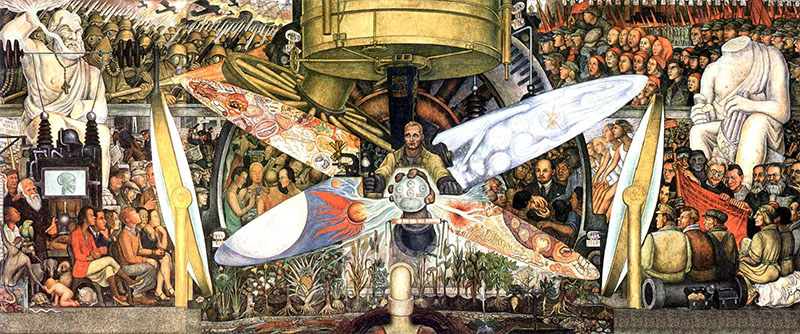
Many of Rivera’s monumental murals that punctuate the city today depict these native cultures, figured into his own unique brand of Modernism. One of his most famous is Man, Controller of the Universe, which we viewed at the Palacio de Bellas Artes (figure 3). At the center of the mural is a man operating a giant machine, while to the left and right are symbols of capitalism and socialism. Armies and workers are massing, and a sculpture is broken and toppled, signaling the tumultuous interwar period. It is the second version of the mural Rivera painted in 1933 for the newly constructed Rockefeller Center in New York, later destroyed.
Modern Mexico City has been shaped by events both cataclysmic and creative. Now it is home to one of the most vibrant artistic and cultural scenes in the Americas. The city continues to draw from a unique and rich history, defined by old and new.
Dennis Carr is the Virginia Steele Scott Chief Curator of American Art at The Huntington.
A print version of this article was published in The Magazine of the Decorative Arts Trust, one of our most popular member benefits. Join today!