
Undercut and Cut Glass “from Below”


Click on images to enlarge them and view captions.
by Joseph H. Larnerd
The forthcoming University of Delaware Press publication, Undercut: Cut Glass in Working-Class Life during the Long Gilded Age, was supported by a generous Publishing Grant from the Decorative Arts Trust. The book offers a social art history of cut glass—bowls, vases, and other domestic objects incised with geometric patterns against stone and metal wheels—during the medium’s heyday (figure 1). As I prepare for the release, I think of primary sources that did not make the cut in the book.
Rather than focus on the elites who ran the largest factories or to whom exemplary wares were marketed, my book foregrounds the lives of cut glass’s many workers. It refracts the medium’s history through the labors required to make and maintain these dazzling artifacts as well as popular representations of this work. I show how public demonstrations, images, and descriptions, as well as actual pieces of cut glass in socially charged settings, could undercut how laborers understood and enacted social class, privilege, and mobility. Cut glass and manifestations of the public interest in its labors offered workers, too, occasions for self-reflection and self-realization. In short, my book is a study of cut glass “from below.”
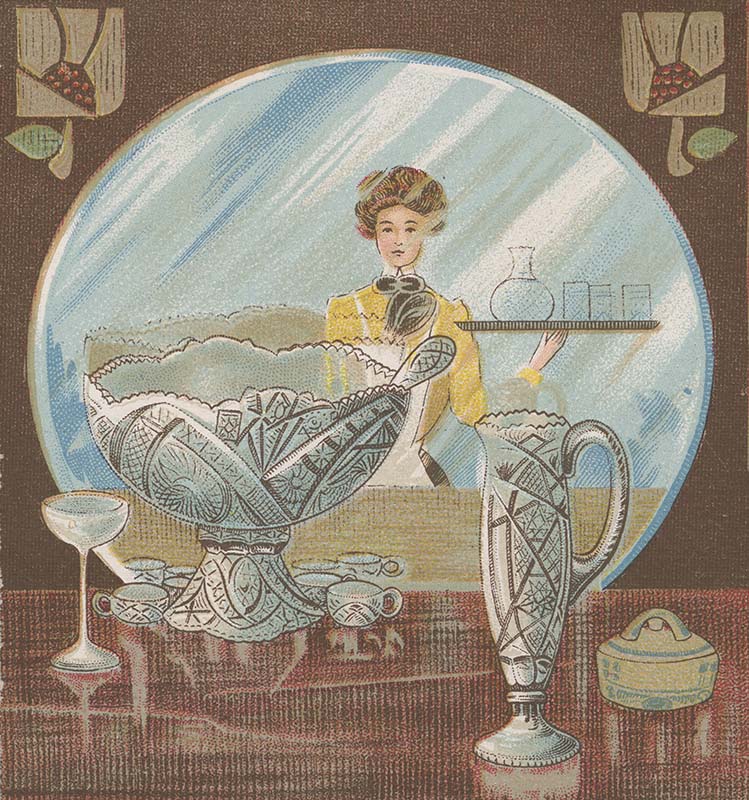
Undercut centers on four object-driven chapters. “The Worker in the Window” highlights how a 1910 storefront display featuring a laborer incising glass made a spectacle of cut glass’s facture as well as the worker’s body, objectifying the latter. “The McKinley Bowl’s Services and Disservices” reveals how a punch bowl gifted to the President in 1898 to much fanfare undermined the President’s posturing as a candidate for “the dinner-pail class” given the medium’s renown as, to use McKinley’s own words, “an article of luxury” that is “chiefly used by the wealthy and opulent.” The chapter “Domestic Reflections” shows how the postcard image selected for the book cover of a white household employee with cut glass in her charge (figure 2) suggested the physical and mental wear of the medium’s upkeep. Finally, a rose bowl cut and gifted by Gustave F. Ekdahl, a Swedish immigrant, to his son Felix in 1909 offers the child object lessons in class privilege and mobility in “The Boy and His Bowl” (figure 3).
In what follows, I would like to share two sources that readers will not find referenced in Undercut. Perhaps a bit redundant if included in the book, they preview the kinds of materials I use to support my interpretations of cut glass’s labor history. Primary sources like newspapers allow me to ground my analyses in articles and advertisements from the period of my study.
The first source is The Hartford Courant’s 1900 report of Mr. and Mrs. Ernest G. Woodward’s fifteenth anniversary celebration. A “Rev. Dr. William Alfred Gay … describe[ed] in detail … the various processes employed in making cut glass and compar[ed] the same with the different phases of life” before the couple received “an exceedingly handsome set of crystal tableware.” Around the turn of the century, explications of glassmaking were not merely instructional. Viewers could—and did—read into these expositions. Gay, at some point, encountered an explanation of glass cutting and, subsequently, mapped the process onto the seasons of life. The making of cut glass, therefore, offered a framework for understanding something more abstract—sometimes that included social class.
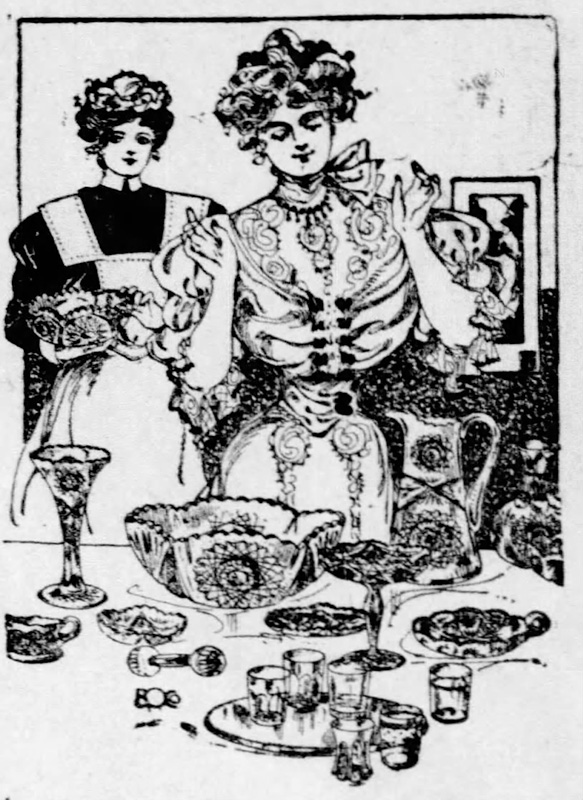
The second source is an image that appeared in The Pittsburg Press in 1905 (figure 4). In the top right of a nearly full-page advertisement for the store Kaufmann’s, a white woman stands with her hands lifted in delight before a table topped with pieces of cut glass: a bowl, a pitcher, a vase, a nappy, and more. Behind her, another white woman holds a cut-glass bowl that, presumably, will soon join its peers on the table. The latter’s cap and apron signal to viewers that she is a domestic worker. She seems content to attend to her employer; that is, she does not appear to be work-weary like the household laborers with cut glass that I introduce in my third chapter. Still, like The Hartford Courant’s report, the illustration is part of a dynamic archive of cut glass’s labors explored in Undercut.
- I am borrowing from the title of the British labor historian E.P. Thompson’s influential 1966 essay. E.P. Thompson, “History from Below,” in The Essential E. P. Thompson, ed. Dorothy Thompson (The New Press, 2001), 481-489.
- For “the dinner-pail class,” see Church Economist as quoted in “What is Christian ‘Work’?,” The Church Record, Buffalo Commercial, January 22, 1898, 5 O’Clock Edition, 8. From Newspapers.com.
- McKinley as quoted in “McKinley Opens Fire,” Boston Sunday Globe, September 9, 1894, 16. From Newspapers.com.
- “The Golden Wedding of Mr. and Mrs. E. G. Woodward,” Terryville, Hartford (CT) Courant, April 11, 1900, 13. From Newspapers.com.
- Kaufmann’s advertisement, Pittsburg Press, October 30, 1905, Stock Edition, 16. From Newspapers.com.
Joseph H. Larnerd, PhD, is the Assistant Professor of Design History at Drexel University. Preorder Undercut: Cut Glass in Working-Class Life during the Long Gilded Age at udpress.udel.edu.
A print version of this article was published in The Magazine of the Decorative Arts Trust, one of our most popular member benefits. Join today!