
The Work of the Edinburgh Upholstery Company at Hopetoun House
Click on images to enlarge them and view captions.
by Stephen Jackson
In the mid-18th century, partnerships involving two or more individuals became a common feature of cabinetmaking in Great Britain. One of the first such enterprises in Scotland was the Edinburgh Upholstery Company, which flourished between 1754 and 1759.
The Company was the brainchild of James Cullen, a Scot apprenticed in London to the renowned upholsterer William Bradshaw, for whom he continued to work through the 1740s. In 1752, he appeared in Edinburgh and entered into a partnership agreement with John Schaw, the city’s leading upholsterer, Schaw’s son Alexander, and the cabinetmaker David Smith. Under this arrangement, the Schaws contributed funds of £700 and Cullen and Smith £300 and £200 respectively. Profits were to be divided in proportion to the capital invested, and no partner was to trade outside of the company.
Cullen retained an option to withdraw after 12 months and did exactly that. In 1754, he entered into a new five-way partnership with Charles Butter, Alexander Peter, George Stevenson, and James Brown. Styled the Edinburgh Upholstery Company, the enterprise was headquartered at Butter’s warehouse. Both Butter and Stevenson served as Deacon of the Wrights, the elected chairman of the joiners and cabinet-makers guild in Edinburgh. Stevenson was a subscriber to Thomas Chippendale’s recently published The Gentleman & Cabinet-Maker’s Director, and Alexander Peter was working at Dumfries House where the Earl of Dumfries was employing Chippendale to fit out the principal rooms. The driving force behind the new collective enterprise, however, was Cullen. Press notices for the Company emphasized its upholstery expertise, promising “very fine silk and worsted damasks, morreens, harrateens, chincies, printed stuffs, linseys, checks of all sorts… carpets of all sorts… [a] great variety of paper for hanging rooms of entire new patterns, a large assortment of curious India paper, and a new sort of English gilt India ditto for hangings.”1
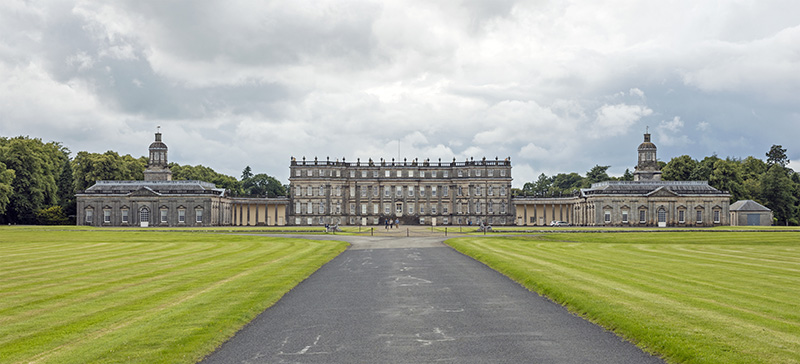
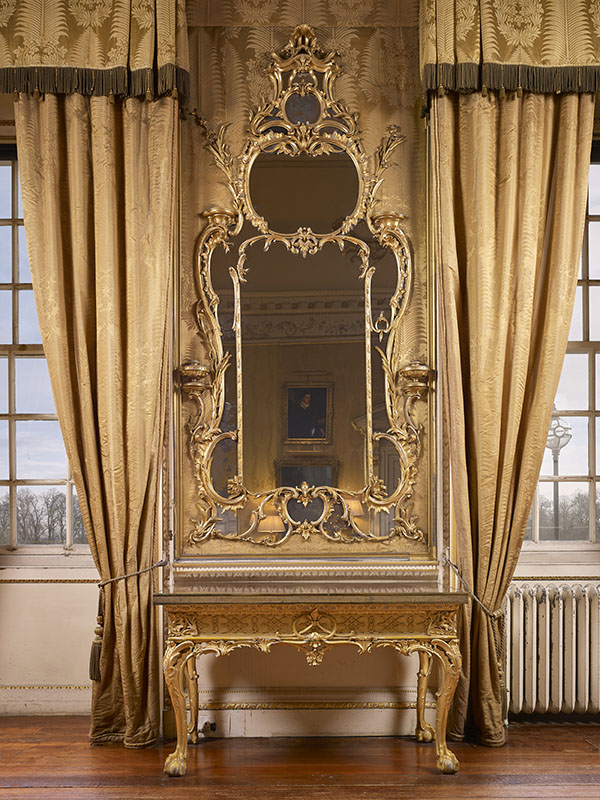
Immediately, the Edinburgh Upholstery Company was involved in the lucrative fitting out of Hopetoun House (figure 1), nine miles to the west of the city, which members of the Decorative Arts Trust visited during the June 2026 Study Trip Abroad to Scotland. William Adam and his sons, John, Robert, and James, worked to complete its rebuilding between 1721 and 1757. Between 1754 and 1759, the Earl of Hopetoun paid the Edinburgh Upholstery Company over £400. Detailed accounts are incomplete, but a letter from James Cullen to the earl makes it clear that the pier tables and glasses in the State Dining Room (figure 2) were made in Edinburgh around 1755, probably sub-contracted to the carver William Mathie. Cullen personally supplied over a thousand yards of crimson silk damask to cover the walls, state bed, and seating furniture, and he also procured the mahogany state bed frame from the recently bankrupted Samuel Norman in London.
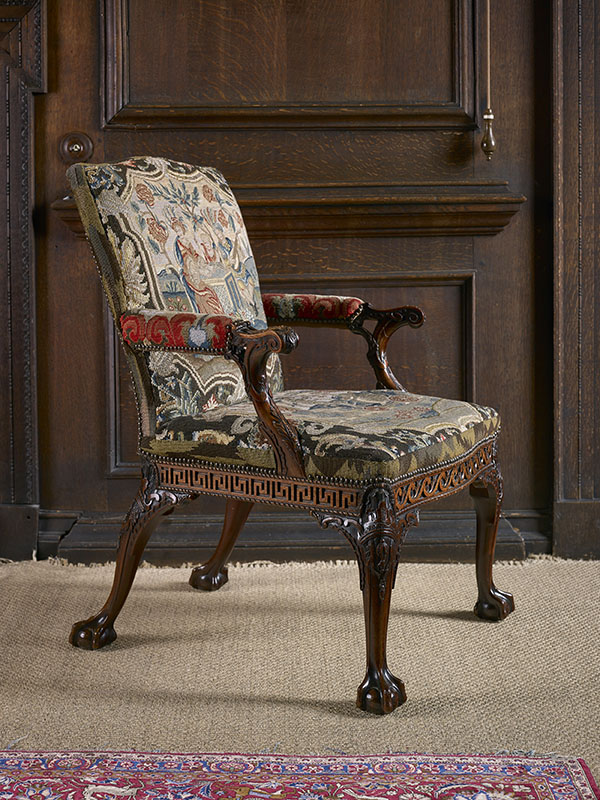
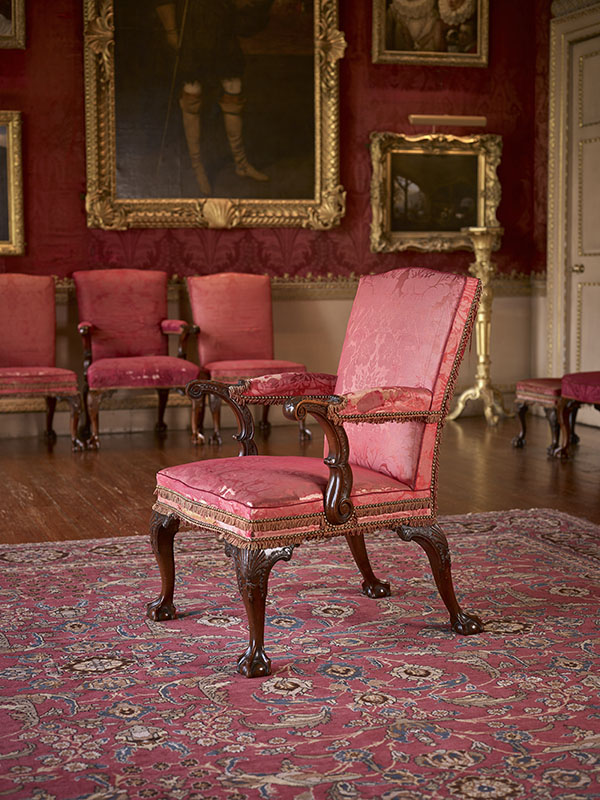
In 1758, the Company supplied a pattern chair (figure 3), which relates to the practice of purchasing a single item from a fashionable and expensive maker before having it copied by someone else. This process was not uncommon. In 1758, the Earl of Dumfries wrote to his cousin, the Earl of Loudoun, that he intended to have “one pattern elbow chair, and the two settees made at London, and the others I should chose to get made in Edinburgh,”2 at considerably less expense. The Hopetoun pattern chair was unusual, however, in that each seat rail was decorated with a different pattern of blind fretwork, literally incorporating three design options: Vitruvian scroll, Greek key, and alternating diagonal lines. The Company charged an unusually high price of £5 for it, presumably with the knowledge that Lord Hopetoun would have his estate wright, Thomas Welsh, do the copying. Indeed, Welsh, who possessed his own copy of the Director, worked on six armchairs and eight side chairs in the manner of the pattern chair between 1764 and 1768 (figure 4), and many retain the damask supplied for them by Cullen. He also made a sofa imitating one supplied by the Company in 1757.
In 1759, James Cullen returned to London, taking on the workshop of his deceased master, William Bradshaw. Alexander Peter withdrew from the Edinburgh Upholstery Company and, although it continued to trade, it failed to gain distinguished commissions. The Company’s stock-in-trade was sold off in 1776, a year before Cullen himself succumbed to bankruptcy.
- The Caledonian Mercury, 31 August 1752; The Edinburgh Evening Courant, 21 May 1754.
- Christopher Gilbert, The Life and Work of Thomas Chippendale (Studio Vista, 1978), 132.
Stephen Jackson is the Senior Curator, Furniture & Woodwork, in the Department of Global Arts, Cultures and Design at the National Museums Scotland, and author of Scottish Furniture, 1500–1914 (Edinburgh: National Museums Scotland, 2024). He graciously hosted Trust members during the recent Study Trip.
A print version of this article was published in The Magazine of the Decorative Arts Trust, one of our most popular member benefits. Join today!