The Art of Devotion: Religious Sculpture from the Royal Porcelain Manufactory at Meissen, ca. 1710-1790
The earliest religious figures in white Meissen porcelain are considered to be the diminutive Virgin Mary and St. John of ca. 1719, which were sometimes mounted with a larger corpus on a wooden Cross. Ten years later, much larger figures of the apostles, a Christo morto and the Stations of the Cross were ordered for Augustus the Strong’s private chapel in his never-completed Japanese Palace. Subsequently, porcelain altar garnitures, small devotional figures and multipart “tableaux” were commissioned by Augustus III and Maria Josepha, some for their own private devotional spaces and others for use as gifts. Most of these were left in the white, with touches of gilding, in contrast to the colorful enameled Meissen figures produced for the court pantries (dessert kitchens/Hof-Konditoreien) for use as table decorations. This fact invites comparison with more precious devotional works in other media, notably silver, ivory, crystal and marble, not to mention the “colorless” black-and-white engravings used as artistic sources. This lecture will consider the function and artistic sources for Meissen devotional figures, before and after the Seven Years War.
Maureen Cassidy-Geiger, MA, FSA, is a specialist in European decorative arts and court culture and patterns of collecting and display, with the court of Dresden her primary focus. Based in New York, she was curator of the exhibitions Fragile Diplomacy: Meissen Porcelain for European Courts, ca. 1710-63 (BGC/NYC, 2007-2008) and The Grand Cure [Die Grande Kur]: A Disabled Saxon Prince and his Tour of Italy, 1738-40 (SKD/Dresden, 2018). Her current research topics include the history of devotional sculpture in Meissen porcelain, ca. 1710-1790, and a survey and comparison of the privy purses (spending accounts) of Queen Maria Josepha (1699-1757) and her son, Crown Prince Friedrich Christian (1722-63).
Free
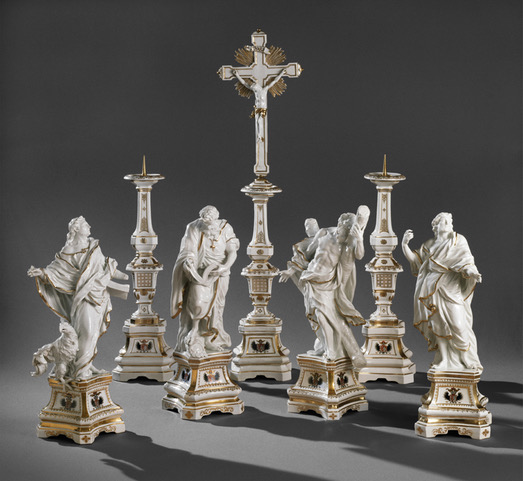
Pictured: Detail of Der Altargarnitur der Kaiserin Wilhelmine Amalia (Parts of an Altar Garniture with the Habsburg Arms), Meissen Factory, Johann Joachim Kaendler (Modeller), hard-paste porcelain, ca. 1737-40, Kunsthistorisches Museum Vienna, (inventory nos. 7078-7096 and 7101).
Additional Details
Institution or Organization name - Connecticut Ceramics Circle